




AARP Hearing Center






































































Video: 3 Tax Changes That People 60+ Should Know
Tax season is here. While that might not be the most exciting news for some, you do have control over how smoothly it will go. And, not surprisingly, knowledge is the key. With the right information, you can breeze through tax season without a hitch. You might also save a little money in the process.
With that in mind, here are 10 things you should know about filing your federal income tax return this year.
1. Taxes are due April 15 (for most people)
Federal income tax returns for the 2025 tax year are due April 15, 2026 — with a few exceptions. One exception applies to victims of certain natural disasters. If you lived in a federally declared disaster area, the IRS may grant you an extension to file and pay your taxes. For example, people in Washington who have been impacted by severe storms, flooding and landslides that began Dec. 9, 2025, have until May 1, 2026, to file their federal tax returns. You can find the areas with extensions and the revised tax filing deadline for affected residents on the IRS website.
Additional filing time is also available to members of the military and others serving in a combat zone or contingency operation. See IRS Publication 3, Armed Forces' Tax Guide for details.
2. It’s easy to get a filing extension
You can get an automatic filing extension for your 2025 tax return until Oct. 15, 2026. All you have to do is fill out and file IRS Form 4868 by April 15. The catch — and it’s a big one — is that you must still pay your taxes by April 15, even if you have an extension to file. But you’ll dodge the failure-to-file penalty, which is much higher than the failure-to-pay penalty.
The penalty for late filing is 5 percent of the amount due each month, and the failure to pay is 0.5 percent a month. Both penalties max out at 25 percent. (When both penalties are levied in the same month, the total penalty is 5 percent a month: 4.5 percent for failure to file and 0.5 percent for failure to pay.) You’ll also owe interest on the unpaid taxes. (The interest rate for the first three months of 2026 is 7 percent.)
3. There’s a special tax form for older taxpayers
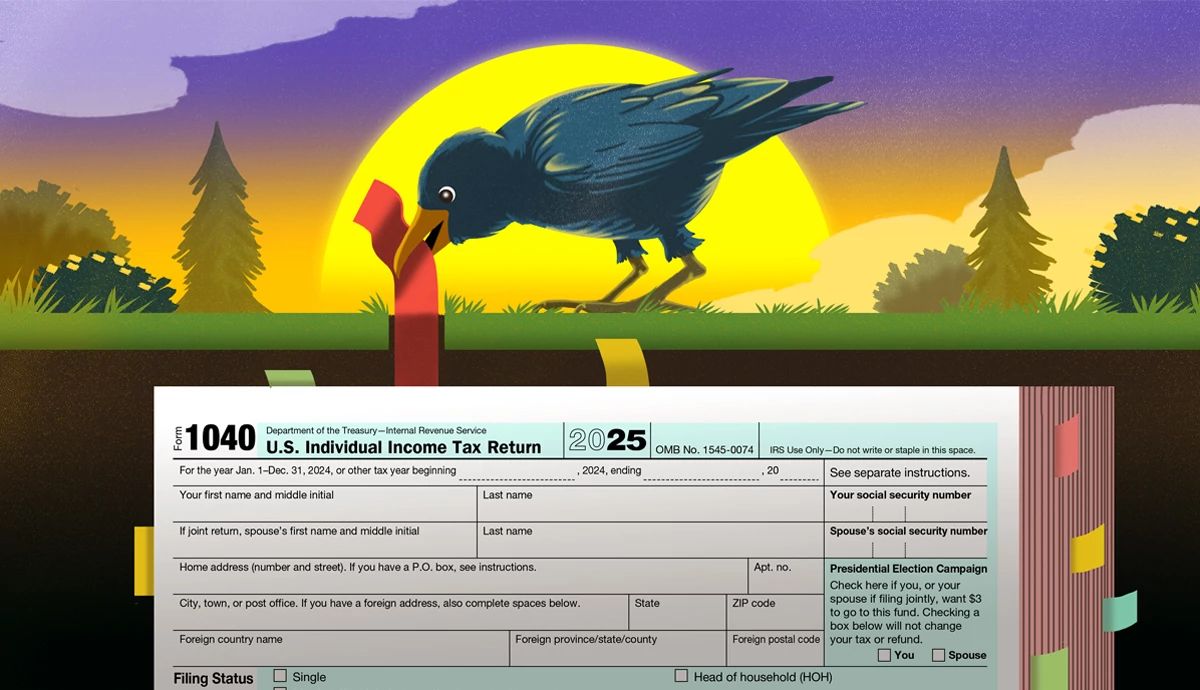
If you’re having trouble reading IRS Form 1040 — your main income tax form — because of vision issues, consider IRS Form 1040-SR. This form has larger type than the regular 1040. It also has a chart for calculating your standard deduction — a good way to ensure that taxpayers 65 and older take the larger standard deduction to which they are entitled.
4. You get a higher standard deduction if you’re 65 or older
The standard deduction reduces your taxable income — and by quite a lot. For single filers and for those who are married but filing separately, it is $15,750 for the 2025 tax year, up $1,150 from the 2024 tax year. For married couples filing a joint return, the standard exemption is $31,500, up $2,300 from 2024.
The standard deduction is even larger if you’re 65 or older. Single filers in that age group can claim an additional $2,000, and married couples can increase their standard deduction by $1,600 per spouse, for a total of $3,200. In total, single filers 65 or older would have a standard deduction of $17,750. A married couple would have a standard deduction of $34,700 if both spouses are 65 or older.
In addition to the standard deduction, there’s a new $6,000 bonus deduction if you are 65 or older and have modified adjusted gross income (MAGI) of $75,000 or less as a single filer. Married couples filing jointly can claim a total of $12,000 if both spouses are 65 and older and have MAGI of $150,000. The deduction is reduced as income exceeds those limits and is completely phased out at $175,000 for single filers and $250,000 for married couples filing jointly.


More From AARP
The Federal Income Tax Brackets for 2026
Find out how much you will owe
10 Weird Tax Breaks the IRS Allows
Need a break for your whaling ship? Tax law has you covered
Great Ways to Skirt Hidden Fees
Tips to spot and sidestep surprise charges