






















































Javascript is not enabled.

Javascript must be enabled to use this site. Please enable Javascript in your browser and try again.

Skip to content
Content starts here
CLOSE ×
Search
CLOSE ×
Search
Leaving AARP.org Website

You are now leaving AARP.org and going to a website that is not operated by AARP. A different privacy policy and terms of service will apply.

How Your Favorite TV Shows Shaped Your Gen X Identity

Little did you know that the television you loved as a kid was a blueprint for your adulthood


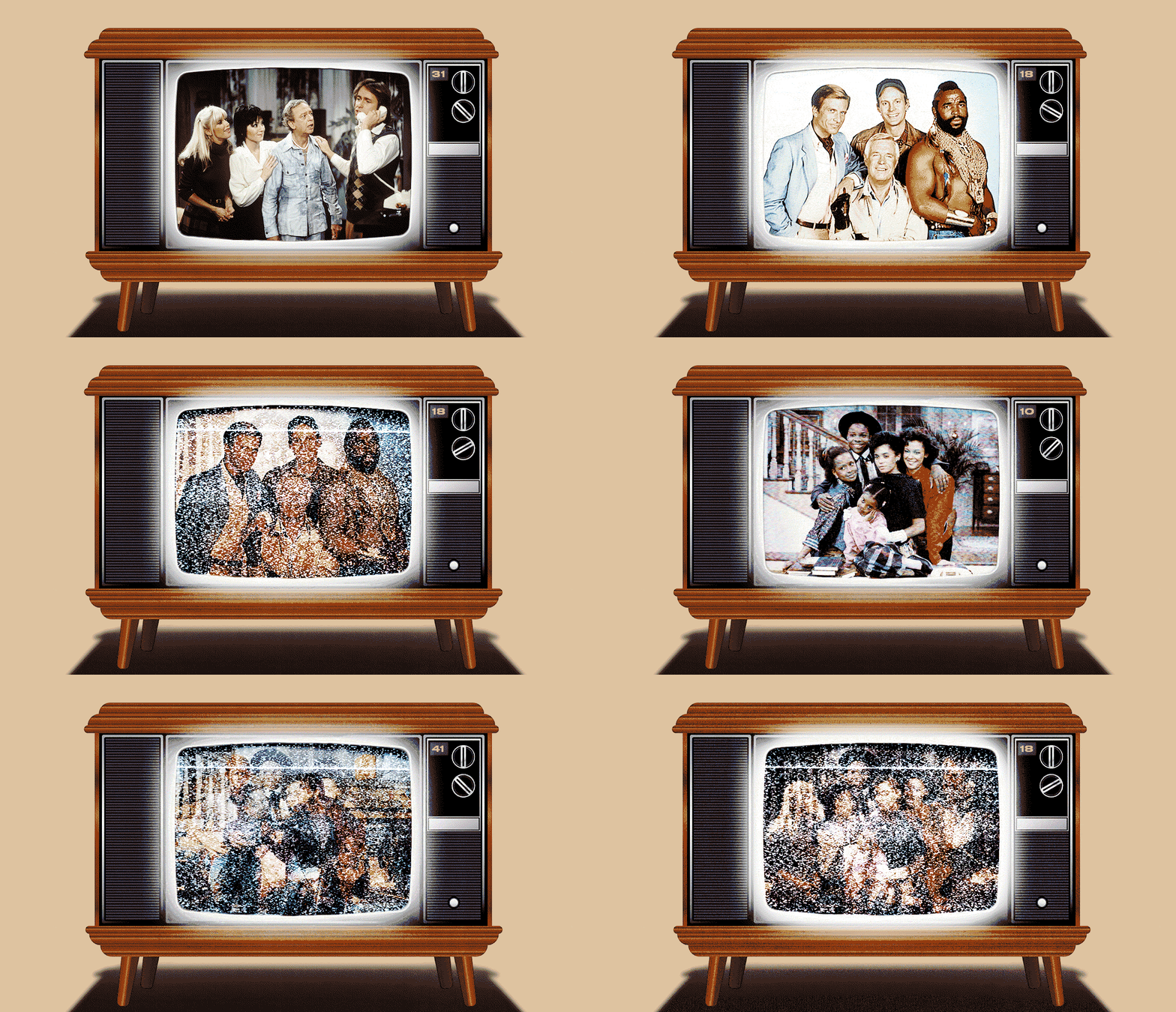
an animated gif with a vintage t v set showing a series of images of shows from the 1970s to the 1990s
The shows you loved the most are still part of you.
Paul Spella (Masterfile, ABC/Courtesy Everett Collection, Universal/Courtesy Everett Collection, NBCU Photo Bank/NBCUniversal via Getty Images ABC Photo Archives/Disney General Entertainment Content via Getty Images)

Television shows never really die; they continue to live inside the people who watched them. Like parasitic ghosts.

If you’re among the generations raised on TV shows, before TikTok, before YouTube, before streaming services gave you a thousand options and somehow made television worse, those shows you loved the most are still part of you. Consciously or not, you studied them, you identified with them and they imprinted upon you.

If you’re over 50, that imprinting goes deeper than you probably realize, because the brain that was watching Happy Days and M*A*S*H was a brain in the middle of becoming something. Researchers have found that when older adults revisit a TV show or other touchstone of their formative years, they don’t just feel warmly about it, they experience it as self-defining, as more revealing of who they are than almost anything else in their actual lives.

Of course, different shows had different effects. The more you loved the following shows, the more completely they made you who you are. This is not an opinion. This is science.

Mister Rogers’ Neighborhood (1968–2001)

You’re a fundamentally good person in a world that wasn’t designed with you in mind. You’ve known this for 50 years and have chosen to show up anyway, in a cardigan, on time.​ You change into comfortable shoes the moment you get home. You believe that you are special, that you are loved, and that the world is basically a neighborhood full of people doing their best. This belief has been tested repeatedly since 1968 and you have chosen to retain it anyway, which is either your greatest strength or the reason you keep getting blindsided.

Gilligan’s Island (1964–1967)

You often feel stranded by and stuck in your circumstances, with no viable path of escape. Creativity is your gift, but it has certain unusual limits: you can build a radio out of coconuts but can’t seem to build a boat out of trees. You are keenly aware of social hierarchy and your position within it, which is somewhere between the Professor and Gilligan, and this awareness has not made you happy. When you finally do devise a perfect way to bust out of your situation, you accidentally sabotage it every time, leading you to chase yourself into a lagoon and beat yourself with a hat.

The Brady Bunch (1969–1974)

Disagreements and conflict are a natural part of any family situation. But as long as there is plenty of love and support, everyone gets their own very special episode; and if you never ask any questions about what became of your second original parent, you can work anything out. You believe deeply that there is always a lesson to be learned, and that lesson fits neatly into 22 minutes, with time for commercials. The one exception is when your youngest son steals a cursed tiki idol from a Hawaiian burial site and Vincent Price traps your other sons in a cave, in which case you will need a three-parter.

M*A*S*H (1972–1983) 

You’re funny! And caring! You embrace life wholeheartedly and mourn death with the aid of emotional monologues! You like to think of yourself as a drinker with a surgery problem instead of the other way around. You have complicated feelings about authority that you resolve by making authority figures look foolish at formal dinners. This has not served you well professionally, but you maintain that it was worth it.

Happy Days (1974–1984)

You buy into traditional images of cool (leather jackets, motorcycles) and have a friend you insist on calling “Potsie” despite his complaints about that. Your home office is decorated like a diner bathroom. Whenever something in your home breaks, your instinct is to hit it, and this works more often than it should. There is a moment in your past, probably from your mid-30s, that everyone who knows you agrees was the point where you jumped the shark. You disagree and point out that you were still going strong for years afterward. Both things are true. Your brother Chuck disappeared, and you are never to speak of him.

a scene from an episode of little house on the prairie
Living proof you can endure anything in a bonnet: “Little House on the Prairie” (1974–1983).
NBCU Photo Bank/NBCUniversal via Getty Images

Little House on the Prairie (1974–1983) 

You have an exceptionally high tolerance for hardship and an unshakable belief that hard work, faith and family are all anyone really needs. You have been tested by prairie fires, blizzards, scarlet fever, locust swarms, blindness, bankruptcy and an insufferable rich kid named Nellie Oleson, and you have emerged from all of it with your values intact and your face slightly windburned. Every time you achieve a measure of stability, something burns down, and not always metaphorically. When something in your life actually burns down, you strongly suspect Pa had something to do with it.

a scene from an episode of threes company
Life is all fun and games until the landlord shows up: “Three’s Company” (1977–1984)
ABC/Courtesy Everett Collection

Three’s Company (1977–1984) 

You have an enlightened and progressive view of sexuality, gender and Santa Monica, and it serves you well. The main complicating issue you sometimes run into is the outsized role your landlord plays in your life. Every misunderstanding in your world could be resolved with a single honest sentence, and yet you have never once spoken that sentence. Also, you are constantly falling off bicycles on the beach, and the injuries are starting to add up.

a scene from an episode of the jeffersons
You got the deluxe apartment in the sky. The neighbors are insufficiently impressed. “The Jeffersons” (1975–1985).
Courtesy Everett Collection

The Jeffersons (1975–1985) 

You made it. You moved on up. You got the deluxe apartment, the dry-cleaning empire and the doorman who tolerates you. The one thing nobody told you about finally arriving at the place you always dreamed of is that you would still fundamentally be yourself when you got there, which has turned out to be both the best and the most complicated part. Your neighbors find you abrasive. You find your neighbors insufficiently impressed. You’ve been having this same argument for 50 years, and neither side is backing down. Your spouse is the only reason you have any friends, and on some level you know this.

The Love Boat (1977–1987) 

You believe, with a conviction that no amount of evidence has been able to fully dislodge, that love can be found anywhere, including international waters, and that three days is a perfectly reasonable amount of time in which to find it. You have taken this philosophy ashore with you and applied it to situations where it did not strictly apply, and the results have been mixed at best.

Diff’rent Strokes (1978–1986)

You are small in stature but enormous in presence, and you have been using this disparity to your advantage since childhood. You were taken in by people with more money than you and asked to be grateful for it, and you were. You also had questions, and the questions were often better than the answers. You’ve been asking “Whatchu talkin’ bout” of the world for your entire adult life, and the world has yet to provide a satisfying response.

Mork & Mindy (1978–1982) 

You have always felt slightly outside the human experience, watching it from a remove that is equal parts amusing and bewildering. You are the funniest person you know, and also the saddest, and these two things are so thoroughly braided together that you have stopped trying to tell them apart. You arrived in other people’s lives like a weather event and you made everything louder and brighter and faster, and when you left the room, people noticed the quiet in a way they could not quite explain. Na-nu na-nu. You did your best.

Magnum, P.I. (1980–1988) 

Possessed of a keen intellect, an inquisitive mind and a rakish charm, you really thought you could rock the mustache-Hawaiian-shirt-and-short-shorts look. You believed on some level that living in someone else’s guesthouse while solving their problems was a viable long-term arrangement. You’ve spent your adult life working for a boss you’ve never once met, driving a car you don’t own and running a tab nobody expects you to pay. The truly unsettling thing is that this has all worked out fine.

Cheers (1982–1993) 

You have a place where everybody knows your name, and this place is a bar, and you have thought carefully about whether that says something about you and decided that it does not. You are funnier than you are successful, more loyal than you are ambitious, and considerably more comfortable on a barstool than in any situation that requires you to grow as a person. You are at your absolute best surrounded by people who have nowhere better to be. This is not an insult. Some of those people are the smartest, funniest, most loyal humans you will ever meet. They are all at a bar at two in the afternoon, and so are you, and for reasons that would take 11 seasons to fully explain, this is exactly where everyone belongs.

Knight Rider (1982–1986)

You believe that one person with the right vehicle can make a difference, and you have organized your entire adult life around this worldview. To be fair, it is a very good vehicle. The talking-to-your-car part started as a quirk and has become load-bearing. Your car always knows what to do, which is more than you can say for most of the people in your life, and you have made your peace with what that means, and so has your car, and honestly that’s enough.

The A-Team (1983–1987) 

You’re at your best as part of a small, highly specific team of people who should not work together yet absolutely do. You pity the fool who underestimates you, and there have been many fools, and they’ve all been proven wrong. None of them were seriously injured in the process despite an incomprehensible amount of ammunition expended in their general direction. You have never been sure if this reflects well on you or on them. The van is incredible, though. Everyone agrees about the van.

Murder, She Wrote (1984–1996) 

You are surrounded by murderers. Statistically, the per capita homicide rate in your immediate social circle is without precedent in the criminological literature, yet no one has thought to mention this to you, least of all the sheriff, who has his hands full. You have traveled to 49 states and 11 countries, and the body count has followed you to every one of them. You’ve chosen to interpret this as a gift for detection rather than examining the alternative explanation.

The Cosby Show (1984–1992) 

In liking things, you do the best you can with the information you have at the time you have it.

a scene from an episode of the golden girls
Friendship is chosen family plus better insults: “The Golden Girls” (1985–1992).
Joseph Del Valle/NBCU Photo Bank/Getty Images

The Golden Girls (1985–1992) 

You are one of four people: the sardonic realist who sees everything clearly and is exhausted by it; the romantic who has confused attention for love her entire life; the sweet one whose simplicity conceals a devastatingly accurate view of the world; or the tiny, ancient one who will outlive everyone and has made her peace with this. You know which one you are. So does everyone at the table.

MacGyver (1985–1992) 

You do not panic in a crisis. You assess, you improvise and you solve the problem with whatever happens to be nearby, which is a genuinely useful quality that has also made you insufferable at hardware stores. You have never encountered a situation that could not be improved by a Swiss Army Knife and 15 seconds of quiet thinking, and you have applied this philosophy to your relationships, career and home repairs, with results that have been at minimum structurally sound.

ALF (1986–1990) 

You showed up uninvited in someone else’s home and never quite left, and the family that took you in has spent years being alternately charmed and exhausted by this. You’ve interpreted both reactions as affection, which is either emotional intelligence or a complete lack of self-awareness, and the distinction has never troubled you. You eat things you’re not supposed to eat. You say things you’re not supposed to say. The cat remains missing.

Pee-wee’s Playhouse (1986–1991) 

You are unapologetically yourself in a world that has spent considerable energy suggesting you shouldn’t be, and you have the playhouse to prove it. Your friends include a talking chair, a genie and a cowboy, and you’ve never once ranked them by their usefulness or their normalcy, which is either the healthiest possible approach to relationships or a sign that you were always operating on a different frequency than everyone else. You understand that absurdism is not the opposite of sincerity but the fullest possible expression of it, and you arrived at this understanding before you had the vocabulary for it, sitting on a floor in your pajamas on a Saturday morning, and it has informed everything since.

The Wonder Years (1988–1993) 

You remember your childhood with clarity and an ache that has never fully resolved, and you’ve spent considerable time since then wondering whether it was actually that good or whether the narrator in your head has been editing the footage. The answer is both, which you already knew, which somehow makes the ache worse rather than better. You had a Winnie Cooper, an early crush you’ve never entirely gotten over. Nobody ever entirely gets over their Winnie Cooper.

Quantum Leap (1989–1993)

You’ve spent your life stepping into other people’s situations, sorting out their problems with incomplete information and 30 minutes on the clock, then moving on before anyone could properly thank you. You’ve told yourself this is a calling rather than a pattern, and on good days you believe it. Then you leap again, you’re somewhere new, the mirror shows someone else’s face, and you fix what once went wrong. It’s never quite enough to get you home, and you go anyway.

Saved by the Bell (1989–1992)

You went to a high school where everyone was attractive, the principal was a buffoon, class lasted approximately four minutes and every problem was resolved before the bell rang. You peaked in a way that was televised, which is its own specific condition. The clothes were tremendous. The hair was ambitious. You understood on some level that this was not how high school actually worked, but it was the blueprint you brought with you anyway, and the gap between Bayside and reality has been a subject you’ve been quietly processing for 30 years.

Twin Peaks (1990–1991)

You have been murdered. The investigation revealed that everyone in your town was hiding something, that evil wears familiar faces, that the red curtains part for everyone eventually and that the coffee at the Double R is, without question, a damn fine cup. The owls are not what they seem. Neither are you, which is cold comfort given the circumstances.

Unlock Access to AARP Members Edition

Join AARP to Continue

Already a Member?


Join AARP for only $11 per year with a 5-year membership. Get instant access to members-only products and hundreds of benefits, a free second membership, and a subscription to AARP The Magazine.