
AARP Hearing Center























.jpg?anchor=17,8&q=80&color=ffffffff&u=8wsalu&w=375 "Fall Movie Preview 2026")
















.png?crop=true&anchor=0,26&color=ffffffff&u=ucxnmh&w=2048&h=1177&credit=Marco%20Baccioli)


What Caregivers Should Know After a Loved One’s Stroke
Experts share ways to provide support and help a loved one regain strength and independence
9-minute read


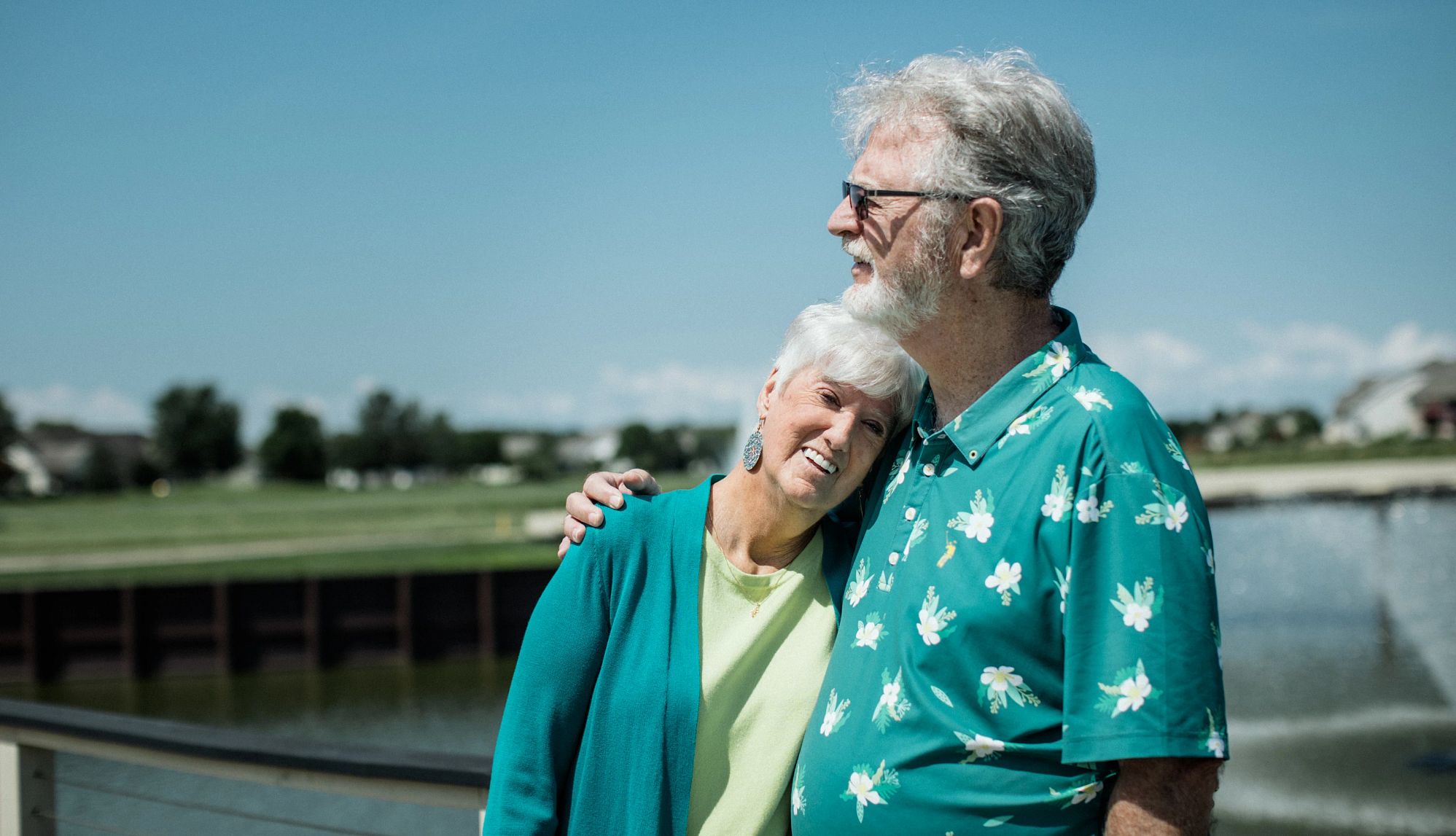
Cressida McKean and Russell Borthwick on a trip to Sicily in May 2023 and with their grandson at the Brooklyn Botanic Garden. Following his stroke, Borthwick underwent intense physical therapy to relearn how to walk.
Courtesy Cressida McKean
Key takeaways
- Stroke caregivers often juggle medical, household and emotional responsibilities while supporting a loved one’s recovery.
- Experts recommend building a support team, accepting help and creating routines that promote safety and independence.
- Recovery can continue for years after a stroke, and caregivers should prioritize their own well-being to avoid burnout.
In an instant, Cressida McKean’s entire life was upended.
One moment, this mother of two was preparing for the day after a Sunday breakfast with her husband, Russell Borthwick. The next, she was on the phone with 911, getting emergency assistance for him.
Starting that morning in 2007, McKean, now 73, joined the ranks of countless others in caregiving for a stroke survivor.
More Ways to Benefit
- Related Benefit 1
- Related Benefit 2
- Related Benefit 3
- Related Benefit 4
- Related Benefit 5
The short- and long-term effects of a stroke can vary, depending on its severity and the area of the brain affected, but the results can be far-reaching. Language, vision, memory and spatial perception, as well as physical disabilities such as paralysis, are among the many potential issues.
This can be demoralizing and frustrating for the survivor, who can become depressed after a stroke. It’s also daunting for those who become caregivers. These loved ones must learn to support the survivor physically, mentally and emotionally while often juggling other duties, such as managing medical bills and appointments, preparing meals, doing laundry and going grocery shopping. Adding to the pressure, many caregivers are parents or hold full-time jobs.
As McKean experienced, if a spouse has a stroke, a caregiver may need to pick up duties the stroke survivor once handled. For instance, among her many tasks, she had to also “figure out how to do the taxes, how to bleed the pipes in the winter,” she says.
At first, McKean tried to do it all — taking on the role of “the ultimate caregiver” — but eventually realized she needed aid from others to best help herself and Borthwick, who is now 70.
That team approach to caregiving is essential, says rehabilitation psychologist Efrat Hedges Eichenbaum. “Even with the best intentions and the highest level of motivation, no one can be a 24-hour caregiver,” she says. “It is important, if you can, to get your own social and caregiver support.”
Assistance can include professionals such as a neurologist, physical therapist, speech therapist and occupational therapist, as well as family, friends, caregiver support groups and resources, including a state brain injury association or the American Stroke Association’s caregiver website and fact sheet.
To help caregivers on their journey, AARP reached out to medical professionals and the loved ones of stroke survivors to get insights and advice. Here’s what they said.
Get expert advice on how to assist
When possible, join your loved one at doctor and therapy visits, says Tamilyn Bakas, a nursing professor at the University of Cincinnati and a volunteer expert with the Council on Cardiovascular and Stroke Nursing, which is within the American Heart Association.
Join Our Fight for Caregivers
Here’s how you can help:
- Sign up to become part of AARP’s online advocacy network and help family caregivers get the support they need.
- Find out more about how we’re fighting for you every day in Congress and across the country.
- AARP is your fierce defender on the issues that matter to people 50-plus. Become a member or renew your membership today.
Bakas suggests keeping a list of daily medications — including a medicine’s name, dosage and any possible side effects — and bringing it to all appointments. A notebook can be helpful to write down important points about your loved one’s recovery and how you can help.
Establish a consistent schedule
To assist with memory, Bakas says many caregivers find that creating a daily routine, such as providing meals and assisting with personal care at the same time each day, helps. Incorporate tasks a loved one can do safely, such as drying dishes and folding laundry.
Avoid too many activities going on at the same time. As you craft your routine, build in breaks for yourself, says Hedges Eichenbaum.
Accept help from others
“When someone says, ‘How can I help you?’ you have to be very specific about what you need. You can’t just say, ‘I’ve got it under control,’ ” McKean says.
Caregivers often need time to recharge, and that can happen if someone else spends time with the stroke survivor. Having a written daily schedule, clear care instructions and a list of critical medical contacts makes it easier for others to fill in. Welcoming outside help is vital for a caregiver to maintain mental and physical health, says Susan Ryerson, a physical therapist with extensive experience in stroke patient care.
“Taking care of yourself while you’re taking care of your loved one is important. If you get hurt, then who’s going to care for them?” she says.

Prepare the home
It’s important to get individualized advice from an occupational and physical therapist about preparing your living environment, says Hedges Eichenbaum, as recommendations will differ depending on each patient’s needs. Getting specific advice will prevent unnecessary and expensive home modifications.
The American Stroke Association advises being mindful of passageway widths (such as the space in hallways and between furniture) if a loved one uses a wheelchair or a walker. Remove throw rugs that may be a tripping hazard and install grab bars in bathrooms to aid with balance, if needed.
Put away clutter, Bakas says, and you may need to remove potentially dangerous items such as sharp knives and household chemicals. “Try to make your home as safe as possible,” she says.
Incorporate tools to enhance memory
Use memory aids such as sticky notes, charts, calendars or reminders of upcoming important events, Bakas says. Engage in activities that stimulate the brain, such as solving crossword puzzles, playing video and board games, listening to music and taking walks.
For the tech-savvy, there are apps that can be accessed via smartphone or tablet to assist with memory, cognition and even language skills. The American Heart Association recommends several, including Elevate, Peak and Stop, Breathe & Think.
Facilitate more effective communication
If your loved one has communication issues, try to speak slowly and clearly with short sentences, Bakas says. Sometimes, yes/no questions with thumbs-up and thumbs-down can be helpful.
Try to avoid noisy settings when discussing something important, Bakas adds. A quiet room or turning down the TV can help. When out and about, some find it helpful to carry a card that says, “It is very hard for me to speak, read or write because I have had a stroke. I can usually understand what you are saying if you speak clearly. Thank you for your help and patience.”
Cultivate an ongoing partnership with a health care provider
As with routine dental visits, it’s beneficial to schedule regular sessions with a professional, such as an occupational therapist or a psychologist, Ryerson says. It doesn’t have to be a doctor. It just needs to be a knowledgeable professional with whom you have a good rapport.
The aim is to ensure “you’re not starting at square one every time there’s a small issue,” Ryerson says. “If you catch the small issues before they get big, you’re ahead of the game.”
Consider a caregiver support group
Those in similar situations can provide not only ideas and resources for caring for a loved one but also insights into how to take better care of themselves. McKean serves as a moderator for the Caring Connection at the nonprofit Stroke Comeback Center in Vienna, Virginia.
“It’s work that I love. It means a great deal to be a sounding board for people in great need and to bear witness to their struggles,” she says. “My secret sauce is being positive and hearing the positive parts of what caregivers share.”
Add more joy to both of your lives
Reimagine activities that you and a loved one enjoyed together, Ryerson says. For instance, if travel was a shared passion, you could take a car ride to a beach or through the woods, roll down the windows and take in the scenery. If dining out with others was part of your routine, you can order takeout, set up a table outside and invite two people over for an alfresco meal.
People with mobility challenges may benefit from working with a recreational therapist who can help them enjoy hobbies in an adapted manner, says Hedges Eichenbaum. “With the help of a recreational therapist, people with mobility issues have even been able to go skydiving and skiing,” she says.
In addition, there are virtual and in-person social events designed for people who have mobility challenges. Check out your state Brain Injury Association’s events page for information.
Maintain hope
“There’s no cookie-cutter approach to this. You’ve got to figure it out in terms of your situation,” McKean says. “You can learn how to deal with it. A positive attitude goes a really long way.”
For Borthwick, that stance — along with McKean’s support, therapy’s help and his determination — led to substantial progress. “Russell could barely sit upright and could not walk for the first year and a half after his stroke,” McKean says. During their summer in the Poconos this year, McKean enlisted a physical therapist assistant who was also a certified massage therapist to help Russell with physical therapy and range-of-motion exercises. He thrived.
“We may be getting older, but Russell is determined to make exercise integral to his life. At home, he now uses the treadmill twice a day and works out with an athletic trainer four times a week,” McKean says.
If maintaining hope feels beyond your ability, enlist the assistance of a therapist or mental health professional to help light the way.
Stroke Recovery: What Not to Miss
- The window for recovery is longer than you think. Early intensive rehabilitation is critical, but recovery does not stop after the first weeks or months. The brain retains the ability to rewire itself for years after a stroke, and patients who continue working at therapy often make meaningful gains years later.
- Doing too much for the survivor can slow recovery. Well-meaning caregivers who step in to handle every task can inadvertently deprive the survivor of the practice they need. Rehabilitation specialists emphasize giving survivors the chance to attempt tasks independently, even when it is difficult or slow. The effort itself is therapeutic.
- Caregivers need to take care of themselves. Caregiver burnout is well-documented and common. A caregiver who is exhausted, isolated or depressed cannot provide effective care. Building in respite, accepting help from others and seeking support, whether from a therapist or a support group, is not a luxury but a necessity.
- Ask for a neuropsychological evaluation if one was not performed. Cognitive deficits after a stroke — in memory, attention, processing speed and executive function — are often less visible than physical ones and can go undiagnosed. A formal evaluation provides a baseline and informs the rehabilitation plan.
- Personality and emotional changes are neurological, not personal. Irritability, emotional outbursts, sudden crying or laughing, and uncharacteristic behavior are common after a stroke and stem from brain damage, not the survivor’s will or character. Understanding this can help caregivers respond with patience rather than frustration.
— Yudhijit Bhattacharjee
The key takeaways were created with the assistance of generative AI. An AARP editor reviewed and refined the content for accuracy and clarity.

AARP Membership
Join AARP for only $15 per year with automatic renewal. Get instant access to members-only products and hundreds of benefits, a free second membership, and a subscription to AARP The Magazine.
More From AARP
Caregiver Support: Exercises for Bedbound
Small daily movements assist a person on the road to recoveryManaging Anxiety While Awaiting Test Results
Navigating test result anxiety with assertivenessWhat New Family Caregivers Really Need to Know
Tips for thriving in caregiving roles