
AARP Hearing Center









































4 Common Election Scams to Avoid This Year
Criminals may target voters with bogus registration sites, requests for donations to fake PACs, and other fraud
8-minute read

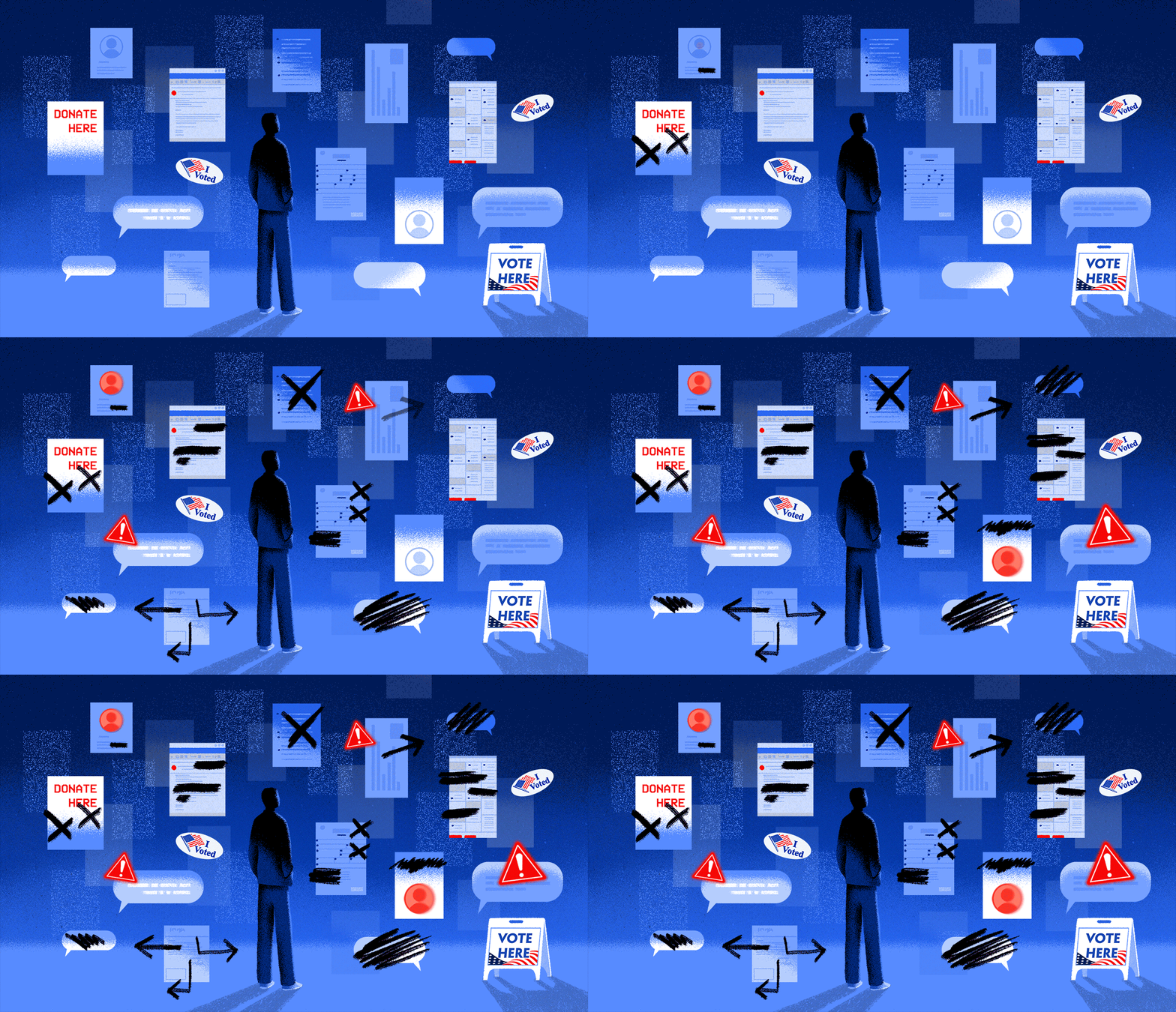
Illustration: Matt Chinworth
About Election Scams
Signs to Watch For
- Unexpected messages may ask you to verify your voter registration, donate or click a link.
- Suspicious polls may offer prizes while requesting personal or financial information
How to Protect Yourself
- Use official government websites to register or confirm election information.
- Visit a candidate’s certified site before donating, and avoid unsolicited links or calls.
Get Help
- Report a scam PAC to your local FBI field office and ask for an election crimes coordinator. Report online scams to the FBI's Internet Crime Complaint Center at IC3.gov.
As Michael Bruemmer, 67, shopped for a Christmas tree at a Kiwanis lot near his Austin, Texas, home, a voter-registration volunteer approached him with an iPad to register him for the next election. The registration ploy was a scam, but unbeknownst to the scammer, Bruemmer was not an easy target: He’s a fraud expert and vice president of data breach resolution for Experian, a data analytics and consumer credit reporting company. Bruemmer quickly noticed misspellings on the supposed registration page.
“I said, ‘First of all, I’m already registered to vote, and second, your site is fake,’” recalls Bruemmer.
More Ways to Benefit
- Related Benefit 1
- Related Benefit 2
- Related Benefit 3
- Related Benefit 4
- Related Benefit 5
The flustered scammer stammered and gave excuses but quickly recovered — then, Bruemmer says, the guy asked him for his phone so he could download a registration app, “and I said, ‘I’m sorry, sir. You’re not going to download anything.’”
That was four years ago. Since then, scammers have only grown more sophisticated, and they’ll likely use the midterm elections to target your data and cash. In a one-month period in the spring of 2026, over 4,000 “vote”-related web domains were registered online, and while some are legit, many are used for scams, from donation frauds to phishing schemes disguised as voter information sites, according to a 2026 U.S. Midterm Election Threat Outlook from Check Point, a cybersecurity company.
In part due to advances in and availability of AI, they’re likely to use this year’s election to target your data and cash. Adding to the problem: AI has become more advanced, more available, and more powerful since the elections in 2024.. Here are four common scams and ways to protect yourself.
1. Voter registration scams
When Bruemmer’s scammer offered to download a voter registration app on his phone, he likely would have downloaded a malicious app instead, allowing cybercriminals to steal personal data such as payment information and login credentials. Some apps “can suck people’s information out over Wi-Fi or Bluetooth,” Bruemmer cautions.
How to vote in your state
Learn more about absentee and early voting, ID requirements and registration in all 50 states, the District of Columbia, Puerto Rico and the U.S. Virgin Islands.
The more common problem, however, involves links to fake voter registration forms that scammers send by phone, email or text. Those links may be phishing scams to collect personal data (such as your passwords and Social Security number) for or allow others to access your devices, according to Experian.
“Phishing remains one of the most likely operational threats surrounding the 2026 election cycle,” the Check Point report found.
Scammers are also sending links urging you to confirm that you’re still registered to vote. In Rhode Island, the state’s election division issued a July alert about a phishing email that urged recipients to click a voter-verification link. In September, voters from Pennsylvania to Virginia received texts with the message, “You are making a huge mistake continuing to ignore us like this. We’re asking one last time. Verify your voter profile ASAP.” The message was followed by a link that included “gop-way1.org” in the URL.
In both cases, the goal was the same: “It’s a scam to get you to download malware,” Bruemmer says.
How to protect yourself:
- If someone claims you’re not registered to vote and offers to register you by phone, hang up. You cannot register by phone, email or text. In all 50 states, you can only register to vote online, by mail, or in person at a local election office.
- The safest option is to register at a government location or do so by mail. If you do register online, do not use unsolicited links.
- Voter registration drives often occur at events such as festivals and farmers’ markets, and sometimes the filled-out forms are left on tables where anyone can see them, the Identity Theft Resource Center warns. A better option is to complete a form and mail or deliver it in person to an election office.
2. Robocalls
In 2024, days before the January New Hampshire primary, as many as 25,000 Granite State residents received a robocall from what sounded like Joe Biden but was actually an AI-generated voice. The message: Don’t vote. “Your vote makes a difference in November, not this Tuesday,” the fake Biden said. In response, the Federal Communications Commission issued a declaratory ruling in February that made “voice cloning technology used in common robocall scams” illegal.
Despite the ruling, voters should remain on high alert for AI-generated audio and video, whether in phone calls or social media posts.
In the Georgia U.S. Senate race, for example, Rep. Mike Collins’ campaign released a deepfake video showing his opponent, Sen. Jon Ossoff, mocking farmers and defending a government shutdown. Ossoff, however, never made those comments.
Although fake video is a powerful tool, Dan Evon, senior manager of education design for the News Literacy Project, is more concerned about fake audio. “The one genre of misinformation I’m most worried about for the election is fake audio,” says Dan Evon, senior manager of education design for the News Literacy Project. In a video, he explains, visual cues can help indicate it’s fake, such as speeches where the words don’t match the candidates’ mouths, and you can at least search for its source online. But with a phone call, “It’s much harder to tell where it’s coming from,” he says. With a robocall, “There are not as many obvious red flags to indicate whether something is false.”

How big is the problem? The dark-web market for voice-cloning services grew more than sevenfold between 2024 and 2026, digital privacy and security company NordVPN reported in September.
Scammers could use fake audio for multiple purposes, from spreading misinformation to directing voters to a fraudulent donation site.
Ways to protect yourself:
- Be suspicious of robocalls and verify the accuracy of the information. If a robocall tells you that your polling place will be closed on Election Day, for example, don’t believe it. Instead, follow up with your local election office.
- “If you receive a suspicious call from someone trying to influence your vote, the best thing to do is just hang up,” notes a consumer alert from North Carolina Attorney General Josh Stein. And never trust a robocall that directs you to donate, Bruemmer advises.
- Be skeptical of unexpected calls from someone claiming to be a politician or a celebrity. In recent months, scammers have released deepfake videos of famous people such as Bill Gates, Elon Musk and Oprah Winfrey for fraudulent product endorsements.
3. Donation scams
Cybercriminals also use fake audio to request campaign contributions. In some cases, a supposed candidate may ask for a donation and tell you to push a number on your phone, which directs you to a representative, reports ID Watchdog, a consumer site from Equifax. Or an actual human may call, encouraging you to donate. You may also receive emails or texts with donation links; as with bogus voter registration links, these could be phishing scams.
Some solicitations come from fake political action committees (PACs). The FBI defines scam PACs as “fraudulent political action committees designed to reroute political contributions for personal gain,” which is a federal crime. Bruemmer compares their tactics to those of phony charities that raise money after natural disasters. They frequently seem credible and often employ high-pressure, emotional appeals.
Ways to protect yourself:
- If you want to donate to candidates, visit their official sites. “Don’t answer any phone calls, don’t click on any links in an email or text, even if it’s from somebody you recognize or you might think is reputable,” Bruemmer says. “Someone could have taken over their account and started spamming you.”
- Don’t rely on Caller ID: Scammers can impersonate a political campaign phone number through a tactic known as spoofing.
- Another reason not to answer calls: Cybercriminals only need a few seconds to record your voice and use AI to create a dialogue that could evade authentication with your financial institution or credit card company.
- Visit the Federal Election Commission’s website and search to see if a PAC is registered. If it’s not, it’s not legal, the FBI states.
- If you’ve been targeted by a scam PAC, contact your local FBI field office and ask to speak to an election crimes coordinator.
4. Fake surveys, petitions and polls
Opinion polls are almost as common as campaign rallies during election season, but be careful when participating in a survey or signing a petition.
The process often seems innocuous. Someone contacts you by phone, email, text or in person to answer a few questions. Or you might receive an urgent email — often featuring a well-known politician’s name and photo — asking you to sign a petition and make a small contribution, notes former Federal Election Commission Chair Ann M. Ravel. The problem, however, is when you’re asked to provide personal information, such as your birth date and email address. Some scammers may offer a gift card or other prize as an incentive to participate in the survey and then request your Social Security number, home address and other info — including your credit card number to cover taxes and shipping costs for your prize.
Ways to protect yourself:
- A legitimate survey may ask how you to plan to vote along with your political affiliation, and surveyors may request demographic information, such as age or race, notes Equifax’s ID Watchdog. But don’t share more specific information. Age is one thing, your birth date is another. Decline to provide your name, address, email address, Social Security number or driver’s license number.
- As with other election scams, don’t click on survey links from unsolicited emails and texts.
- If someone conducting a survey or poll offers a prize, don’t participate. “Real political polls rarely offer prizes for participation, and none would ask for a credit card number,” ID Watchdog states.
The key takeaways were created with the assistance of generative AI. An AARP editor reviewed and refined the content for accuracy and clarity.

AARP Membership
Join AARP for only $15 per year with automatic renewal. Get instant access to members-only products and hundreds of benefits, a free second membership, and a subscription to AARP The Magazine.
More From AARP
AI Makes Election Falsehoods Harder to Spot
Learn the warning signs of false election content and where to verify claims
Amazon-Impersonator Scams: Stay Informed
Be aware of the latest ways criminals use the company’s name to steal from consumers
What to Do If You Become a Scam Victim
How one woman worked quickly — with help — to avoid being charged through PayPal