
AARP Hearing Center









































8 Things to Know About Election Disinformation in the Age of AI
Artificial intelligence is helping spread and amplify falsehoods, but you can fight back

Paul Spella (Source: Getty Images (2))
The hotly contested midterm election campaigns are in full swing.
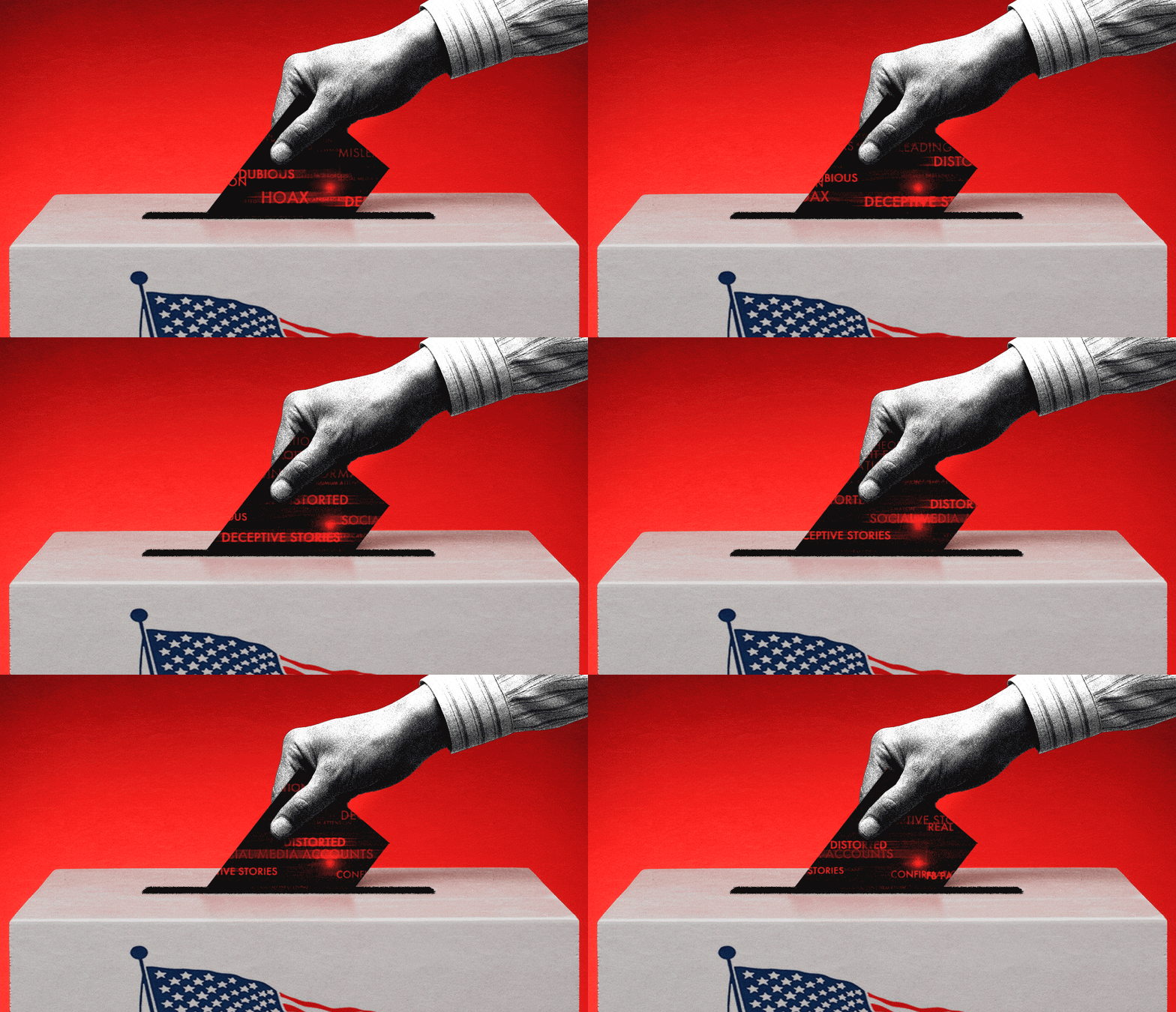
But whomever you intend to vote for, the potential to spread election disinformation is highly troubling, more so in this burgeoning age of generative artificial intelligence (AI) — the type that can churn out words, computer code, pictures and video based on text or other prompts from a user.
More Ways to Benefit
- Related Benefit 1
- Related Benefit 2
- Related Benefit 3
- Related Benefit 4
- Related Benefit 5
Seismic advancements in AI make it more difficult for you to figure out whether an announcement attributed to candidates and their representatives is actually from the campaigns. Supporters on the political fringes — and trolls who like to stir up trouble — have more tools at their disposal than ever before.
There are also lessons to be drawn from the 2024 presidential election. To varying degrees, candidates have always made exaggerated claims, and meddling in elections dates to the earliest days of politics. But AI-enhanced tools, amplified by the speedy and vast reach of social media, are digital carcinogens that can sow doubt about what is or isn’t factual.
“Election high jinks are as old as time, [but with AI] I do think there’s a step change from the past,” says Alondra Nelson, a Princeton, New Jersey-based professor at the independent research Institute for Advanced Study. A coauthor of Auditing AI, Nelson also served as acting director of the White House Office of Science and Technology Policy from 2021 to 2023.
The problem is both foreign and domestic, and it’s not just doctored text. Readily available online tools let anyone with even modest tech skills create bogus news websites, clone voices, manipulate photos and fabricate video that seems so authentic, it appears as though a candidate appeared at a place he or she never set foot in and said something never uttered.
For example, during the 2024 presidential campaign, an AI-generated robocall impersonating President Joe Biden’s voice urged some 5,000 Democrats in New Hampshire not to vote in a primary. A political operative tied to former Democratic primary challenger Dean Phillips admitted to creating the call. The Federal Communications Commission fined the operative, Steve Kramer, $6 million for the scheme.
The Biden robocall exemplifies how technology can be deployed to widen divisions and suppress votes in certain communities, says Claire Wardle, an associate professor of communications at Cornell University and a cofounder and former codirector of the Information Futures Lab at Brown University. Essentially, changing even a few minds could tilt the scales in a close election.
Here’s what to look out for:
1. If the message seems off, it’s probably false
What lent a modicum of legitimacy to the Biden robocall is that call quality these days is far from perfect. Damage can be wrought “if it sounds enough like somebody,” Wardle says.
The smartest thing voters can do under such circumstances is ask themselves whether it passes the smell test.
“[Did] it really make sense to you that Joe Biden is making a call telling you not to vote in the primary?” asks Hany Farid, who recently rejoined the faculty at Dartmouth after serving as a digital forensics professor at the University of California, Berkeley, and member of Berkeley’s artificial intelligence lab. “Take a breath, because the fact is, whether you’re 50 and above or a Gen Z or a millennial, we do tend to move very fast on the internet.”
2. ‘Cheap fakes’ can be as effective as slick fakes
The budget version of a deepfake, created with Adobe Photoshop or other editing software rather than AI, can wreak havoc too, Wardle says. Cheap fakes might alter when an image was captured, make an older candidate look more youthful or change the context entirely.
Back in 2020, a manipulated video of Nancy Pelosi made the former speaker appear as if she were intoxicated and slurring her speech. It went viral.
During the last national election, pictures of President Donald Trump circulated on social media showing him in a crowd of smiling Black voters and posing with a half dozen young Black men. AI created both images at the request of a radio host, who later acknowledged they weren’t real. Trump has courted Black voters, but just 15 percent of them cast their ballot for him in 2024, according to the Pew Research Center.
More recently, an AI-generated deepfake video of Texas Democratic Senate hopeful James Talarico depicted the candidate in a dress similar to the one Julie Andrews wore as Maria von Trapp in The Sound of Music, singing a parody of My Favorite Things. The attack ad, published by a conservative group called Citizens for Sanity, changed the song lyrics to mock Talarico’s views on transgender rights.
3. The obvious red flags will be fewer

AARP (Source: Getty Images (2))
Polished deepfakes present their own challenges. The red flags that once tipped off an AI-generated image are largely gone. Rarely will you see six fingers, an unattached earlobe and other weird body parts or backgrounds that strike you as dubious. Fake videos, or what have been derisively referred to as AI slop, are increasingly made to look and sound remarkably real.
According to the cybersecurity firm DeepStrike, deepfake content is multiplying exponentially and rose from about 500,000 in 2023 to more than 8 million by last year.
“How do we know a movie like Independence Day is a movie and not news of an alien invasion?” asks Joan Donovan, an assistant professor of journalism and emerging media studies at Boston University. “This is where your own knowledge of how the world works is going to be to your benefit. If something seems too scandalous, too outrageous or too novel, then seek other sources and do a little bit of your own fact-checking, or find out if reputable news organizations are also reporting on it.”
That fact-checking should extend beyond words. Consider doing a reverse image search that may help you learn about when and where a photo was taken.
4. What’s flagged as fake may be true
We understand that AI can be used maliciously. Wardle worries about another possibility.
“That this technology exists allows a politician who does something wrong and gets caught to say, ‘Oh, that’s a deepfake. That wasn’t me. That wasn’t a hot mic moment. Somebody manipulated that,’ ” she says. “It gives the kind of plausible deniability to the people who are up to no good.”
Nelson agrees: “You can search for a trusted news source to verify it. But here’s the catch: Deepfakes also give bad actors cover when they claim a real image or video is fake to skirt the truth.”
5. ‘Pink slime’ may be lurking in your browser history

AARP (Source: Getty Images (3))
Pink slime isn’t something from a horror flick, but it can creep up on you just the same.
The term, which you may associate with meat slurry used in processed foods, refers to websites that masquerade as local news outlets with official-sounding names. Their undisclosed financing comes from political operatives on the left and the right.
What marks a pink slime site? “They load quickly, have no paywalls, have no pop-up ads,” Wardle says. “Stories are written by people who are trying to support their own candidate or smear the other one.”
A study by the Institution for Social and Policy Studies at Yale University found that people often trust fake local news sites more than real ones. “People can come across these sites and be tricked into thinking they were real and trustworthy when they are algorithmically generated,” writes Yale political scientist Kevin DeLuca in an article posted on the ISPS website. “But that’s not the most troubling aspect to me. These sites seem to take money from campaigns or political operatives and write pieces that are biased or have some sort of angle, with this veneer of a legitimate news site.”
NewsGuard, an organization founded by media entrepreneur and journalist Steven Brill that rates the trustworthiness of news and information websites, launched the 2024 Elections Misinformation Tracking Center . At the time, it found 963 websites worldwide that repeatedly published false claims about elections and 793 social media accounts associated with those sites. Partisan sites masqueraded as local news outlets under names such as The Philadelphia Leader and The Copper Courier.
When readers see a news site, they should investigate further. Go to a fact-checking website such as PolitiFact, Snopes or NewsGuard, which may have vetted an unfamiliar outlet’s legitimacy, says Carmen Nobel, former editor-in-chief and strategic director of The Journalist’s Resource and a consultant at SciLine, a nonpartisan, nonprofit dedicated to enriching U.S. journalism with scientific evidence. Be on the alert for outrageous headlines or photos that are manipulated to look like headline images or news stories but don’t link to any articles. If a site claims to be a nonprofit, one potential, but not foolproof, designation is a “.org” at the end of the web address — public information should be available.
On any website, look at the About Us page. Does it adequately explain what the news organization is? Do you see a physical address or an easy way to get in touch? Treat the absence of these things as a warning.

6. Misinformation may not come from the top of the ticket
You may see fake imagery, stories and videos about the candidates before Election Day. Someone could just as easily spread disinformation by impersonating a local election official who says the polls are closed when they’re not.
“If you go back to the [most recent] national elections, people tried all kinds of shenanigans to get people not to vote,” Farid says. “ ‘Oh, [the] voting date has changed. Oh, you can text your vote here. Oh, mail-in voting doesn’t work. Oh, your ballot boxes are full.’ ”
Social media, email and texts quickly circulated the lies with little, if any, cost. The same can happen today.
7. AI chatbots are unreliable sources for election info
Nelson says studies show that chatbots perform better at generalized questions along the lines of “What is a tariff?” than hyperlocal queries such as “Where is my polling place?,” “How to register,” or “What are the mail-in ballot rules?” The real danger, she says, is that “AI-generated answers now pop up first, before you have scrolled down to a trusted source like your local election office.” Despite improvements, AI chatbots still hallucinate, meaning they sound correct or authoritative but may deliver answers that are wrong or fabricated. And AI is increasingly melding into, or replacing, what you might think of as traditional search.
8. Social media shouldn’t be your source for news
Facebook parent Meta had problems with data misuse during the 2014 midterm elections, fake posts and hate speech during the 2016 presidential elections, and misleading ads during the 2020 election and its aftermath. Meta put measures in place to curb AI misinformation in 2024.
At the time, its policy required Facebook and Instagram advertisers to disclose whenever a social issue, election or political ad contained a photorealistic image or video or realistic-sounding audio that was digitally created or altered.
And Meta said it would not allow ads that independent fact-checkers rate as “false, altered, partly false or missing context.”
But Meta pulled an about-face early last year: It said it would no longer rely on third-party fact-checkers across company-owned platforms Facebook, Instagram and Threads and would instead lean on a “community notes” model.
Critics of Facebook and other social media platforms had already warned people to avoid using them to learn about the news. Meta’s policy change of heart elevated concerns.
“The science is unequivocal here. Social media is bad for your mental and physical health, let alone your IQ,” Farid says. “If you must be on social media, don’t use [those platforms] as a news source.… [They are] a place for entertainment and connecting with your buddies.”
Instead, Farid advises people to get news from mainstream media outlets, however imperfect they may be. Before sharing anything, people must be responsible and seek out trusted fact-checking organizations that are “a Google search away,” he says.
“This election season, it’s important for voters to realize they have an important role,” echoes Nelson. “Be skeptical of viral claims on social media. Don’t let concerns about AI prevent you from voting. But this can’t fall on voters alone. Legislators need to step in. They should require that AI-generated content be clearly labeled or watermarked. They need enforcement mechanisms to stop misleading information about voting. And they need to require that AI tools be evaluated before they’re deployed and audited for bias and effectiveness after they are in use. The stakes for democracy are too high to leave this to chance.”
This story, originally published April 3, 2024, has been updated with additional information ahead of the 2026 midterm elections.
Contributing: Chris Morris and Lexi Pandell

AARP Membership
Join AARP for only $15 per year with automatic renewal. Get instant access to members-only products and hundreds of benefits, a free second membership, and a subscription to AARP The Magazine.
More From AARP
Should You Take High-Tech Shortcuts at Work?
Older workers are using AI to streamline tasks. Some of their tips—and a few key warnings
Unravel AI Mysteries: Take This Fun Quiz!
AI's complexities explored in a fun quiz
Is Someone Impersonating You on Social Media?
How to report an impostor on 5 of the major platforms