
AARP Hearing Center























.jpg?anchor=17,8&q=80&color=ffffffff&u=8wsalu&w=375 "Fall Movie Preview 2026")
















Chris Gash
The cost-of-living adjustment (COLA) may be the most widely anticipated way Social Security changes from year to year, but it’s far from the only one.
Inflation, wage trends and new policies directly affect not just the more than 68 million people receiving Social Security benefits but also the estimated 184 million workers (and future beneficiaries) paying into the system. Social Security field offices are changing how they do business, and millions of retirees will no longer see their benefits reduced because they also get a government pension.
More Ways to Benefit
- Related Benefit 1
- Related Benefit 2
- Related Benefit 3
- Related Benefit 4
- Related Benefit 5
Here are eight important ways Social Security will be different in 2025.
1. Cost-of-living adjustment
Inflation continued to cool last year, resulting in a 2.5 percent COLA for 2025 for people receiving Social Security payments, down from 3.2 percent in 2024. The estimated average retirement benefit will increase by $49 a month, from $1,927 to $1,976, starting in January, according to the Social Security Administration (SSA).
It’s the lowest COLA in four years, reflecting a return to pre-pandemic inflation trends. The average COLA since 2000 has been about 2.6 percent, even factoring in the spike in consumer prices that produced benefit increases of 5.9 percent in 2022 and 8.7 percent in 2023.
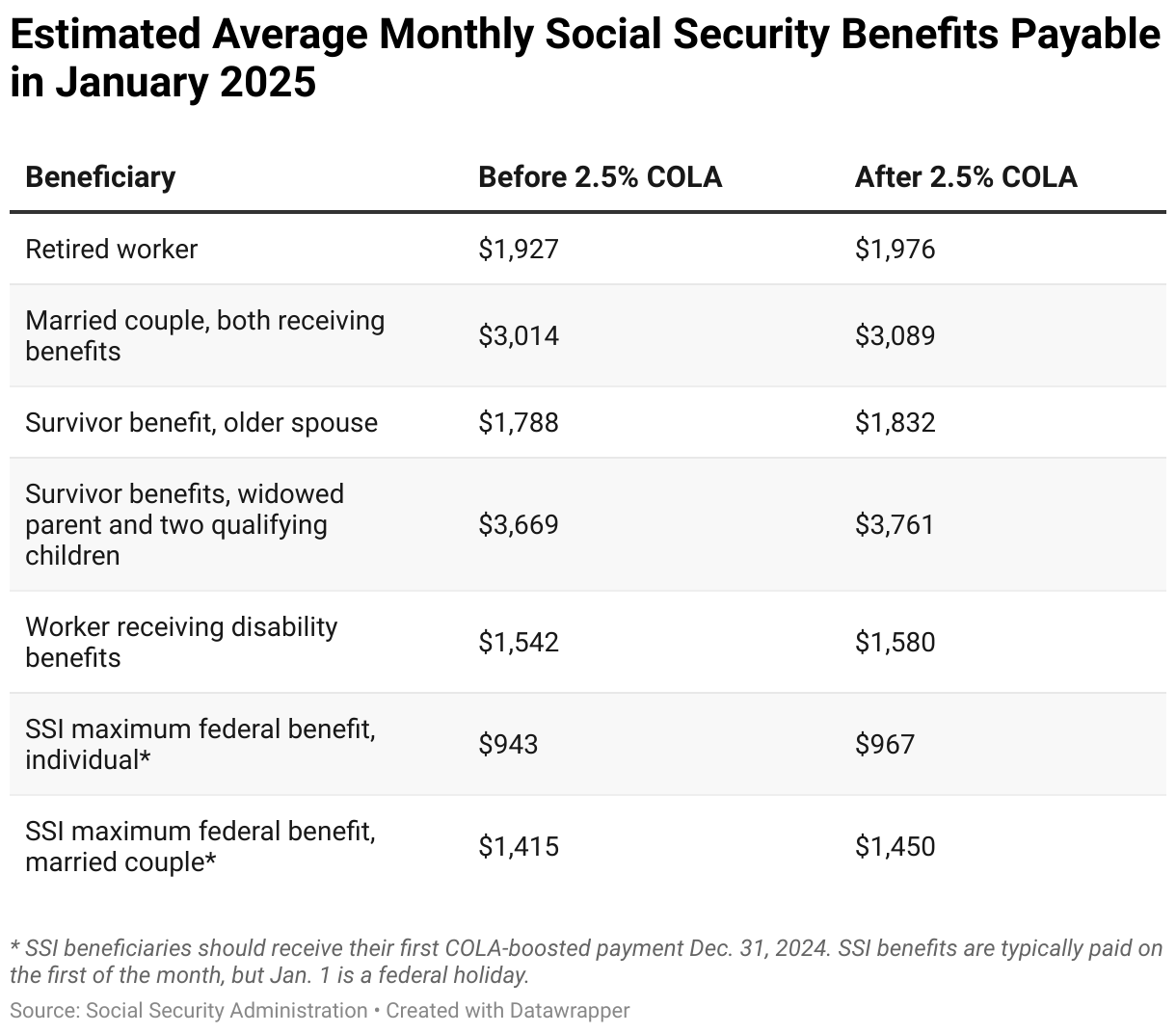
The COLA is applied to all Social Security payments — survivor benefits, family benefits and disability benefits, as well as retirement benefits — and to Supplemental Security Income (SSI), a monthly benefit administered by the SSA for people with low incomes and limited assets who are 65 or older, blind or have a disability.
2. Medicare premiums
The standard monthly premium for Medicare Part B, which covers doctor visits and other outpatient treatment, goes up from $174.70 to $185 in January. Most Medicare enrollees pay this standard rate, typically as a deduction from their Social Security payments, so the premium increase has the effect of partially offsetting the COLA, by $10.30 a month.
3. Government pensions
In December 2024, Congress repealed the Windfall Elimination Provision (WEP) and the Government Pension Offset (GPO), ending policies that for more than four decades reduced benefits for many people who qualified for both Social Security and a pension from a “non-covered” job where they did not pay into Social Security via FICA withholding from their paychecks.
The two provisions affected about 3 million beneficiaries. Most are former employees of state and local government agencies that do not participate in the Social Security system, including many teachers, police officers and firefighters.
Under the WEP, enacted in 1983, people who collected a non-covered pension and also Social Security retirement benefits (based on having other jobs where they did pay FICA taxes) could see their benefit reduced by up to one-half of the pension amount. The GPO, enacted in 1977, applied to those drawing such a pension and Social Security spouse benefits or survivor benefits and cut those payments by up to two-thirds of the pension amount.
The repeal law, called the Social Security Fairness Act, is retroactive to cover 2024 benefit payments. The SSA says it has adjusted monthly benefits amounts for those previously covered by the WEP and the GPO and made lump-sum repayments for last year’s withholding. Check the agency’s Social Security Fairness Act page for more information.
4. Service at Social Security offices
Since April 2022, when local Social Security offices reopened after two years of pandemic restrictions, the SSA has been recommending customers seeking in-person help call ahead rather than dropping in. In 2025, that recommendation becomes a requirement in most situations.
As of Jan. 6, “we will require customers to schedule an appointment for service in our field offices, including requests for Social Security cards,” Dawn Bystry, SSA associate commissioner in the Office of Strategic and Digital Communications, wrote in a Nov. 13 message emailed to advocacy groups and posted on the agency’s website.
The aim is to “reduce wait times, streamline service delivery and improve the overall customer experience” at its 1,200-plus field offices, Bystry said, adding that several hundred offices have already made the transition and “seen significant improvements in wait times.”
To schedule an office visit, call the SSA’s national help line at 800-772-1213 or contact your local office. You can also access many SSA services online, if you have a My Social Security account, or by phone.
The appointment edict is not absolute. Bystry said offices “will not turn people away for service who are unable to make an appointment or do not want to make an appointment. For example, members of vulnerable populations, military personnel, people with terminal illnesses and individuals with other situations requiring immediate or specialized attention may still walk in for service at our field offices.”
5. Full retirement age
Full retirement age, or FRA, is the age at which you become eligible to claim 100 percent of the retirement benefit calculated from your lifetime earnings. For the past several years it has been going up two months at a time, based on year of birth.
FRA is 66 years and 8 months for people born in 1958 and 66 and 10 months for those born in 1959; people born May 2, 1958, through Feb. 28, 1959, will reach it in 2025. (Under current law, it will settle at 67 for people born in 1960 and afterward.)
You can start collecting retirement benefits before FRA — the minimum age is 62 — but your monthly payment will be permanently reduced, by as much as 30 percent. You can also wait past FRA and reap Social Security's bonus for delaying benefits: an extra 8 percent a year until age 70, when you can claim your maximum benefit.

6. Social Security taxes
Social Security is primarily funded by a 12.4 percent tax on most workers’ earnings. If you earn wages, you pay 6.2 percent (through FICA withholding from your paycheck) and your employer pays 6.2 percent. Self-employed people pay both shares as part of their annual tax return.
The rate has not changed since 1990, but the amount of income subject to it is adjusted annually to reflect national wage trends. In 2025, you’ll pay the tax on work income up to $176,100 (up from $168,600 in 2024). Earnings above that threshold are not taxed for the purpose of funding Social Security, nor is any income from investments.
7. Social Security earnings test
Social Security applies an earnings test to beneficiaries who have not yet reached full retirement age. People who collect retirement, survivor or family benefits before reaching that milestone and continue to work may temporarily lose a share of their Social Security benefits if their earnings exceed a certain level.
That threshold changes annually, tracking wage trends. In 2025, beneficiaries who will not reach FRA until a later year have $1 withheld from their Social Security payment for every $2 in work income above $23,400 (up from $22,320 in 2024). For example, if you earn $40,000 from work in 2025, your benefits for the year would be reduced by $8,300 — half the difference between $23,400 and $40,000.
The earnings test eases in the year you reach FRA: Social Security holds back $1 in benefits for every $3 in earnings above $62,160 (up from $59,520 in 2024) until the month when you hit the milestone. At that point, the test goes away: There’s no longer any benefit deduction, no matter how much you earn, and the SSA adjusts your monthly payment upward so that, over time, you recoup the prior withholding.
There are different income rules for people receiving Social Security Disability Insurance (SSDI). Because disability benefits are intended for people who are largely unable to work for an extended period due to a serious medical condition, you can lose them if your earnings reflect what the SSA calls “substantial gainful activity.”
In 2025, that threshold is $1,620 a month for most SSDI beneficiaries, a $70 increase from 2024. People receiving SSDI on the basis of blindness are subject to a higher income limit: $2,700 a month in 2025, $110 more than in 2024.
8. Qualifying for benefits
The first step in qualifying for Social Security retirement benefits is having at least 40 Social Security credits. You earn credits, or “quarters of coverage” in SSA parlance, by doing work in which you pay Social Security taxes on your income. You can earn up to four credits a year, so most workers reach the eligibility threshold after 10 years in the labor force.
In 2025, you earn one credit for earnings of $1,810 ($80 more than the 2024 level), so you bank your maximum of four credits when your work income for the year reaches $7,240.

AARP Membership
Join AARP for only $15 per year with automatic renewal. Get instant access to members-only products and hundreds of benefits, a free second membership, and a subscription to AARP The Magazine.
More From AARP
Why I Regret Taking Social Security Early
Claiming benefits at the minimum age can shore up cash flow but comes with a cost
Social Security Funds Face 2035 Shortfall
Benefits would be cut by 17% without action by Congress
8 Social Security Services Beyond Benefits
Surprising, useful services beyond monthly checks