
AARP Hearing Center











































MTV at 45: The Moments That Raised Gen X
A look back at how MTV turned music videos, live performances and breaking news into events we watched together

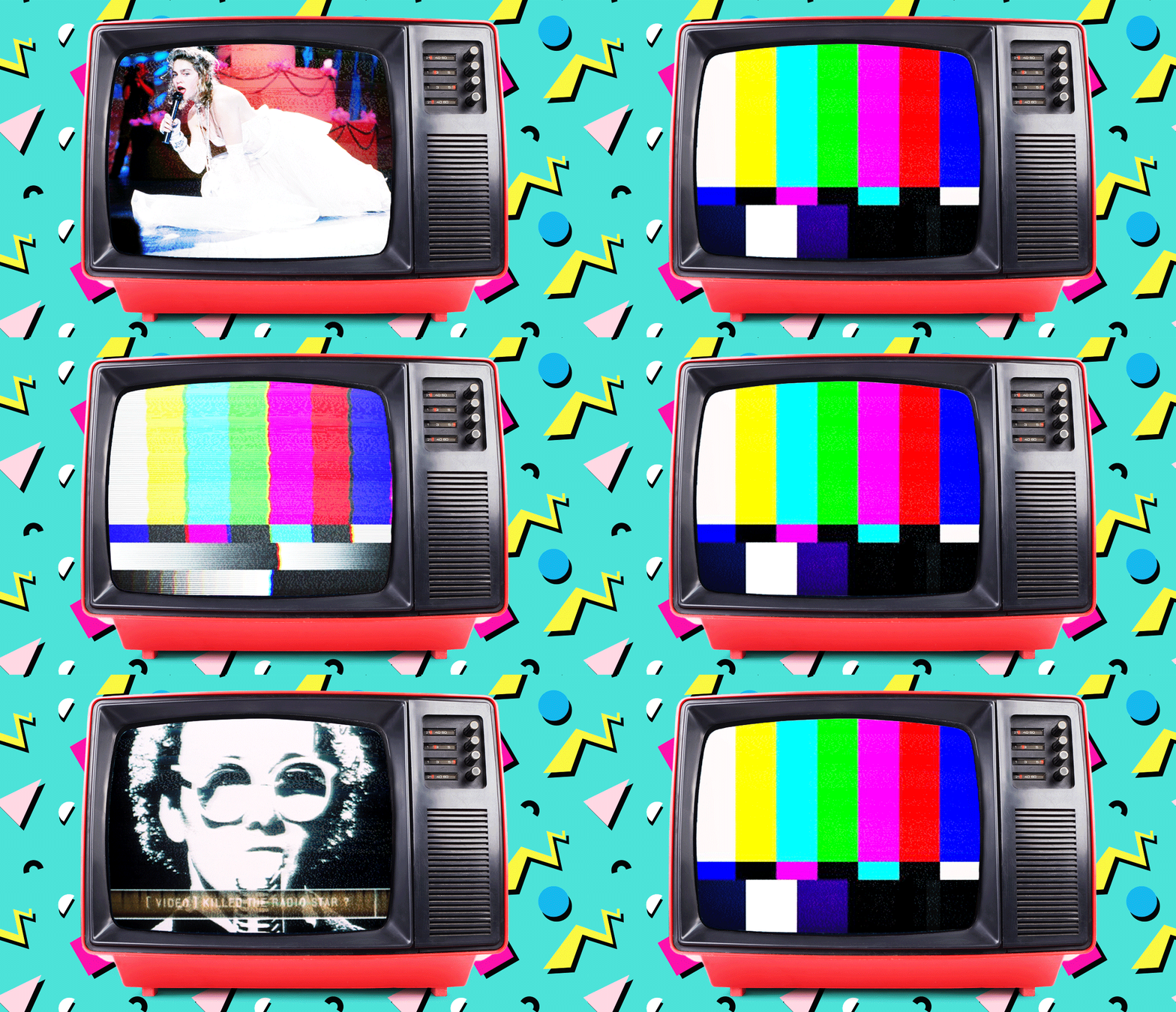
The Buggles launched MTV. Michael Jackson reinvented it. Madonna shocked it. Beavis and Butt-Head mocked it. Together, they tell the story of a channel that changed how Gen X watched, heard and talked about music.
AARP (Shutterstock, Getty Images, MTV/Courtesy Everett Collection, Courtesy Everett Collection, MTV/Courtesy Everett Collection, Courtesy Everett Collection)
MTV turns 45 on August 1, which means it’s technically old enough to get a colonoscopy. I discovered the network in the early ’80s and reorganized my life around it with the solemnity most people reserve for a new religion or a court order. MTV swallowed whole afternoons. My father couldn’t understand it. “How do you just sit there and watch the same videos over and over again?” he demanded. He had a point; MTV played Yes’ “Owner of a Lonely Heart” so often that I can still storyboard the video from memory.

VIDEO: Original MTV VJs React to '80s Music Videos
AARP Studios
VJs stitched the videos together with concerts, news, comedy and interviews, and the next four minutes could introduce you to a band, a haircut or an entirely new species of person. I was a kid alone in a suburban house after school, but MTV made that solitude feel communal. It was our shared campfire in a world before Wi-Fi.
More Ways to Benefit
- Related Benefit 1
- Related Benefit 2
- Related Benefit 3
- Related Benefit 4
- Related Benefit 5
MTV cofounder Tom Freston told AARP he felt the channel’s influence almost immediately. “I would travel to places like Tulsa, Oklahoma, and find out that people were going into barbershops asking for haircuts like the guys in Duran Duran or A Flock of Seagulls,” he said. This was in 1981, before MTV was even available in New York or Los Angeles.
Rumors of MTV’s demise spread earlier this year, after several music-only channels closed overseas. MTV remains on the air in the U.S., though its endless-video era is gone. Anyone missing that version can find it at MTV Rewind, a streaming website where more than 113,000 videos play around the clock, interrupted only by vintage commercials for Blockbuster, Mentos and Gak. Somehow, advertising has never felt so comforting.
For those who still remember when MTV could hijack an afternoon, here are the moments that made Gen X stop and watch.
1. MTV signs on with “Video Killed the Radio Star”
At 12:01 a.m. on August 1, 1981, MTV cocreator John Lack introduced the new channel with: “Ladies and gentlemen, rock ’n’ roll.”
“All of us on the early team were crusaders. Deep believers,” Freston said. Convincing advertisers, cable operators, artists and record companies took more work. “Everyone always said, ‘Who’s gonna watch music on television?’”
Then MTV played The Buggles’ “Video Killed the Radio Star.” The choice now feels suspiciously prophetic. A song about new technology replacing an older medium opened a channel that changed how musicians dressed, performed and became famous.
2. “Thriller” turns a music-video premiere into appointment television
By late 1983, Michael Jackson had forced MTV to confront its early preference for white rock acts, which limited airtime for Black artists. The debate “came to a head with the popularity of Michael Jackson,” whose videos became too popular to ignore, says Amanda Ann Klein, an East Carolina University film professor and author of Millennials Killed the Video Star.
Then came “Thriller.” The John Landis–directed video premiered on December 2, 1983, and ran nearly 14 minutes. Jackson transformed into a werewolf, led a zombie uprising and turned a promotional clip into a miniature Hollywood production, leading to a video that demanded your full attention and, preferably, a roomful of people willing to attempt the choreography afterward.
3. Madonna performs “Like a Virgin” at the first VMAs
During the first MTV Video Music Awards on September 14, 1984, Madonna emerged from a towering wedding cake in a bridal gown, bustier and “Boy Toy” belt and rewrote the rules before MTV had finished inventing them.
Her original idea involved a live Bengal tiger, but MTV declined. The version that aired became even less controllable when one of her stilettos slipped off as she descended the cake. Madonna later said she dropped to the floor to retrieve it and pretended the move was intentional. Her dress rode up, the cameras stayed close, and the performance turned into a writhing send-up of wedding-night innocence.
4. Live Aid turns MTV into the world’s living room
On July 13, 1985, Live Aid connected Wembley Stadium in London with JFK Stadium in Philadelphia. MTV carried 17 hours of coverage to an enormous U.S. audience. Freston said the concert “really upped our visibility and credibility.”

Martha Quinn and Alan Hunter report from Live Aid in Philadelphia in 1985, a day when MTV carried one of the biggest concerts in history into homes across the country.
MTV/Courtesy Everett Collection
U2 devoted roughly 12 minutes to “Bad” after Bono left the stage to dance with a fan, forcing the band to drop “Pride (In the Name of Love)” from its set. U2 feared it had blown the opportunity, but viewers disagreed.
Queen understood the assignment. The band rehearsed and timed its condensed parade of hits, while Freddie Mercury made 72,000 people sound like his backup singers.
5. 120 Minutes gives alternative kids a secret clubhouse
By 1986, MTV was dividing its video stream into scheduled territories. For alternative kids, the most important address was 120 Minutes, where Kate Bush, R.E.M., Sonic Youth, The Smiths and other bands ignored by mainstream radio suddenly reached living rooms across America.
Dave Kendall, who created the show and hosted it from the late 1980s to 1992, described it as a distribution channel for music largely ignored by commercial radio. In 1991, the program premiered Nirvana’s “Smells Like Teen Spirit,” which soon escaped its late-night clubhouse and took over MTV.
Kendall passed away earlier this month at 63. Fellow host Matt Pinfield wrote, “He didn’t just host a show. He gave a home to music that deserved to be heard.”
6. Yo! MTV Raps brings hip-hop culture into millions of homes

Andre “Dr. Dre” Brown, left, and Ed Lover on the set of “Yo! MTV Raps,” which introduced countless viewers to hip-hop artists, videos and culture rarely seen on mainstream television.
MTV/Courtesy Everett Collection
MTV arrived late to hip-hop, but once it did, it got on board in a big way. Freston remembered Yo! MTV Raps carrying hip-hop “into the living rooms of middle-American homes.” From there, it would travel far beyond American suburbs
RUN DMC hosted the 1988 pilot. Fab 5 Freddy took over the weekly series, followed by Dr. Dre and Ed Lover’s looser daily version.
Chuck D reportedly described the show as “the Black CNN,” and it soon evolved into an international phenomenon. Fans in countries without MTV traded taped episodes. Fab 5 Freddy once met a Russian woman whose relatives mailed her VHS recordings from Europe so her neighborhood could watch together.
“Yo! MTV Raps was a snapshot in time,” Dr. Dre told Vulture in 2018. “It happened when it was most needed.”
7. The Real World launches MTV’s second life
When The Real World premiered in 1992, MTV put seven strangers in a New York loft, surrounded them with cameras and waited for the arguments to begin.

The creators imagined a social experiment involving race, gender, sexuality and class. MTV also had a practical motive. “The main reason MTV turned to reality TV was because it was cheap,” Klein says. Real people required no writers, professional actors, sets or costumes.
The Real World turned ordinary young adults into characters whom viewers judged and argued about. Reality television gave MTV a second life and soon began crowding music videos out of the schedule.
8. Beavis and Butt-Head turns watching MTV into a show
On March 8, 1993, two slack-jawed teenage metalheads took over MTV. Beavis and Butt-Head had first appeared in Mike Judge’s cartoon short Frog Baseball on Liquid Television, the network’s strange animation showcase, in 1992.

“Beavis and Butt-Head” first started turning heads in 1993. Soon after, their running commentary on music videos transformed the dim-witted couch potatoes into two of MTV’s biggest stars.
Yvonne Hemsey/Getty Images
The new series added a perfect wrinkle. Beavis and Butt-Head watched the same videos we did, then mocked the clothes, music and pretensions with snickers and insults. Judge improvised much of their commentary, occasionally letting a genuine critical insight slip through.
The show also inspired a national panic. After an Ohio mother blamed Beavis’ obsession with fire when her 5-year-old son started a blaze that killed his 2-year-old sister, MTV moved the series past 10:30 p.m. and removed arson references from earlier episodes. But by then, the idiots had become cultural authorities.
9. Kurt Loder reports Kurt Cobain’s death
On April 8, 1994, Kurt Loder soberly appeared on MTV and told viewers that Kurt Cobain was dead. For countless Gen Xers, the news came from the same channel that had introduced them to Nirvana.
By then, MTV News had spent years earning that trust. Klein says The Week in Rock gradually moved beyond concerts and album releases to cover “the social, political, and historical issues tied to pop music, and to youth audiences in general.”
Loder spoke directly to young viewers as MTV cleared its schedule for reports, interviews, tributes and reactions. The channel had helped turn Cobain into the reluctant voice of a generation. That afternoon, it became the place where that generation mourned him together.
10. Total Request Live gives MTV one last after-school ritual
When Total Request Live debuted on September 14, 1998, Carson Daly stood inside MTV’s glass-walled Times Square studio and counted down the top 10 videos selected by viewers. Soon, teenagers were packing the sidewalks, boy bands shut down Times Square, and Daly became the Dick Clark of the frosted-tips era.

Carson Daly, left, with Tom Cruise on the set of “TRL,” the after-school countdown that mixed fan voting, celebrity appearances and crowds packed outside MTV’s Times Square studio.
Scott Gries/ImageDirect/Getty Images
TRL made pop music feel like a competitive sport. Backstreet Boys and *NSYNC fans fought for the top spot, while the live format produced delightful nonsense. Eminem needled Mark Wahlberg, Mariah Carey arrived pushing an ice cream cart, and Fred Durst blew up a boat because apparently the millennium required a ceremonial sacrifice.
But beneath the chaos was something MTV had been building toward for years. The audience was no longer just watching; it was helping decide what happened next. Klein says the show allowed fans to become “a physical part of the entertainment they consumed.” They voted by phone and online, crowded outside the studio and maneuvered for a few seconds on camera. TRL was both MTV’s final great communal ritual and a preview of the internet culture that would replace it.
By the time TRL ended in 2008, YouTube had made waiting for a video seem absurd. “With MTV, since we played a wide variety of different types of music, you could bump into something you didn’t know about,” Freston says. “You discovered something you were not looking for.”

AARP Membership
Join AARP for only $15 per year with automatic renewal. Get instant access to members-only products and hundreds of benefits, a free second membership, and a subscription to AARP The Magazine.
You Might Also Like
How Your Favorite TV Shows Shaped Your Identity
The television you loved as a kid was a blueprint for your adulthood
The Ultimate Gen X Summer Playlist
50 songs that bring back the hot car seats, public pool chlorine and late-August ache
The 100 Films That Define Generation X
These movie classics formed us as much as they entertained us