





















































Javascript is not enabled.

Javascript must be enabled to use this site. Please enable Javascript in your browser and try again.

Skip to content
Content starts here
CLOSE ×
Search
CLOSE ×
Search
Leaving AARP.org Website

You are now leaving AARP.org and going to a website that is not operated by AARP. A different privacy policy and terms of service will apply.

In Defense of the Miserable, Magical American Road Trip

Wrong turns, back-seat wars and gas station beef jerky built stronger families than any resort ever did. Here’s how to do it right

an illustration of a family inside a car
Once upon a time, families got closer by getting lost together in a station wagon with gas station snacks, no Wi-Fi, and the shared delusion that Dad knew where he was going.
Ryan Johnson

My father’s Rand McNally atlas lived in our family station wagon, the way a first-aid kit does — something you hoped you wouldn’t need, but there it was. It was held together with electrical tape and stubbornness, and every summer it emerged from under the seat, already dog-eared, its margins scrawled with my father’s handwritten notes from previous outings.

During road trips, he’d spread it across the steering wheel like a general studying a battlefield, squinting at the page while the car drifted toward the shoulder, and my mother would say his name in the tone she reserved for moments when she felt our mortality was being unnecessarily tested. 

This was the early 1980s. I was around 11, my brother was 9, and we were somewhere in the long, flat middle of a drive from Michigan to New York to visit our grandparents in Rochester. We were cutting through Canada and stopping, we’d been promised, at Niagara Falls.

a vintage photo of a boy in the backseat of a car
The author in the backseat of his parents’ car in the 1970s, learning that boredom wasn’t the enemy. It was the portal.
Courtesy Eric Spitznagel

Meanwhile, from the front passenger seat, my mother was running her own operation. She’d packed a cooler with peanut butter and jelly sandwiches and was distributing them with cheerful authority. My brother and I received them the way vampires receive direct sunlight. We’d passed no fewer than a dozen McDonald’s in the last hour. A Big Mac was not a luxury, it was a constitutional right.

“We can either get enough gas to make it to Niagara Falls,” my mother said in a voice that suggested this was a perfectly reasonable thing to say to children, “or you can have your precious Big Macs. You really want to ruin the trip for that poison?”

My brother and I accepted our sandwiches under protest and retreated to our halves of the back seat, the border between us sacred. I stared out the window. The Canadian countryside rolled by. My father smacked the atlas again.

It was miserable. But it was also perfect. Somewhere in the accumulated torture of those hours — the invisible border disputes, the thwarted hamburgers, the atlas losing every argument and somehow still being wrong — something was being built. I just didn’t know it yet.

Why America is hitting the road again

The American road trip has never really gone away, but the data suggests something interesting is happening right now.

According to a 2025 Harris Poll conducted for Marriott Bonvoy, 91 percent of Americans planned to travel in 2026, with 49 percent expecting to travel more than they did the previous year. Domestic road trips tied for the most popular trip type, at 44 percent, and the reasons people gave for wanting to travel cut against every assumption about what modern leisure is supposed to look like: 55 percent named quality time with loved ones as the primary goal.

an illustration of a car transforming into a newer model
The road trip changes shape, but the spell is the same: a family moving through America together, trapped just long enough to become a story.
Ryan Johnson

In an era of algorithmic entertainment and infinite scroll, what a lot of Americans apparently want most is to get in a car and drive somewhere with the people they love.

By the time my future wife, Kelly, and I started dating in the mid-1990s, the road trip had shed its family associations and become something else entirely. A dare, a romance, a loose theory about who we were and how far we could go before we had to turn around. We drove from Chicago to California and back, taking the northern route out and the southern route home, with no real itinerary beyond a belief that things would work out.

They mostly did, with interesting exceptions. We slept in a log cabin outside Yellowstone and woke up to a moose standing in the parking lot, regarding our car with an expression of pure philosophical contempt. We got chased out of a highway rest stop in Texas by bats — actual bats, pouring out of the eaves at dusk while we sprinted back to the car, laughing in a way that only works when you’re young and nothing has actually hurt you yet. We stopped at a casino in Nevada that turned out, on closer inspection, to also be a brothel, and we played the slots for an hour without discussing this fact out loud.

“The beauty of the road trip is that it’s an expression of individuality,” says Jim Hinckley, author of more than 20 travel books, including The Route 66 Encyclopedia. “If you overplan, you lose the spontaneity that fills road trips with surprises. And if a person simply takes to the road with no plan other than heading west, they may end up sleeping in the car a night or two, or eating cold beans from a can along the highway.”

Somewhere in all of that, my wife and I made a promise to each other: When we had a kid someday, we’d raise them on the road. We’d be like the Scooby-Doo gang: always moving, solving whatever mysteries the next town had to offer, living out of the Mystery Machine. It was the kind of vow that sounds ridiculous and feels serious, which is maybe the best kind.

We had Charlie, and before he turned 6 he’d seen Graceland, Times Square and the Hollywood Sign. He stood at the base of Mount Rushmore and pronounced it “really big,” which is both accurate and genuinely moving. For a while, the three of us on a highway felt like the best version of our family: loose, improvisational and happiest when we didn’t quite know what was coming next.

Then Charlie became a teenager and discovered that his smartphone contained everything he could possibly want, and that cars were primarily useful for getting to a friend’s house. The (metaphorical) Mystery Machine sat in the garage.

This past spring break, I decided we were doing a road trip, old-school, just the three of us. Chicago to Nashville, nine hours each way, radio on, phones locked in our suitcases. Charlie received this news the way political prisoners receive their sentences, with a stunned disbelief that hardens into resignation. He used the word “egregious.” I told him to think of it like an escape room: We just had to figure out how to survive each other, and eventually a door would open. He did not find this comforting. We left on a Tuesday morning anyway.

Three people, one car, no escape

The first few hours out of Chicago were a disaster.

Charlie sat in the back seat radiating the energy of someone who’d been wrongfully imprisoned. Kelly and I made conversation in the front seat with the forced cheerfulness of hostage negotiators trying to establish a rapport. Nobody was having fun. The highway unspooled ahead of us, flat, gray and indifferent, and somewhere around hour two I started to wonder if we’d made a terrible mistake.

Then, out of desperation, someone started flipping through the radio. The rule emerged organically, the way the best road trip rules do: first person to identify the song gets a point. Within 20 minutes, Charlie was lunging forward from the back seat, shouting the name of a Nirvana song before the first chord had fully resolved, and Kelly was disputing the call with the intensity of someone who had money on the outcome. 

Somewhere in Tennessee, the first real negotiation arose. Charlie needed a bathroom. Kelly had spotted a scenic overlook on the map and wanted to stop. I was the tiebreaker, which is a position of great power and significant domestic risk. My ruling: We’d visit the scenic overlook, and Charlie would handle his business off the side of it, in the traditional roadside manner. He stood at the railing, looked out over the Tennessee hills, and took care of things with the satisfied air of a man who’d gotten exactly what he wanted, which, technically, he had.

For lunch, we passed a Wendy’s, a McDonald’s, a Hardee’s, and a place that claimed to be a Subway. We kept driving. Somewhere in Kentucky we stopped at a you-pick blueberry farm and spent an hour in the rows filling containers we didn’t have room for, leaving with far more blueberries than three people could eat and an apron that read “Kissin’ don’t last, cookin’ do.” Eventually we found a barbecue place run by a family who looked like they’d appeared on at least one true-crime podcast, and ate at a picnic table while feeding blueberries to a dog of uncertain breed. It was the best meal of the trip.

The motel we checked into that night had a pool, which was the whole reason I’d booked it. The pool was filled with water, but also closed for the season. There was a sign. There was also a latch that responded well to a certain kind of patient optimism, and the three of us were in the water 20 minutes later, in the dark, trying not to make too much noise.

Charlie complained about the temperature. Then he laughed at something Kelly said, a real laugh, unguarded and unperformed, the kind I hadn’t heard from him in longer than I wanted to admit. It was the laugh of a kid who had briefly forgotten that he was supposed to be somewhere else.  

That was the moment I knew the trip was working.

What the road requires

Every road trip has its own personality, but the best ones share some nonnegotiable ingredients. Consider this a packing list for anyone who wants to do it right.

Someone must be confidently wrong about the route

This is foundational, and it is almost always the driver. Pre-GPS, every family road trip required one self-appointed Magellan who treated wrong turns as a form of leadership rather than evidence against his theory. The atlas is less a reference tool than an opponent. My father could miss exits in two states and still feel that the situation was under control.

There must be a back-seat battle

A full constitutional crisis, triggered by leg space, window rights, disputed armrest territory and someone breathing at a suspicious volume. The invisible border drawn down the center of the seat carries more moral weight than most international treaties and is enforced with comparable aggression.

The car must contain food that only exists off the highway

Warm sodas sweating through a gas-station bag. Beef jerky with the structural integrity of roofing material. A candy bar with a name you’ve never heard of. Road trip cuisine exists in its own category. The whole point is that you are not eating well, you are eating memorably.

There must be a restroom emergency

The child who waited too long. The driver who said they’d “just hold it” at the last exit and now deeply regrets it. After eating that weird candy bar, the frantic negotiation over whether the next town has a gas station or just a historical marker and a broken dream. Nothing exposes the family democracy quite like a potential catastrophe.

an illustration of people posing near a dinosaur statue
A proper road trip requires at least one stop nobody planned, nobody understands and everybody remembers forever.
Ryan Johnson

A roadside attraction nobody would visit on purpose

A dinosaur park where the brontosauruses are made of painted concrete and the gift shop smells like mildew. A museum devoted entirely to barbed wire, or mustard, or dolls that people have donated because they might be haunted. A giant fiberglass pecan in front of a gas station with no explanation offered or requested. You did not plan to stop here. You will never forget that you did.

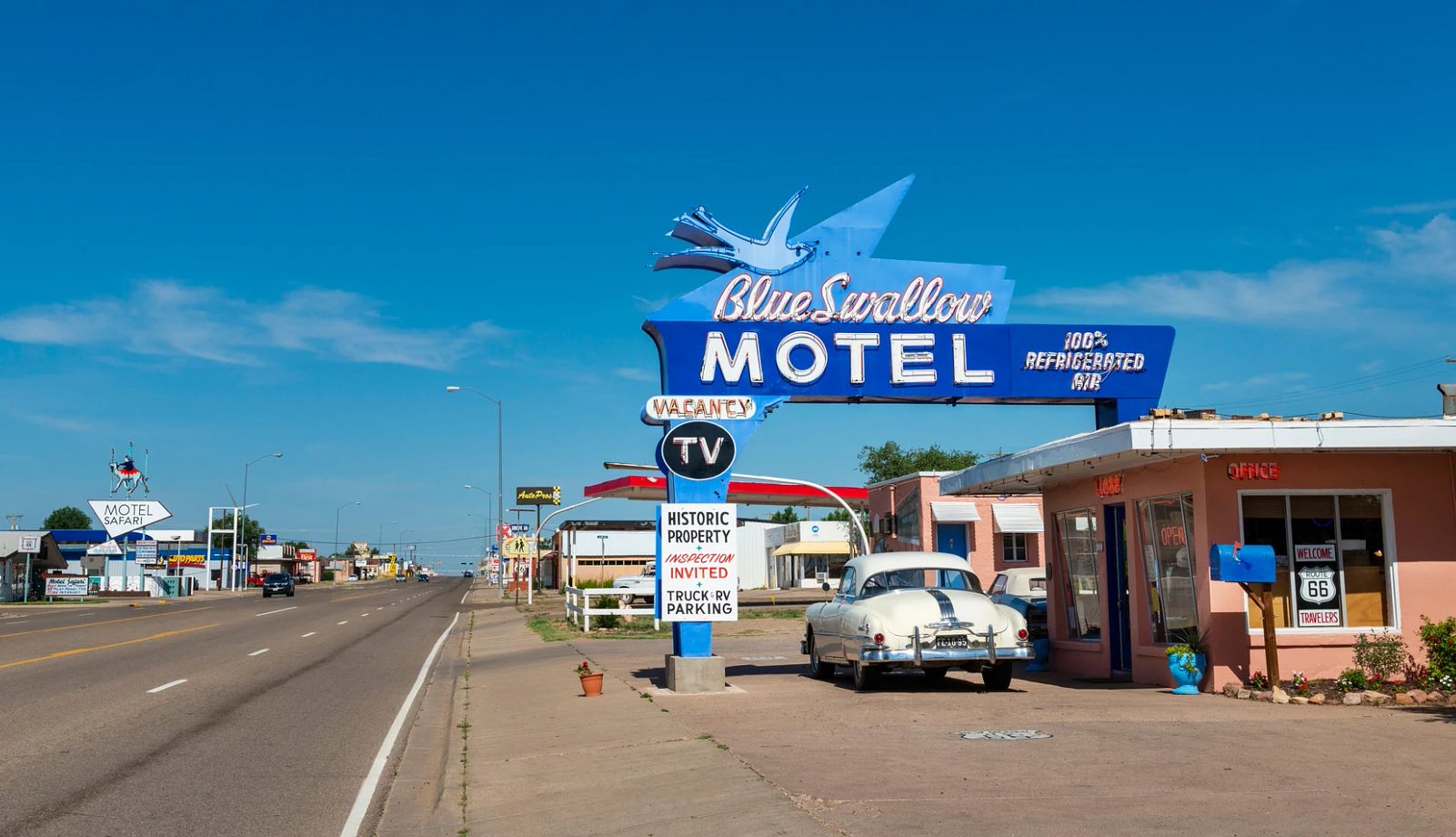
The motel must be a little sad and a little magical

The ice machine clatters all night. The carpet smells of chlorine so intensely that you briefly wonder if you’re being sedated. The bedspread features a pattern that could generously be described as regional. And out back, barely lit, surrounded by a chain-link fence, is the pool. When you are 10 years old and have been in a car for eight hours, that pool is the most beautiful thing you have ever seen in your life.

The soundtrack must be contested

AM static bleeding in and out over flat country. Dad’s country station that nobody else voted for. A cassette played so many times it begins to warp at the bridges. Someone singing along badly. Someone else requesting — with increasing desperation — silence. In the modern version, your teenager solves this problem by disappearing into earbuds and staring at a screen, which technically ends the argument yet somehow makes everything worse.

There should be a weather event

A thunderstorm that turns a stretch of Ohio interstate into something cinematic. A desert so hot the air shimmers, and everyone in the car goes quiet. Fog rolling in off a mountain so gigantic it makes the driver slow down and the passengers sit up straight. Weather has a way of making a drive feel like something is actually happening, which is what a good road trip requires.

A local meal must reroute the day

A barbecue joint in Texas with a handwritten menu and a line out the door at 11 in the morning. A catfish shack in Mississippi that appears to have been there since before the road. A diner outside Toledo where the pie is so unexpectedly good that it changes the entire mood of the afternoon. Pre-internet travel ran on a beautiful and reliable system. If a place looks busy, pull over. The crowd was the review.

Someone must insist the destination is close when it absolutely is not

“We’re almost there” is one of the foundational lies of the American road trip, deployed with total sincerity by someone who has not actually looked at the map in 45 minutes. It is always wrong. It is said anyway. It functions less as information and more as a morale operation, which would be fine if morale weren’t immediately destroyed when the next sign says 214 miles.

The mechanical scare that unites everyone in quiet reverence

A temperature gauge climbing toward a color that seems bad. A noise from the rear wheel that everyone pretends not to hear. A station wagon that begins to smell, in my father’s precise and memorable diagnosis, “kind of hot.” For a few minutes, everyone in the car is of the same religion, praying to the same god, specifically the god of not breaking down in rural Pennsylvania.

The trip must produce a family legend

The missed exit that added three hours and somehow became the best part. The shortcut through whatever that was. The night that went sideways in a manner that was terrifying at the time and is now told every Thanksgiving with increasing embellishment.

The boredom that mutates into rapt attention

This is the rule that phones have broken, and it matters more than the others. Pre-screen road trips forced you to stare out the window until your brain started actually noticing things. Barns. Storm clouds. State-line signs. A church in the middle of a field with a marquee that reads something either profound or deeply strange. A water tower built like a peach. Boredom was the whole mechanism, the thing that cracked you open wide enough to actually see where you were.

There is a corollary to this rule, ancient and inviolable. When a father spots cows in a field, he is required by law to announce it. Just “cows,” delivered with the gravity of a man reporting something the car needs to know. Everyone nods. The cows remain indifferent.

The destination should matter less than the drift

The American road trip was the last family vacation built around inconvenience as a feature rather than a flaw. The wrong turns, the bad food, the contested back seat, the rattling motel, the boredom that eventually became something else entirely — none of that was the obstacle between you and the trip. It was the trip. The destination was just the reason you got in the car.

Unlock Access to AARP Members Edition

Join AARP to Continue

Already a Member?

AARP Travel Center

Or Call: 1-800-675-4318

Enter a valid departing date

Enter a valid returning date

Age of children:

Child under 2 must either sit in laps or in seats:

Enter a valid departing date

Age of children:

Child under 2 must either sit in laps or in seats:

Enter a valid departing date

Age of children:

Child under 2 must either sit in laps or in seats:

Flight 2

Enter a valid departing date

Flight 3

Enter a valid departing date

Flight 4

Enter a valid departing date

Flight 5

Enter a valid departing date

+ Add Another Flight

Enter a valid checking in date

Enter a valid checking out date


Occupants of Room 1:


Occupants of Room 2:


Occupants of Room 3:


Occupants of Room 4:


Occupants of Room 5:


Occupants of Room 6:


Occupants of Room 7:


Occupants of Room 8:


Enter a valid departing date

Enter a valid returning date

Age of children:

Occupants of Room 1:

Age of children:


Occupants of Room 2:

Age of children:


Occupants of Room 3:

Age of children:


Occupants of Room 4:

Age of children:


Occupants of Room 5:

Age of children:

Age of children:

Child under 2 must either sit in laps or in seats:

Enter a valid start date

Please select a Pick Up Time from the list

Enter a valid drop off date

Please select Drop Off Time from the list

Select a valid to location

Select a month

Enter a valid from date

Enter a valid to date