
























































Javascript is not enabled.

Javascript must be enabled to use this site. Please enable Javascript in your browser and try again.

Skip to content
Content starts here
CLOSE ×
Search
CLOSE ×
Search
Leaving AARP.org Website

You are now leaving AARP.org and going to a website that is not operated by AARP. A different privacy policy and terms of service will apply.

This 10-Second Fit Test Could Predict How Long You Will Live

Researchers say this floor-to-stand test is a powerful predictor of longevity, assessing strength, balance, and flexibility in less than a minute.


instructional graphic showing a man sitting cross-legged on a yoga mat. Overlays highlight his hand on his knee and his foot position, demonstrating how to score the 10-second floor-to-stand test
Elena Lacey

Can you sit down on the floor and stand back up again without using your hands or getting on your knees for support? Your ability to do this simple-sounding but challenging movement reveals a surprising amount about your physical health and how long you’ll live, new research shows.

A June 2024 study published in the European Journal of Preventive Cardiology found that adults ages 46 to 75 with the highest scores on the sitting-rising test were about six times less likely to die from heart disease and other cardiovascular conditions during the next decade, and four times less likely to die from any cause compared to those who struggled the most with the movement.  

Dr. Claudio Gil Araújo, a sports medicine doctor and the study’s lead author, says the test is a particularly strong predictor of lifespan because it measures not just aerobic fitness, but also muscle power, strength, flexibility, balance and body composition — all in one move.

Together, those qualities are essential not only for autonomy and quality of life, he says, but also for avoiding falls, which can be serious and even deadly for older adults.

The takeaway, Araújo says, is that “if you are physically active, it’s good,” but when it comes to longevity, “you have to be good in all the components.”

He added, “Sometimes people run a good marathon time, but they are unable to lace their shoes.”

Dr. Anje'le Zhantil Alston, an internal medicine and sports medicine physician at Southern California Permanente Medical Group who was not involved in the research, typically assesses her patients using a sit-to-stand test, counting how many times they can rise from a chair in 30 seconds.

But she says Araújo’s results are compelling. 

“It does seem to be actually a better predictor of longevity than just the sit-to-stand,” she says. “If you can get off the floor, that’s more challenging. Now you’re testing more things. … In an ideal world, we would be doing this on every patient at least once a year, to see where they’re at.”
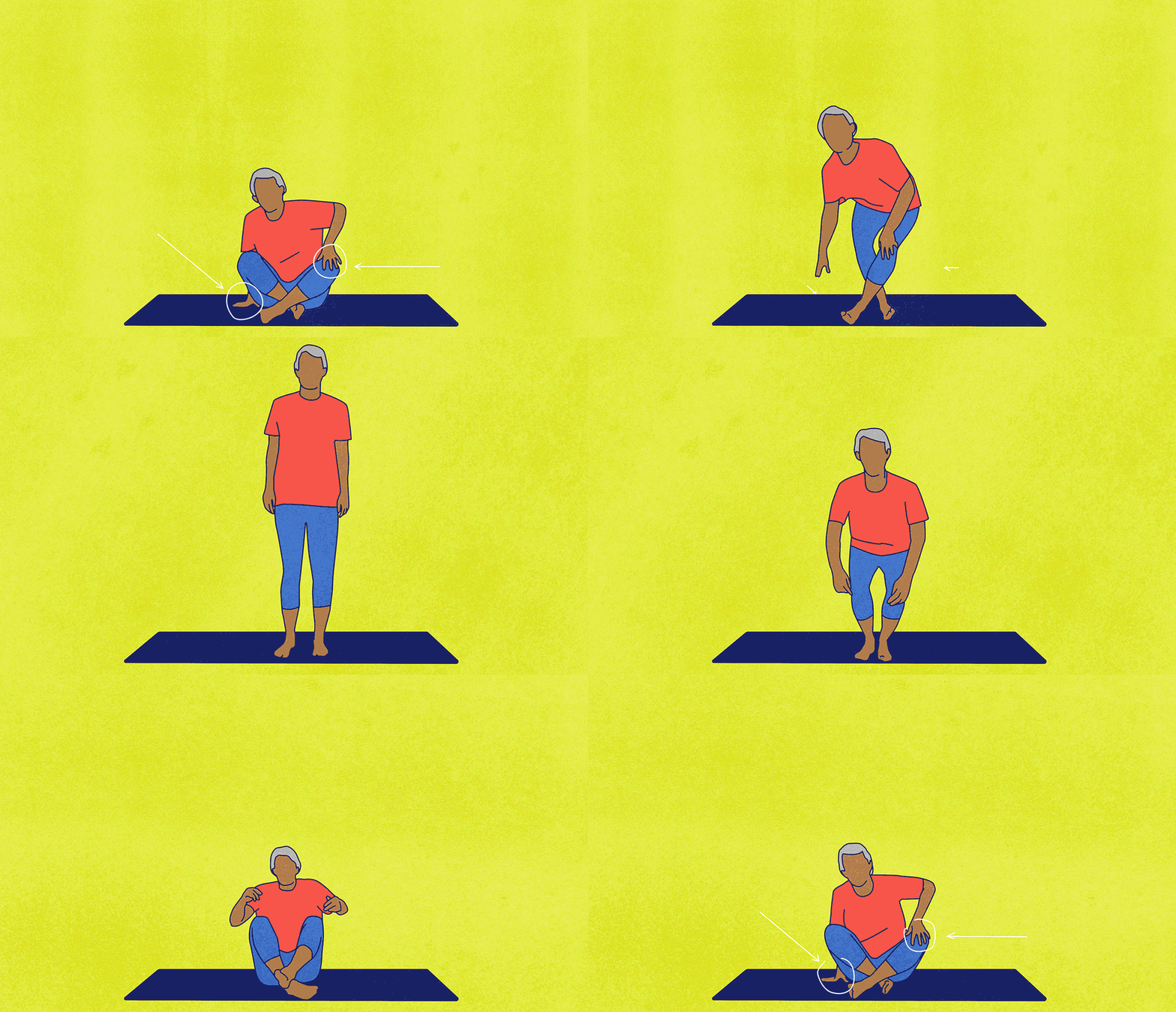
Illustration of a woman performing lunges on a yoga mat
Jon Krause


Couch-to-Fit Challenge

Help improve your strength, flexibility, and balance all while earning AARP Rewards points.

Sitting-rising test may not be for everyone

Araújo’s trial excluded those with serious mobility issues and severe joint pain, and that’s important to know, especially for older adults, says Dr. Karl B. Fields, a sports medicine physician at Cone Health in Greensboro, N.C., and a professor at the University of North Carolina at Chapel Hill.

Fields says people with severe hip or knee arthritis or a joint replacement might struggle to get down to the floor and back up safely. Indeed, his own artificial knee joint doesn’t offer the range of motion for him to sit flat on the floor.

“If you’re getting joint pain and struggling with really doing this because of some joint limitations, don’t push yourself,” he advises.

Instead, he recommends asking your doctor about other tests that can still offer insight into your longevity and functional fitness level, such as the 30-second balance test, the Timed Up & Go test, the six-minute walk test or the aforementioned sit-to-stand test. (See also: These 5 Tests Can Tell You How Well You’re Aging.)

“All of these tests have some good correlations that if you’re doing better, you have a better chance of living longer,” Fields says.  Because results can vary, clinicians often look at a combination of tests, he says.

That said, Fields says he appreciates the way the sitting-rising test incorporates balance, flexibility, strength and power into one assessment.

“It’s an impressive study,” he says. “If you can do it, boy, it’s a powerful predictor.”

How to perform the sitting-rising test

If you are ready to give the sitting-rising test a go, this video from Araújo’s Clinimex exercise clinic demonstrates how it’s done. Here are the basic steps:

  • Recruit a family member or friend to help with the test. They will watch you perform the movement, tally up your score and provide support if you get off balance.
  • Clear a space on a non-slippery, flat surface. If the floor isn’t carpeted, put down an exercise mat behind you in case you land hard while sitting.  You also might want to have a sturdy chair nearby in case you need support.
  • Remove your shoes and socks.
  • Without worrying about speed, cross your legs and slowly lower yourself to the floor. Try to use the least amount of support possible, such as putting your hands on the floor.
  • Then, rise from the floor, again using the minimum support you believe is needed.
  • Scoring: You earn a maximum 5 points each for sitting and standing, for a total score of 10. You get a perfect score if you complete both movements without using your hands, knees, elbows or any other support. One point is subtracted each time you use a body part for assistance — like putting a hand on your knee or your knee on the floor. An additional half-point is deducted for any unsteadiness.

5 ways to improve your score on the sitting-rising test

Data from Araújo’s clinic shows that scores on the sitting-rising test tend to decline with age, with fewer than 8 percent of adults ages 55 or older achieving a perfect score of 10.

Ideally, Araújo says, you should aim for a score greater than 8. If your score is below that, the good news is that you can improve it, he says.

He recommends trying to identify which component is hurting your score — whether it’s balance, flexibility, strength, power or body composition — and targeting it directly.

Your primary care doctor or medical specialist, a personal trainer or a physical therapist can also help pinpoint weaknesses and specific exercises.

Here are some ways to improve your performance:

1. Work on balance

If you can’t stand on one leg for 10 to 15 seconds, it’s a sign your balance needs work, says Araújo. The easiest fix? Practice. Try standing on one leg several times a day, maybe while brushing your teeth or waiting for your coffee to brew, Alston suggests. Once that’s easy, try doing it with your eyes closed. (AARP members try: The #1 Exercise for Balance)

2. Add resistance training

Federal guidelines recommends at least two strength training sessions a week using weights, resistance bands or your body weight. Have only a few minutes? Squatting– in the air, against the wall or from a chair – will build the lower body muscles you need for the sitting-rising test, Alston says. Glute bridges and heel lifts/calf raises will also strengthen key muscles used. (Read: The #1 Exercise to Do As You Age.)

3. Boost your muscle power

If you need more than one hand for support when rising from the floor, your muscular power may be lacking, Araújo says. Power is about how quickly you can move your body weight. “You can be very bulky but unable to climb a flight of stairs,” Araújo explains. To build power, he suggests doing fewer repetitions with heavier weights and focusing on moving through each rep as quickly and explosively as possible.

4. Improve flexibility

A lack of flexibility is a major reason many older adults struggle with sitting and rising, Araújo says. For a basic test of hip and knee flexiblity, he recommends seeing how low you can squat, keeping your heels flat on the ground. Ideally, your buttocks should be close to the floor below your knees. To improve your flexibility, prioritize regular stretching and incorporate activities like yoga, tai chi, Pilates and dance. (To get started with yoga, try Getting Started With Yoga for Fitness.)

5. Minimize chair time, and sit on the floor if you can

Sitting too much is tied to a shorter lifespan and a raft of health problems, including damaging your fitness and mobility levels. Aim to move more throughout the day, Alston suggests, and when you do sit, try sitting on the floor more often (with a cushion if needed). Getting down on the floor regularly can “help maintain natural hip range of motion,” Alston says – and it gives you real-world practice for the fundamental movement behind the sitting-rising test: getting up from the ground with ease.

Unlock Access to AARP Members Edition

Join AARP to Continue

Already a Member?

Red AARP membership card displayed at an angle

Get instant access to members-only products and hundreds of discounts, a free second membership, and a subscription to AARP the Magazine.