
AARP Hearing Center























.jpg?anchor=17,8&q=80&color=ffffffff&u=8wsalu&w=375 "Fall Movie Preview 2026")

















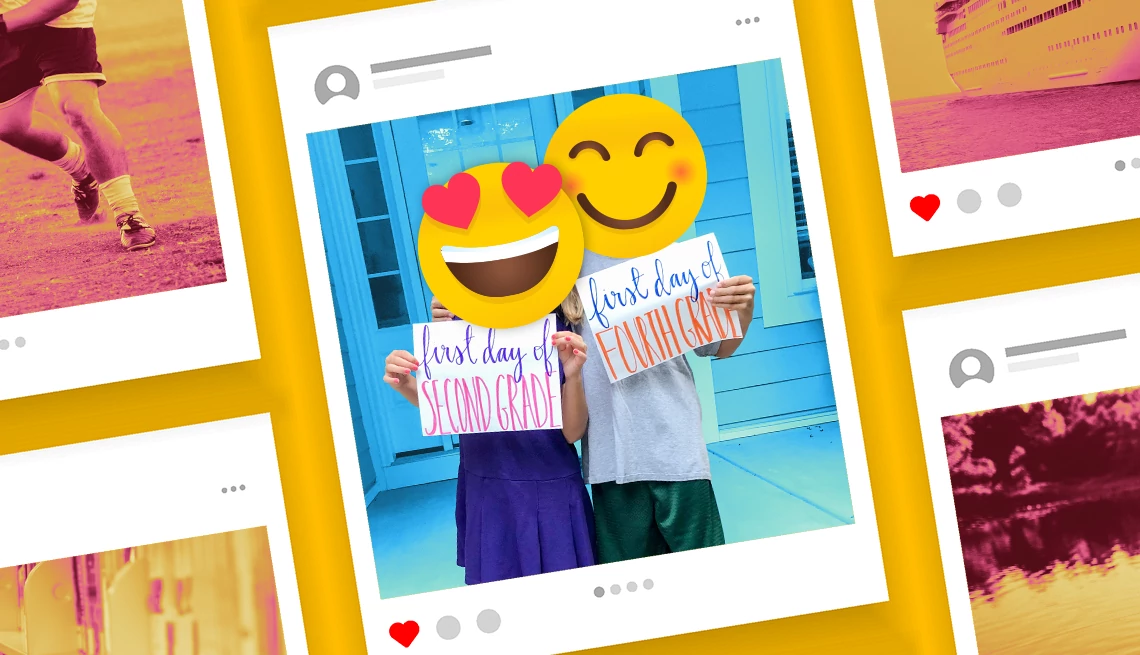







Photo Collage: AARP; (Source: Getty Images (7))
It’s that time of year on social media when proud grandparents post pictures of smiling (and frowning) kids headed back to school. But while images of junior decked out in new togs and hauling an overstuffed backpack may be cute, there is a potential dark side to sharing photos of your favorite kiddos.
The dangers of cyberstalking, bullying, not to mention the countless privacy violations are why some parents (and kids) get annoyed at grandparents posting pictures.
More Ways to Benefit
- Related Benefit 1
- Related Benefit 2
- Related Benefit 3
- Related Benefit 4
- Related Benefit 5
OK, but is sharing a little grandparental pride online really so bad?
It can be, says Parry Aftab, who not only is a grandmother but also a preeminent lawyer who has specialized in digital privacy and cybersecurity for more than 20 years. Aftab is a vocal consumer advocate in the New York City area and has advised organizations — from the United Nations to UNESCO — on privacy and the risks to children online.
“I’ve got grandsons, so I know how grandparents can disagree with parents about what happens online,” she says.
Innocuous posts can land elsewhere
Even if you think you’re keeping kids safe from cyberbullying and cyberstalking by not including any identifying information, that still might not be enough. Photos on sites such as Facebook and Google are tagged automatically with a series of keywords that can identify the child, and those photos can end up in databases used by businesses, law enforcement, marketers, schools — even foreign governments, Aftab says.
Or worse.
The extensive use of artificial intelligence (AI) programs has led to the creation of deepfake pornography where the images of real people — including children — are superimposed on pornographic images. Indeed, according to the National Center for Missing and Exploited Children, half of the photos shared by child sexual abusers were initially posted on social media sites by family members. This is why privacy experts often criticize relatives who post too frequently and refer to it as “sharenting.”
Unbeknownst to most consumers, digital photos also often include embedded time and location information, which makes it even easier to track people and their families. So images combined with other clues, like a seemingly innocuous “Happy birthday!” caption, can yield personal information that makes someone more vulnerable to identity theft and fraud.
“It’s important for grandparents to understand that privacy is not about ‘hiding.’ It’s about safety,” says Evan Greer, the director of Fight for the Future, a nonprofit digital-rights advocacy group based in Boston. “Modern technology makes it all too easy for photos or personal information that are shared with the best of intentions to be exploited and used to do harm.”
Everything’s part of their permanent record
Particularly unnerving today is the explosion in the use of facial recognition software to identify millions of individuals in photos and videos. Thanks to a new generation of more accurate and complex computer algorithms introduced in 2015, face recognition has become a nearly ubiquitous tool for marketers and law enforcement alike.
“It’s as if you’re all now part of a virtual lineup all day long,” explains Nita A. Farahany, a professor of law and philosophy at Duke University in Durham, North Carolina, about how the technology can be deployed. With the exception of a couple of states, use of facial recognition technology has virtually no restrictions in the United States, and that can lead to unintended consequences.
- If a photo is taken near a particular location — say, a hospital or clinic — it can reveal health information, a drug dependency or other personal data.
- In some cases, such as tags that may indicate a person or their relatives have sought help from a mental health professional, people can be stigmatized.
- Image scanning even may identify teens at a party where alcohol was served, potentially tarnishing their reputations with future business recruiters.
All of this information can end up in a permanent digital profile of the child and ultimately affect admission to a particular school or receiving a scholarship. Later, it could dictate whether your grandchild can get a lower interest rate loan, a mortgage or a specific job, according to the Harvard Business Review.
And in the U.S., such profile data can be virtually impossible to check or correct because it is rarely shared with individuals.
Privacy settings really aren’t that private
Many social networks and apps offer privacy settings. But most actually don’t do anything to staunch the flow of information, which exacerbates the problem. “Just because your social media account is set to ‘private’ does not mean that it’s actually private,” Greer says.
Your friends and family can share things you post with their friends and family. And most social media companies do little to protect your personal information from hackers.
TikTok, for example, is currently being sued by the U.S. Justice Department for several years’ worth of child privacy violations. Meanwhile, Facebook parent company Meta agreed to pay the state of Texas $1.4 billion to settle a privacy violations lawsuit going back to 2022.
Despite this, and even with privacy settings in place, social media companies usually resell information about the habits and personal details of their customers to other businesses. In some cases, that includes law enforcement.
A Norwegian Consumer Council study revealed the cascading effect of such information sharing on smartphone apps. In one example, MoPub, a Twitter-owned ad company (now known as X), collected information on individual users of some apps, including their precise location.
MoPub then shared that user data with more than 180 other companies, including an ad company that AT&T owns. That company shared its information with another 1,000-plus businesses.
And then there’s upsetting the kids
The grandchildren may also call you out for posting pictures of them they don’t like.
Kids today are remarkably sophisticated about the use of social media, particularly when it comes to how they present themselves online. Even though they’re technically not supposed to use some of these services, preteens invest a lot of time in their online persona, which they tightly monitor and control on sites like Instagram and TikTok.
Having Grandma post a less-than-flattering picture of them can torpedo all those efforts — because, yes, what you think is a cute photo is pretty much never what they think is cute photo.
Think of how a parental unit can embarrass a child in a store or a restaurant. Now multiple that by thousands.

Talk to your kids about what’s acceptable
Does this mean proud grandparents can never crow online about a child who makes the honor roll or kicks the winning goal at Sunday’s soccer game? Not necessarily.
The first step is to have a conversation with your kids about digital boundaries involving their children.
Ask about what they feel comfortable sharing with friends online. Find out if they would rather you cleared it with them first, say, in a direct email, before posting a photo. They also may be comfortable with private groups on WhatsApp but not on Facebook — even though Facebook owns WhatsApp.
“It’s about values and consistency and peace in the family,” Aftab says.
The second step is to look at the privacy settings and information you share on social networks and websites you use. Take time to read privacy statements and understand privacy settings in apps such as Facebook.
This review takes some work, but it will give you a better understanding of where your personal posts go.
Such a personal online inspection also can help make you less vulnerable. The less information you share on websites, the less likely a criminal will be able to trick you in a scam and gather personal details about your life.
So can you safely post shots of the grandkids bashing piñatas with impunity anywhere online?
“No,” Aftab says. “Our children and grandchildren will never have the level of privacy that we had growing up.”
Unfortunately, the most important lesson we might all take away from the first day of school this year is that while it’s fun to take those precious pictures of junior heading off to class, ultimately we may be better off keeping them to ourselves.
Editor's note: This article was originally published on Feb. 25, 2020. It has been updated to reflect new information.

AARP Membership
Join AARP for only $15 per year with automatic renewal. Get instant access to members-only products and hundreds of benefits, a free second membership, and a subscription to AARP The Magazine.
More on Home and Family
New Tech Tools Enhance Identity Protection
New tech protects consumers from identity theftHow to Talk to Your Kids and Grandkids About AI
7 ways grownups and loved ones can explore togetherGrandparents Building Bonds Across Generations
From technology to travel, it's all about building bonds and memories