
AARP Hearing Center









































Where Were You in 1976?
Remembering the celebration that was the bicentennial

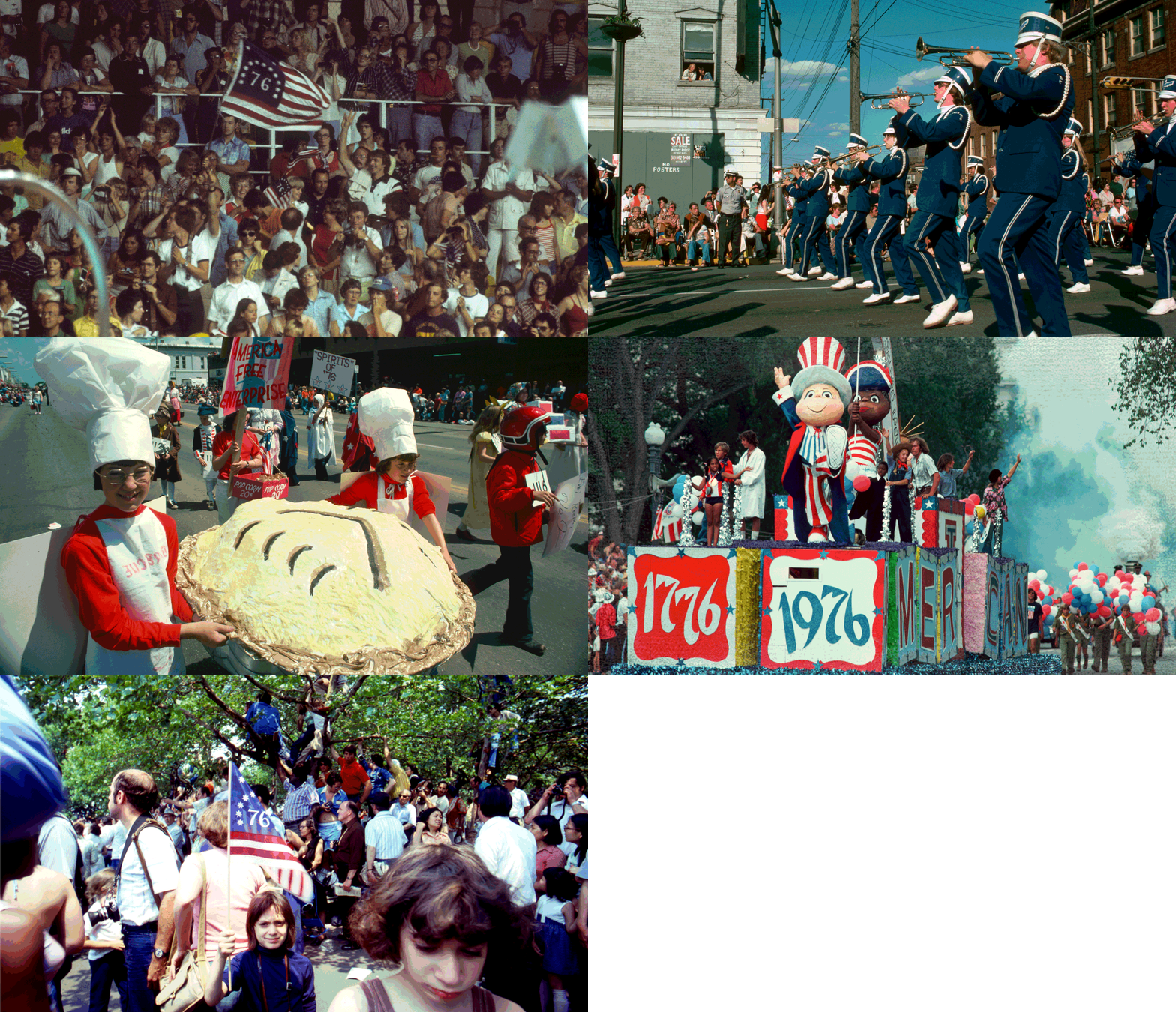
Celebrations rang out nationwide for America’s 200th birthday on July 4, 1976.
BC Photo Archives/Disney General Entertainment Content/Getty Images, Wally McNamee/CORBIS/Corbis/Getty Images (3), David Attie/Getty Images
Tall ships in New York City, massive fireworks displays, the American Freedom Train and more. Fifty years ago, America held a big bash for its 200th anniversary. We asked people across the country to share their bicentennial memories, how they celebrated and what it meant to them.
More Ways to Benefit
- Related Benefit 1
- Related Benefit 2
- Related Benefit 3
- Related Benefit 4
- Related Benefit 5

Guests at Jennifer Carlson’s Betsy Ross-themed birthday party.
Courtesy Jennifer Carlson
Growing up with the country
I turned 9 in 1976. I had a Betsy Ross–themed birthday party. My mom put together everything, including an adorable cake topper — a Betsy Ross pin cushion, which I have handed down to my daughter. The girls showed up in handmade dresses, my mom hand-made puzzles, and we did an exercise where we sewed the flag. Being spirited in ’76 meant believing in tradition while looking forward.
The Spirit of ’76 felt like a moment when the entire country paused to celebrate together. In 1976, patriotism wasn’t just an idea — it was everywhere, woven into everyday life and shared experiences. — Jennifer Carlson, 58, Columbus, Ohio
Tall ships in the Big Apple
I was 11 years old, standing along the East River in New York City. On that day, I was awestruck watching so many ships in the water. I learned later that the main path of the parade was north of me, on the Hudson River, but it still seemed like there were more boats in the East River than I’d ever seen. I knew it was a historical moment for the U.S.A., and I knew I was seeing something special. My immigrant parents also understood this was a moment to celebrate America. The buzz was so exciting, the boats were beautiful, and the fireworks were next level. New York is always busy, but I recall feeling small in the middle of something enormous. — Ingrid Collins, 61, Winter Garden, Florida

The American Freedom Train from 1976 was part of a historic nationwide tour celebrating the United States Bicentennial. It showcased American history and stopped in the Seattle area.
Alamy Stock Photo
Visiting a rolling museum
The American Freedom Train came through the Seattle area with historical artifacts. It was wonderful because we did not have a museum or any place near us with our country’s historical artifacts that we could visit — a lot of that history happened on the East Coast or elsewhere. The lunar rover, Dorothy’s dress from The Wizard of Oz, Martin Luther King Jr.’s Bible, George Washington’s copy of the Constitution were all on the train. It was great to see these items. — Karen Quinn, 64, Duvall, Washington
Music and history
My mom loved the armed services bands. During the bicentennial, the Marine Band and the combined armed services band were playing around the West. We saw them at Utah State University, close to where I grew up, earlier in the year, and my mom got hooked. We spent the rest of the spring and summer following the band around Utah, Montana and Idaho. As we traveled, she read historical books. The whole summer was about American history, and I went on to become an American studies major just because of that. I look back on that summer with such fondness. It raised a heightened sense of patriotism and love for the country, but also a love of what we can be together as a nation. — Tim Summers, 61, Helena, Montana
Real dedication
My dad took us to Brownsville, Texas, to see the dedication of a plaque to commemorate the bicentennial. There were also parades, picnics and festivities surrounding July 1976. It meant a lot to my folks to bring us there because we were all first-generation U.S. citizens. My parents became naturalized citizens in 1985. — Juanita Jiménez-Soto, 59, Houston
Down for the counties
I was 16 years old and living in Mount Vernon, Ohio, during the bicentennial. People came together and celebrated what they had in common, as opposed to focusing on what they disagreed with. People painted fire hydrants and turned it into Betsy Ross, General Washington or Benjamin Franklin. Other people repaired important historic buildings in their communities. There was a resurgence of people joining historical societies and genealogical societies. People took the occasion of 1976 to inquire into their own roots. It was an exciting time where people found their own ways to engage. The spirit of the bicentennial later inspired me when I served as executive director of the Ohio Bicentennial Commission. — Stephen George, 66, Columbus, Ohio

Bicentennial babies
I was a college sophomore at Hampton Institute [now Hampton University] and became a member of Alpha Kappa Alpha Sorority. Women brought into the organization at the same time were called line sisters, and it’s a special bond because we experienced learning about community service and the history of this organization together. We got to name ourselves the Bicentennial Babies, a group of 34 women from across the nation. We could have chosen any other name, but it spoke to the importance of 1976. We had our reunion in April to celebrate the 50th anniversary of the Bicentennial Babies. — Sylvia Cyrus, 70, Upper Marlboro, Maryland
Collecting materials from every state

Bicentennial memorabilia captured the moment.
Courtesy University of Iowa Special Collections
I wrote to all 50 states and asked if they had any free bicentennial memorabilia to send me. A lot of it was events calendars or a little swag they had produced. Every state responded. I think it is reflective of the enthusiasm for that commemoration. I retired 10 years ago and gave a lot of material to the University of Idaho, and it’s in its library now. —Keith Petersen, 75, Pullman, Washington
Graduating into the nation
I graduated from North Forsyth High School in Winston-Salem, North Carolina, in 1976. The entire county was invited to a concert I sang in with the choir, and it told the story of the country’s history through four acts: The Nation Begins, The Nation Takes Shape, The Nation Expands and The Nation Falters. Songs told celebratory and heartbreaking stories. The epilogue was titled “To Each Other” and ended with America the Beautiful. I struggled to sing this last song, being emotionally overwhelmed. This concert caused my 17-year-old brain to think of the United States as a living, breathing entity. Individuals just like me lived through these stages in our history, and they cried, laughed, acted and faced mistakes and victories — all influencing our country. — Annette Fuller, 67, Lake Dallas, Texas
Sound and light
I was working at Mount Vernon [George Washington’s home] at the time as a painter. I worked during the day, then I’d meet up with other college students working the event and we would set up the program for the Sound and Light Show. We watched the show every night and memorized it. The longer I worked here, the more I came to know George Washington and the more awestruck I became by him and what he achieved. Freedom really started there. The one thing that remains from that show are these big lights that are all up and down the Bowling Green, a grassy expanse on the estate, which they still use when they have a special event. These are lights that project up into the big trees that are around the green, and it’s beautiful. Of course, it brings me right back to 1976. — J. Dean Norton, 73, Mount Vernon, Virginia
(After more than five decades of working at Mount Vernon, Norton retired as director of horticulture and livestock. He’s now emeritus director.)

AARP Membership
Join AARP for only $15 per year with automatic renewal. Get instant access to members-only products and hundreds of benefits, a free second membership, and a subscription to AARP The Magazine.
More From AARP