






















































Javascript is not enabled.

Javascript must be enabled to use this site. Please enable Javascript in your browser and try again.

Skip to content
Content starts here
CLOSE ×
Search
CLOSE ×
Search
Leaving AARP.org Website

You are now leaving AARP.org and going to a website that is not operated by AARP. A different privacy policy and terms of service will apply.

25 Great Ways to Avoid Overthinking

Tips and techniques to help you stop catastrophizing and start living


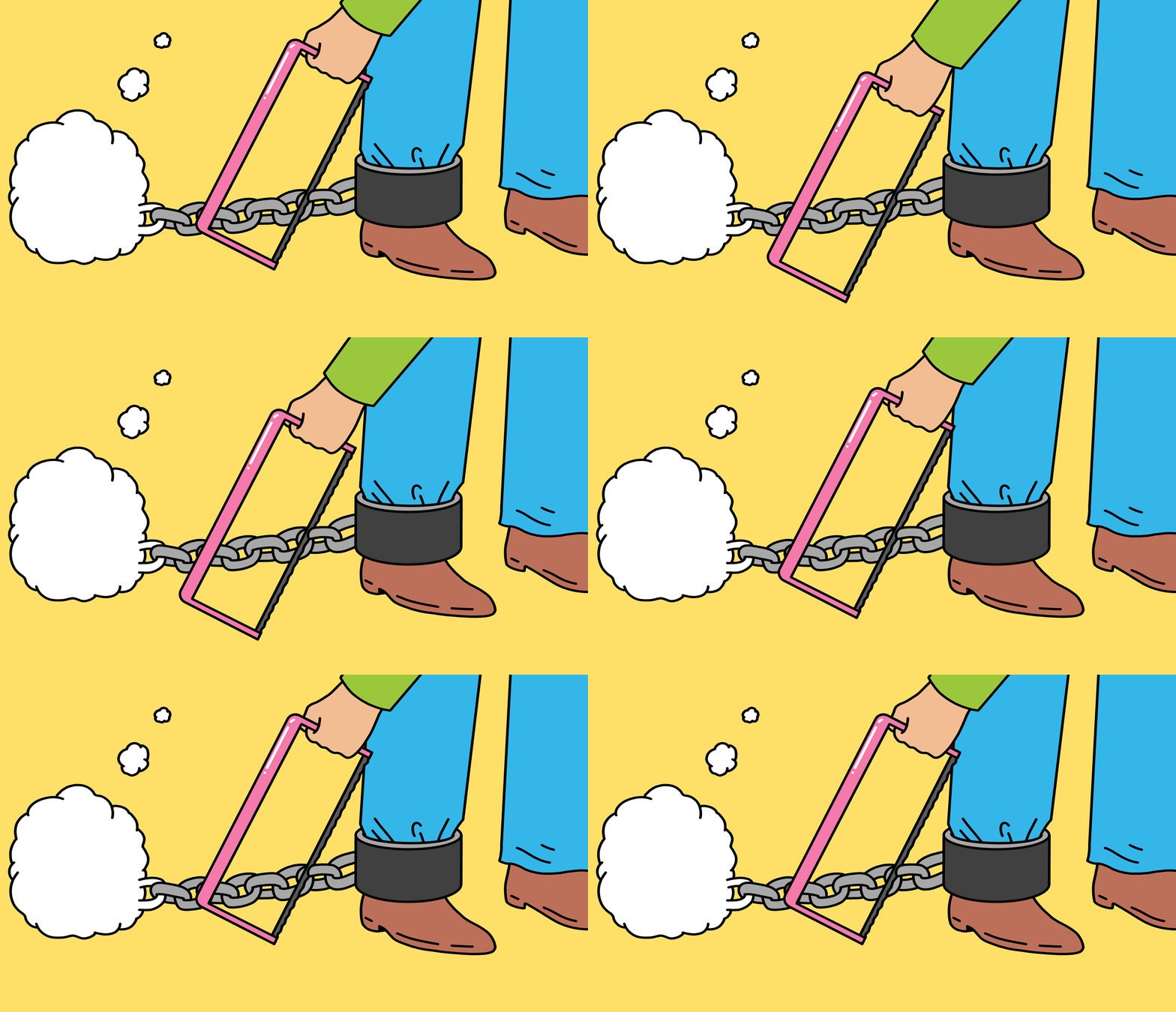
an illustration shows a man sawing away at a chain shackled to his foot. The last link of the chain is latched to a white thought bubble
Overthinking can shackle you to a lot of emotional anguish, but there are many ways to break free.
Sam Island

Will I get another chance at a long-term relationship? Is it normal to be so forgetful? What does the future look like for my grandchildren? Older adults can spend a lot of time contemplating these and many other questions. But know this: Thinking and overthinking are very distinct things. And that distinction can be the difference between a grounded perspective and a catastrophic one.

Also known as rumination, overthinking is repetitive attention to a particular thought, and it often leads to emotional anguish. A type of rumination known as brooding — a deep, negative state of worry — is associated with lower language and memory functions in late-life depression, according to a 2025 study in the Journal of Clinical and Experimental Neuropsychology

“Overthinking can, bottom line, destroy your life,” says Sora Vernikoff, author of the upcoming book Think What You Want! Stop When You Want! The Positivity Management Program. Vernikoff describes herself as an “overthinker’s coach” who is no longer the “queen of overthinking.”

“If you can’t make a decision, you can’t take any action,” she continues. “If you can’t take any action, you can’t reach forward and make your dreams come true. To me, overthinking is a completely self-destructive mindset.”

Sound familiar? You’re not alone.

Thankfully, there are practical, even scientifically backed, ways to stop overanalyzing everything. Here are some of them.

1. Be curious

“Overthinking is just your way of masking other thoughts … because you don’t want to feel the emotions attached to them,” says Vernikoff. “So if you want to get down and dirty and heal yourself, ask, ‘What are these thoughts here to teach me about myself?’” Follow up by visualizing those masked thoughts being exposed and coped with; then ask what you’d start thinking about instead, once you have more mental space. “Every time I overthink, it’s a place in my life where I don’t want to see the other side of what’s going on,” Vernikoff says.

2. Form a personal advisory board

Chad Gammon, a 53-year-old financial adviser from Cedar Rapids, Iowa, established a personal “advisory board” of sorts to help him navigate thoughts he can’t stop processing. To ensure he receives a variety of perspectives, the board is made up of friends and colleagues from different areas of his life, all of whom have “met some criteria of trust.” He reaches out at least monthly. “It can make you feel vulnerable at first, but what you find is they have the same types of questions or things they’re looking for help with, too,” Gammon says.

3. Turn to your breath

Deep, measured breathing can calm the mind, says D. Ivan Young, a behavioral neuroscience expert and Professional Fellow at the Institute of Coaching, an affiliate of Harvard Medical School. He says deep breathing can interrupt the limbic system and the amygdala, which are primed to pump our bodies full of adrenaline, cortisol and other stress hormones. By slowly inhaling and exhaling two or three times, “you’re addressing the seat of human emotion and survival — the ancient ‘smoke detector’ of the brain,” he says. Then it becomes easier to shift your focus.

However, Young says it’s important to remember that the mind and the brain are not the same thing: “When you are intentional with the use of your mind, the primal parts of your brain are forced to take a back seat,” he says.

4. Become effective at time management

Our brains like structure. Without it, unclear mental boundaries easily lead to uncertainty, which fuels worry. Learning how to manage time effectively can help. Look at time management like a cake recipe, says Vernikoff. 

“If you don’t have the steps to your recipe, your cake’s not going to taste good,” she says. In the same vein, have a plan for each part of your day. “If you don’t manage your time well, you’re going to overthink more.” There are many techniques and tools to help you manage your time more effectively. Try out different ones and see what works for you.

5. Record yourself

an illustration shows a man looking at his reflection in a smartphone, which is the size of full-length mirror
If your thoughts bother you, record yourself describing them, then play them back. Hearing them spoken out loud might give you a different perspective.
Sam Island

One way to create psychological distance from chaotic thoughts is to record yourself talking about them. Speaking into a microphone forces you to articulate your otherwise jumbled emotions; playing the recording back gives you a different perspective on those intrusive thoughts. Vernikoff likes an old-fashioned tape recorder, but your mobile phone’s built-in voice recorder is also a good option. 

“When I listen back, I hear it differently,” she says. “The level of objectivity I have over what I said heightens.” Just be careful not to judge what you hear too harshly. “Just listen for a greater understanding of who you are,” Vernikoff says.

6. Try progressive muscle relaxation

Christine DeMaria, a 52-year-old speech language pathologist from Perinton, New York, remembers overthinking even as a child. These days, she uses progressive muscle relaxation exercises to reduce her propensity for “giving everybody power to get in my head.” Progressive muscle relaxation reduces stress, anxiety and depression in adults, according to a 2024 article in the journal Psychology Research and Behavior Management.

Guided by a YouTube video on her phone before falling asleep, DeMaria starts by tightly tensing her toes for a few seconds, then releasing. She repeats the process with her calves, then moves to her thighs. She continues until she reaches her eyes and forehead. To finish, she tenses her entire body, then lies limp. “It removes the focus away from me thinking about my stupid thoughts and brings me to thinking about a very specific task I have to do,” she says.

7. Schedule rumination time

“It’s OK to have a pity party,” says Young, who is also a board-certified health and wellness coach, “but you need to set a time.” You also need a time limit. Young’s advice: Allocate five or 10 minutes, and no more than 15 minutes. Make your rumination time ceremonial if you can, says Young, because “rituals reinforce control.” Jaclyn Spiegel, a licensed psychotherapist in Philadelphia, suggests pairing those dedicated minutes with a regular chore, such as driving to work, walking the dog or taking a shower. 

Meanwhile, it’s crucial to “give the other side equal time,” says Young, referring to optimistic, supportive thoughts. “It’s OK to have a problem; just don’t let the problem have you.”

8. Feel grateful for small things

Gratitude involves shifting your attention toward feelings of satisfaction and away from worry. Young says it’s important to keep in mind that everything is relative, so what seems small to you may feel enormous to someone else. He offers these examples: Look at your backyard and think about how it’s attached to the place providing a roof over your head — and then think about how many people are homeless. If you’re behind on grocery shopping but managed to cobble together a basic meal, appreciate that you were at least able to eat. 

“Gratitude is a powerful thing,” he says. “Thankfulness actually changes the brain. It releases neurotransmitters like dopamine and serotonin. And whatever the brain learns to do, it wants to do more of it, so if every day before going to bed or when you get up in the morning, you trigger your brain’s reward system, you’re signaling pathways to enhance more of these feelings.”

9. Ground yourself

Another way Gammon tries to “wipe my mind clean and stop thinking for a while” is by taking off his shoes. If he’s in his home office, he plants his feet on the floor and shuts off all nearby electronics. If he’s outside in a patio chair, he plants them on the concrete, then closes his eyes and listens to the quiet, the birds or the wind. “I’m not floating. I’m not anxious. I’m rooted into the ground,” he says. “It’s peaceful.”

10. Get to know your ‘parts’

an illustration shows an older adult woman walking inside an overcast thought cloud, using a flashlight for illumination.
Explore the various parts of your psyche. It might help you shine a light on which one is causing you to overthink things.
Sam Island

“A part of me feels this way” is a common phrase. Internal family systems (IFS)  therapy takes that literally, operating with the understanding that the psyche is made up of various parts. Spiegel, who uses this therapeutic model with clients, says, “Some of our parts may marinate on thoughts a lot and think they’re keeping us safe by doing so.” 

Unfortunately, the protective parts of your psyche sense fear, and overthinking can give them a sense of control. “If we know that this part of us is overthinking because it’s scared, developing compassion for that part can be really helpful, versus trying to shut it down,” says Spiegel. She recommends searching online for IFS-related guided worksheets and meditations.

11. Be in nature

Vernikoff recommends heading to a nearby park to focus on nature. “Touch the tree, touch the flowers, breathe the air, look at the sun,” she says. “Once you walk into nature, you’re not overthinking those thoughts that are causing you pain, because you’re thinking, ‘Oh, that’s a nice tree. Look at all the shades of green.’ Or ‘Look at the squirrels.’ You’re trading in the overthinking for a new set of positive thoughts.” 

Time spent in nature can encourage “soft fascination,” a cognitive process that gently refocuses our attention away from our problems. This can reduce the impact of rumination, according to a 2021 article in Frontiers in Psychology.

Don’t live near a park? Choose any green space. Have mobility challenges that keep you indoors most of the time? Watch nature videos. Or search online for a well-known park in any part of the world, and you’ll likely find a video that takes you through it, says Vernikoff. 

12. Defer your thoughts

Summarize an upsetting or all-consuming thought loop on a piece of paper, then tell yourself you’ll come back to it in a bit. “Externalizing it can help with moving on,” says Spiegel, “and simply acknowledging its existence can be soothing in itself.” Spiegel says this technique can be especially helpful when rumination distracts you during work meetings. By the time you read the paper after the meeting, “maybe it’s not a big deal” anymore, she says. “Often, our initial reaction is stronger than it feels when we come back to something later.

13. Keep a journal

“Writing gives you a little bit of working distance,” says Jenny Taitz, a clinical psychologist in Beverly Hills, California, and author of Stress Resets: How to Soothe Your Body and Mind in Minutes. “Studies show that writing about something that was distressing … over several days reduces overthinking.”

Taitz points to the research of Dr. James Pennebaker, a social psychologist and professor emeritus of psychology at the University of Texas at Austin. In a 2024 episode of Speaking of Psychology, a podcast produced by the American Psychological Association, Pennebaker said writing appears to help improve mental health, whether you do it for 20 minutes, 10 minutes or just two minutes. With one caveat: “Writing about the same story in the same way is really the same as rumination,” he said. “If you find that you tell the same story over and over again, you’re not getting any traction.”

14. Go to therapy

A 2023 article in the Journal of Anxiety Disorders found that most interventions targeting rumination involved a form of cognitive-behavioral therapy, which uses structure and goal-setting to change unhelpful thinking and behaviors. “People like that,” says Spiegel. “It’s really concrete.” DeMaria is one of those people. Her therapist often gives her articles to read and questions to answer between appointments — and holds her accountable. “She’ll actually say to me, ‘If you don’t do this homework, then cancel our next therapy session,’” DeMaria says. 

15. Choose a talisman

an illustration shows an older adult man traversing an overcast landscape. In his hand is a talisman, which is projecting light from his hand to the horizon
A talisman is a physical reminder that you have control over your negative thoughts.
Sam Island

A talisman — a stone, an angel or a rock, for instance — is a symbolic object that, when touched or simply noticed, can break patterns. Young says you can use one to curb rumination by creating a healthy association between the talisman and the moment when you decide to leave a thought loop. “Just like you can be triggered in a negative way, you can also willfully trigger yourself with positive reinforcement, and that builds self-efficacy and resilience,” he says.

According to Young, belief in a talisman activates the prefrontal cortex, which is associated with meaning-making and reducing stress responses. Whether or not the device actually has the power to pull our attention away from overthinking doesn’t matter, says Young. “Belief affects change,” he says. “When we expect something to work, it does.”

16. Practice the half-smile

Relax your face, then turn up the corners of your mouth ever so slightly. This distress-tolerance skill, used in dialectical behavior therapy, is known as the half-smile — a signal to your brain that you’re not in danger. It’s not about faking happiness; it’s about nudging your nervous system to self-soothe. “It’s hard to imagine doing the mental equivalent of grimacing while your face is relaxed,” Taitz says.

17. Notice the power of language

If you find yourself saying something along the lines of “I made a huge mistake; I’ve ruined my life,” rise above that toxic language, urges Taitz. Loosening your grip on those catastrophizing words is like going from squeezing lemon juice on your tongue to looking at a drawing of a lemon, she says. A 2022 study published in the journal Cognition and Emotion linked self-compassion with a lower incidence of rumination.

18. Ask the right question

Taitz proposes swapping “Why me?” with “How can I move forward?” She says we tend to focus on why things are easier for other people when instead we should be trying to figure out how to show up for ourselves by moving forward with courage and compassion. “‘Why’ is a dead end,” she says, “and ‘how’ is a propeller of action.”

19. Get physical

During breaks at work, when DeMaria finds herself overthinking, she walks a lap around the building. Afterward, “my mind is able to settle on what I need to work on,” she says. “I’m more calm, content and focused.” It’s another example of how physical activity can improve your mental state.

20. Create a celebratory notebook

an illustration shows a woman in a bathing suit, relaxing her feet in a book a pool. The pool is shaped like a book, which is titled: The Good Life
A scrapbook of uplifting memories can help you focus on positive thoughts.
Sam Island

This is a scrapbook of sorts — part photo album, part diary. Vernikoff suggests giving it a title such as “The Good Life” and filling it with memories, clippings and other things that make you happy. This is particularly helpful for those preoccupied with thoughts of dying, especially as illnesses and funerals become bigger conversation topics among friends, she says.

Life needs to be about “being the best version of yourself each day,” she adds. A notebook like this gives you a positive place to train your concentration, “because if you sit in your house all day thinking you’re going to die, you’ve stolen your day, and that’s unacceptable.”

21. Plan out your next step

Imagine this scenario: You’re going to a high school reunion or other social event with people you haven’t seen in ages. “Maybe you think you’re not good enough, maybe you don’t think you look nice, maybe your hair is white now, maybe you don’t think you’re worthy of the people in the room,” says Vernikoff.  

Acknowledge all of that, then get down to business. What’s a logical next step? Show up anyway. And the next? Wear a smile. After that? Make the effort to speak to one person. You can apply this methodical approach (with tweaks for context) to most scenarios. “They say all your treasure is on the other side of fear," Vernikoff says, “so whenever I’m afraid of doing something, I know I have to do it.”

22. Do something nice for others

Volunteering at a grandchild’s school. Visiting a friend recovering from surgery. No matter the need, “there’s always a gift we can give, no matter what we have in terms of resources, and that gift is ourselves,” says Young. Rumination thrives on feelings of helplessness, but offering to be a companion or confidant shifts attention outward, which activates the brain’s reward circuits and provides a sense of purpose.

23. Look out for cognitive distortions

Cognitive distortions are internal biases or overgeneralizations that skew your view of life — and the world — in a negative way. For example, if you suddenly start to think that a friend doesn’t like you anymore, look for evidence that runs counter to that, such as your friend recently calling and inviting you to lunch. If that’s the case, Spiegel advises asking yourself: “Am I doing all-or-nothing thinking? Am I catastrophizing? Am I fortune-telling?”

24. Call a ‘warmline’

Unlike a crisis hotline, a warmline is a phone number to call if you’re ruminating and just want “to speak to an empathic person,” says Taitz. Warmlines are free and confidential phone, text and chat lines staffed by trained volunteers, and most states have them. (Most also accept calls from other states that don’t yet have one.) While some are open 24/7 and offer unlimited talk time, others have specific hours of operation and time limits. Visit www.warmline.org for a directory.

25. Play the odds

Because you’ve likely come through situations that felt hopeless, “assign a probability to how likely you are to be consumed by the thought or fear in the future,” says Spiegel. “While you may be 100 percent consumed by it at the moment, it’s possible that you will only be 50 percent consumed by it the next week, and 20 percent the next month.” The goal, says Vernikoff, is not to push away thoughts but to keep them from taking up so much headspace. “Thoughts are just clouds,” Vernikoff says. “They come and go, but you have to learn how to manage the weather.”

Unlock Access to AARP Members Edition

Join AARP to Continue

Already a Member?

Red AARP membership card displayed at an angle

Get instant access to members-only products and hundreds of discounts, a free second membership, and a subscription to AARP the Magazine.