
AARP Hearing Center









































May Sweeps and the Lost Joy of Watching Together
In the pre‑streaming era, television was a communal event. We revisit our favorite moments of shared spectacles

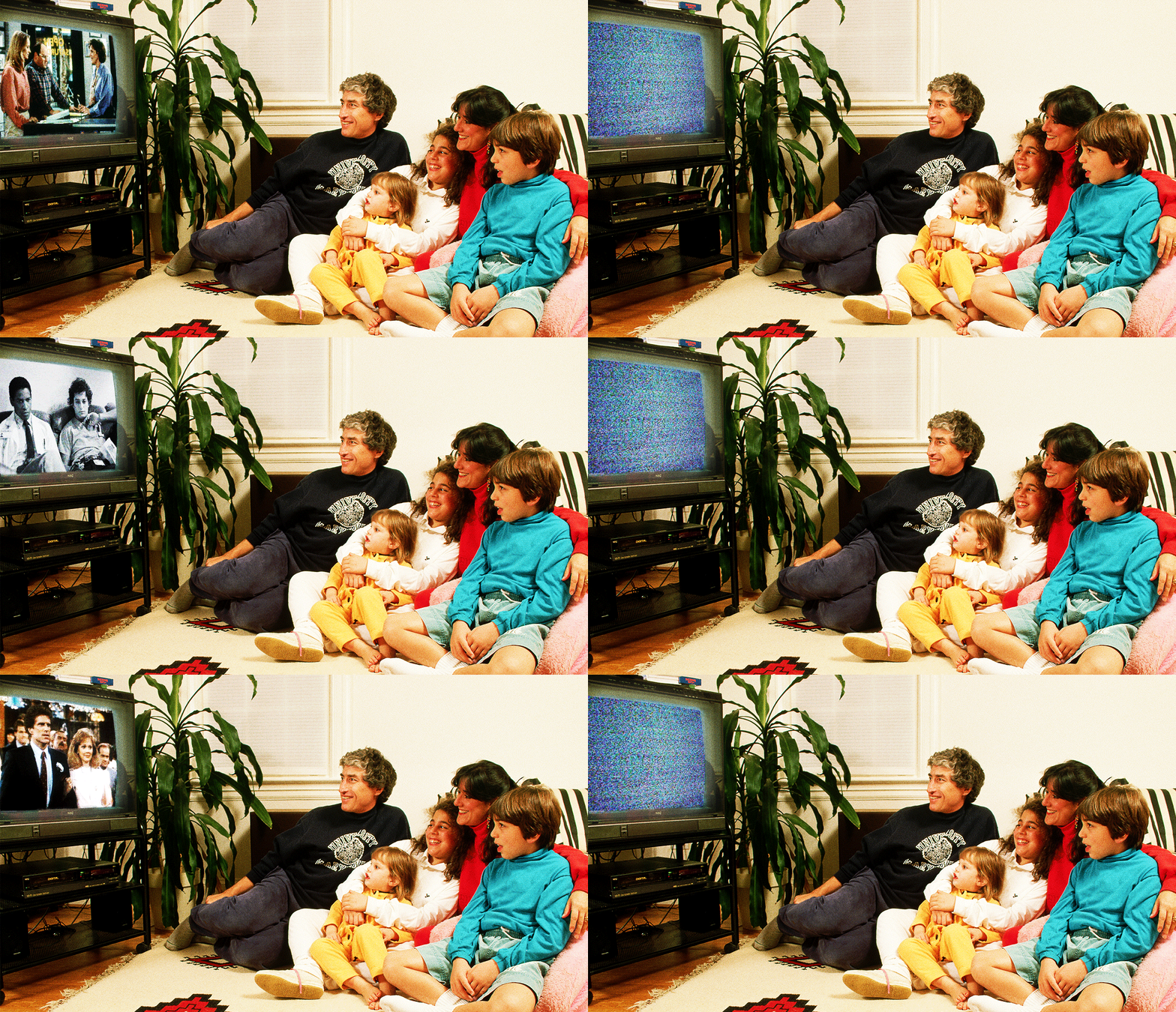
Before streaming turned every living room into its own private island, May sweeps made TV feel like a national campfire where everybody gathered to watch.
AARP (Paramount Television/Courtesy Everett Collection, Carin Baer/Castle Rock Entertainment/Courtesy Everett Collection, Jack Hamilton/NBCU Photo Bank/NBCUniversal via Getty Images, Getty Images)
If you lived in the United States on May 15, 1985, the odds were pretty good that you were watching Dynasty that night. Not necessarily because you were a fan or had been following the Carrington family’s drama all season, but because more than 20 million people were going to be watching.
I was 16 and had absolutely no business caring about Dynasty. My shows were Miami Vice and Cheers. Dynasty was my parents’ show, a prime-time soap opera about obscenely wealthy oil people in Denver who wore shoulder pads to breakfast and feuded in ball gowns. It was not aimed at teenage boys who owned a Clash album.
More Ways to Benefit
- Related Benefit 1
- Related Benefit 2
- Related Benefit 3
- Related Benefit 4
- Related Benefit 5
But that spring, something had shifted, some critical-mass moment when the show stopped being a thing your parents watched and became a thing everyone watched. Kids at school talked about it. Teachers talked about it. The man who ran the hardware store talked about it.
“TV was a way to feel like you still had a pipeline to social connections and the wider world,” says Christine Becker, a professor of television at the University of Notre Dame who studies that era. “So it was as much about public connections as it was about private escapes.”
There were four sweeps periods every year — February, May, July and November — but May set the summer in motion. If you missed the episode, you missed the summer.
So we watched. All of us, together, which in my house meant my parents on the couch, me in the armchair and my little brother on the floor. My mother made popcorn and put it in the big orange bowl we only used for company.
This was a binding social contract we’d entered into without discussing it, because there was no pause button, no rewind, no way to retrieve a moment once it passed. Whatever was going to happen — and something enormous was clearly going to happen — you were either there for it or you spent the next day nodding along to a conversation you couldn’t participate in.

VIDEO: Things You Didn't Know About 7 Iconic TV Moments
David Bianculli, a professor of television studies at Rowan University and TV critic for NPR’s Fresh Air, thinks we “lost something as a culture” when this model broke apart. “The connection, and enjoyment, of reacting to and discussing television events as they happen: That’s something that was taken for granted in the first 50 years of television but that we’ll never get back.”
Live sports is the last place where something like the old feeling still exists, where a significant portion of the country is watching the same thing at the same moment and the result is genuinely unknown. But even that is fracturing now, spread across broadcast networks, cable packages and streaming deals that put different games behind different paywalls.
What we had during sweeps season was something simpler and, it turns out, irreplaceable. To honor the memory, we revisit our favorite sweeps across the decades.
The shocking death
In which the networks discover that killing a character audiences loved is more powerful than any cliffhanger, because a cliffhanger could still resolve happily. A death could not.

On “Seinfeld,” George Costanza proved that during sweeps, even wedding invitations could become a murder weapon.
Carin Baer/Castle Rock Entertainment/Courtesy Everett Collection
Seinfeld, ‘The Invitations,’ May 16, 1996
George Costanza (Jason Alexander) spent an entire season trying to get out of his engagement to Susan (Heidi Swedberg), a woman he had no interest in marrying. He failed repeatedly. And he cheaped out on the wedding invitations. Unbeknownst to George, the low-quality envelopes contained toxic glue, which killed Susan after she licked them.
When George arrived at the hospital and learned she was gone, he and his friends received the news with the kind of mild, slightly relieved indifference that made the moment one of the most audacious things a sitcom had ever done.

Dr. Mark Greene of “ER” didn’t get a shock twist. He got Hawaii, his daughter, one last song and an entire audience pretending it had something in its eye.
Getty Images
ER, ‘On the Beach,’ May 9, 2002
Dr. Mark Greene (Anthony Edwards), the show’s moral anchor and one of the last surviving original cast members, had spent most of Season 8 slowly dying from an inoperable brain tumor. Rather than watch him expire in a hospital corridor, the writers sent him to Hawaii for his final weeks, teaching his estranged teenage daughter to surf and drive a stick shift, rebuilding eight years of distance in the time he had left.
When he died in his sleep, with Israel Kamakawiwo’ole’s version of “Somewhere Over the Rainbow” playing, it was the quietest, least sweeps-baiting death the show had ever done, and it remains one of the most affecting hours of television the form has produced.
The disaster/crisis episode
These were the episodes that arrived with their own promotional language — “a night that will change everything,” “nothing will ever be the same” — and occasionally delivered on it.
Melrose Place, ‘The Big Bang Theory,’ May 22, 1995
The third-season finale of Fox’s prime-time soap ended with a character named Kimberly Shaw (Marcia Cross), who — in the logic of the show, had accumulated sufficient grievances against her neighbors to justify this — blew up the entire apartment complex. The blast flung her into the pool like a rag doll; one side character was killed; another was temporarily blinded; and everyone else walked away with minor cuts and bruises, their photogenic features intact.

“St. Elsewhere” gave us Denzel Washington, Howie Mandel and the most emotionally complicated snow globe in television history.
Jack Hamilton/NBCU Photo Bank/NBCUniversal via Getty Images
St. Elsewhere, ‘The Last One,’ May 25, 1988
The series finale of the critically acclaimed NBC medical drama revealed in its final moments that the entire six-season run — every patient, every death, every heartbreak across 137 episodes — had existed only in the imagination of Tommy Westphall (Chad Allen), an autistic boy staring into a snow globe. As Tommy’s father looked at the globe, a miniature replica of St. Eligius was visible inside it, snow swirling around it as the shot faded to black.
Loyal viewers who had invested six years in these characters were informed, in the last 90 seconds of the series, that none of it had technically happened. This was either a profound meditation on the nature of storytelling and memory or an act of spectacular nerve that left the audience feeling retroactively gaslit. The debate continues. The snow globe is still out there somewhere.

The special guest, or stunt casting
Every sweeps season, someone famous showed up somewhere they had no business being. A movie star, a musician, an athlete. The practice even had its own industry term — “stunt casting” — because using a famous face in an unfamiliar context created a specific kind of excitement that good writing alone couldn’t manufacture.

Ellen DeGeneres and Laura Dern in “The Puppy Episode,” wherein stunt casting stopped being a gimmick and became a cultural event with commercial breaks.
ABC Photo Archives/Disney General Entertainment Content via Getty Images
Ellen, ‘The Puppy Episode,’ April 30, 1997
The episode aired on the first night of May sweeps, or close enough that the distinction hardly mattered to ABC’s scheduling department. The Ellen sitcom had been drifting for seasons, its lead character conspicuously uninterested in any of the romantic entanglements that normally drive a network comedy, when the show’s star and her writers arrived at what turned out to be the obvious solution. Ellen Morgan (Ellen DeGeneres) would come out as gay, making her the first lead character in American prime-time history to do so.
DeGeneres herself came out at the same time. Two weeks before the episode aired, she appeared on the cover of Time magazine under the headline “Yep, I’m Gay,” making the fictional coming-out and the real one nearly simultaneous. It was a personal reckoning and a ratings strategy so perfectly fused that, in retrospect, separating them seems beside the point.
When word got out that the episode was in production, guest stars began lining up. Oprah Winfrey played Ellen’s therapist, Laura Dern played the woman she falls for, and k.d. lang, Demi Moore, Billy Bob Thornton and Dwight Yoakam all appeared as well. More than 42 million people watched the episode, a number roughly five times the show’s usual audience.

Bruce Willis arrived on “Friends” as a threat to Ross, and left as proof that even action heroes are helpless against Rachel Green.
Chris Haston/NBCU Photo Bank/NBCUniversal via Getty Images
Friends, ‘The One Where Ross Meets Elizabeth’s Dad’ / ‘The One Where Paul’s the Man’ / ‘The One With the Ring,’ April 27 to May 11, 2000
As the May sweeps opened, NBC rolled out what the Los Angeles Times called a “stunt casting coup.” Bruce Willis, fresh off The Whole Nine Yards with Matthew Perry, arrives on Friends as Paul Stevens, the rich and terrifying father of Ross Geller’s college girlfriend. He first appears as a stock sitcom obstacle: the disapproving dad with money, posture and the power to ruin Ross’s life. Then the show does something smarter with him. By the next week, he’s dating Rachel, and by the week after that, he has turned into a blubbering emotional wreck, the sort of reversal stunt casting was built for. The first installment drew 20.63 million viewers, and Willis wound up winning an Emmy for the part, meaning a sweeps stunt designed to make noise also happened to work.
The cliffhanger
The foundational unit of sweeps culture. The formula was simple: End the season on a moment so unresolved, so deliberately agonizing, that the audience has no choice but to spend the entire summer in a low-grade state of narrative anxiety.

“Dallas” didn’t invent the cliffhanger, but “Who Shot J.R.?” turned the nation into amateur detectives for a summer.
CBS via Getty Images
Dallas, ‘A House Divided,’ March 21, 1980
Technically, this one didn’t air during May sweeps. It aired in March, because CBS ordered extra episodes late in production, which extended the season. With the writers scrambling to find a dramatic ending, someone in the room reportedly said, “Why don’t we just shoot the bastard?” So they did. J.R. Ewing, the sneering, double-crossing oil baron played by Larry Hagman, is shot twice by an unseen assailant and left bleeding on his office floor. Cut to black. See you in the fall!
The summer that followed was essentially a national parlor game, with everybody asking, ”Who shot J.R.?” Oddsmakers in the United States, Canada and Western Europe set odds on the culprit. “Who Shot J.R.?” and “I Shot J.R.” T-shirts sold across the country all summer. On August 11, Time magazine put J.R. Ewing on its cover with the headline “Whodunit?” Republicans distributed campaign buttons reading “A Democrat shot J.R.,” while President Jimmy Carter, at a fundraiser in Dallas, joked that if anyone could tell him confidentially who shot J.R., he could finance his entire reelection campaign.
The answer finally aired that November — it was Kristin Shepard, J.R.’s sister-in-law and former mistress, and more than 83 million Americans tuned in as part of an estimated 350 million worldwide.
The Simpsons, ‘Who Shot Mr. Burns? (Part One),’ May 21, 1995
Mr. Burns, having spent the season drilling oil from under Springfield Elementary, blocking the sun and generally ruining the lives of every character in the show, is shot by an unknown assailant and left bleeding in the town square. Fox launched a call-in contest for viewers to guess the shooter’s identity, and a website dedicated to the mystery drew over 500,000 hits that summer, at a time when a website drawing 500,000 hits over an entire summer was considered extraordinary.
The culprit, revealed in the September premiere, turned out to be Maggie Simpson, a baby who’d been struggling over a lollipop, which was either an inspired choice or a deliberate provocation against everyone who’d spent four months treating it seriously. Probably both.
The sweeps wedding (or, the wedding that doesn’t happen)
Television weddings were never really about love. They were about the promise of love, which is a different and more useful thing.

Sam and Diane finally made it to the altar, which on “Cheers” meant there was still plenty of time for emotional damage.
Paramount Television/Courtesy Everett Collection
Cheers, ‘I Do, Adieu,’ May 7, 1987
Sam (Ted Danson) and Diane (Shelley Long) had been circling each other for five seasons — fighting, breaking up, getting engaged, fighting again — and when the finale finally arrived, it looked like they were actually going to do it. (Spoiler alert: They did not.) Diane left for her writing career instead, and Sam stood alone in the bar and told her to have a good life. The audience intuitively understood that this was both a breakup and a series-defining statement about the kind of show Cheers actually was.

“Friends” staged the perfect sweeps wedding, then let Ross destroy it with one spectacularly wrong name.
Joseph Del Valle/NBCU Photo Bank/NBCUniversal via Getty Images
Friends, ‘The One With Ross’s Wedding,’ May 7, 1998
Ross (David Schwimmer) is marrying Emily (Helen Baxendale) in London. Rachel (Jennifer Aniston) flies over at the last minute, having realized she’s still in love with him. Everyone knew what was coming except Ross himself, who arrives at the altar and says, “I, Ross, take thee, Rachel.” The episode ended with the minister asking whether they should continue, and viewers only learned the aftermath months later, when the next season began. Ross and Emily did get married. It did not go well.

Only “Dynasty” could give viewers gowns, tiaras, terrorists and a summerlong fake-out where Alexis was absolutely not dead.
ABC Photo Archives/Disney General Entertainment Content via Getty Images
Dynasty, ‘Royal Wedding,’ May 15, 1985
The Carringtons fly to Moldavia (how Moldova was spelled in the Soviet era) for a royal wedding. The ceremony is beautiful. The gowns are extraordinary. Then armed terrorists burst into the chapel and open fire, leaving every major character lying motionless on the floor in their formal wear. When the series resumed the following September, it turned out that only two minor characters had died. Audiences who’d spent the summer convinced that Alexis (Joan Collins) was gone were informed that Alexis was, in fact, fine — which was both a relief and a betrayal.

AARP Membership
Join AARP for only $15 per year with automatic renewal. Get instant access to members-only products and hundreds of benefits, a free second membership, and a subscription to AARP The Magazine.
You Might Also Like
Why Older Women Love Young Adult Shows
We’re drawn to these series because they let us relive the electric rush of first love