
AARP Hearing Center









































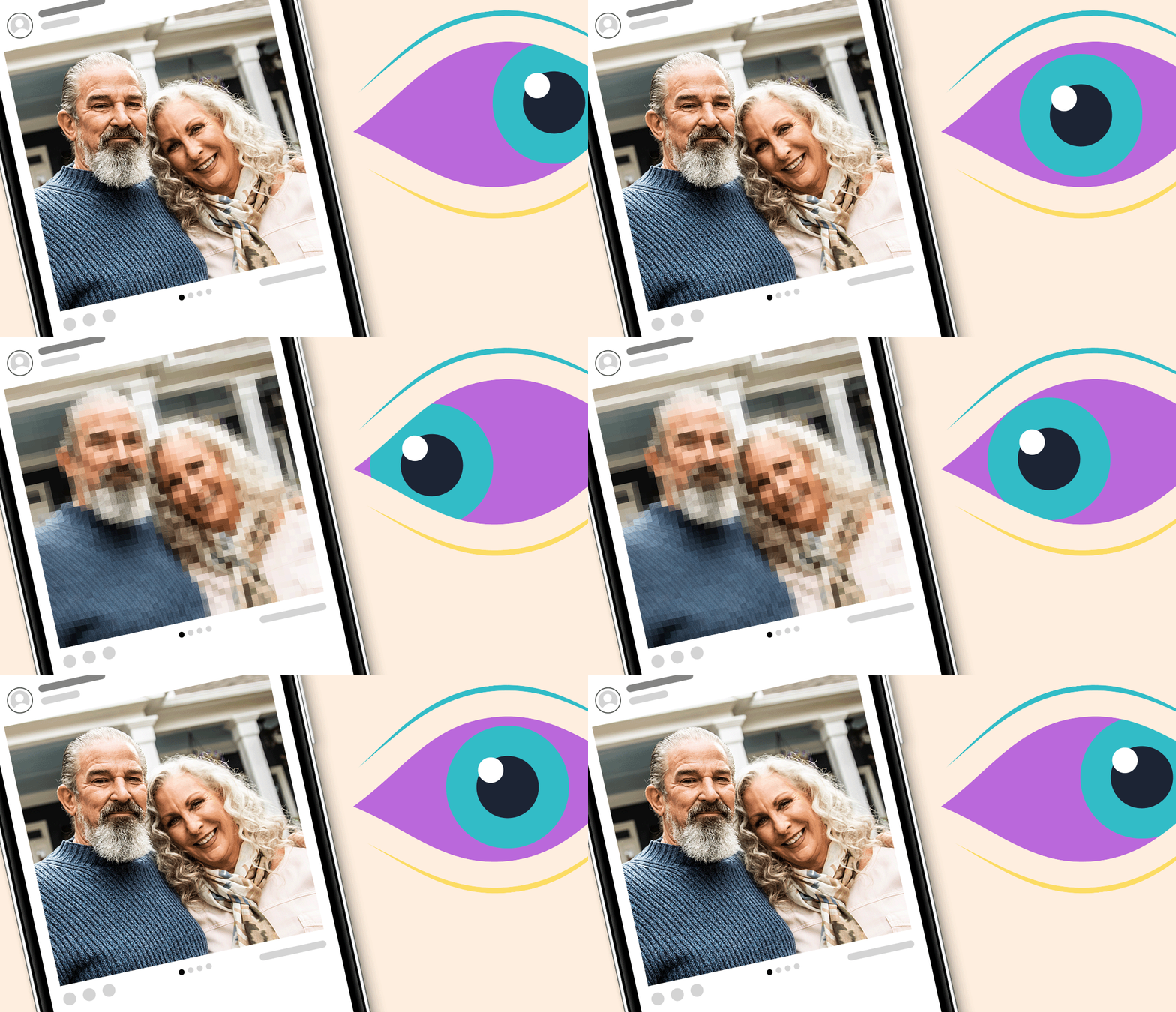
Animation: AARP; (Source: Getty Images (3))
I understand that my social media posts are being used to train artificial intelligence (AI) systems. I’m troubled and wonder what to do about it.
You still can retain some semblance of privacy, a topic of extreme importance to older adults. Though frankly, when it comes to training AI systems, the cat’s mostly out of the bag.
More Ways to Benefit
- Related Benefit 1
- Related Benefit 2
- Related Benefit 3
- Related Benefit 4
- Related Benefit 5
Indeed, the artificial intelligence chatbots and services that are top of mind for many nowadays are sucking up your social media posts to train AI models. We’re seeing this on Facebook and X, and I get why you’re put off.
Pardon a quick detour into geek territory: The so-called generative AI systems attracting most of the attention leverage what are called large language models, essentially ginormous databases drawn from publicly available sources on the internet and sometimes private accounts.
Facebook and Instagram’s parent company, Meta, along with X, the Elon Musk-owned social platform formerly known as Twitter, are by default using your posts to feed their own burgeoning AIs, Meta AI and Grok, respectively. The companies are competing in an increasingly crowded AI sandbox against the likes of Google’s Gemini, Microsoft’s Copilot and OpenAI’s ChatGPT.
X recently tweeted — yep, Elon, I’m still calling them tweets — that in the name of improving the Grok experience, it might “utilize your X posts as well as your user interactions, inputs and results … for training and fine-tuning purposes.” X added that posts might also be shared with a service provider called xAI.
How you can opt out of being food for AI on X
First, you’ll need to do this on a laptop or desktop computer instead of your smartphone. Navigate to x.com and click the More icon, represented by three dots in a circle. Next, click Settings and privacy ⚙️ | Privacy and safety and scroll down under Data sharing and personalization to Grok.
Under Data sharing, uncheck the box Allow your posts as well as your interactions, inputs and results with Grok to be used for training and fine-tuning ▢.
Take note of additional options. You can remove your conversation history with Grok by clicking Delete conversation history | Delete. Conversations will be removed within 30 days, X says, unless security or legal reasons dictate otherwise.
You also can make your account private. In More, click Settings and privacy | Privacy and safety | Audience, media and tagging | Protect your posts. Your posts then will be visible to only your X followers and won’t be used to train Grok.
The truth is that not a lot of people can access Grok, which X describes as an “AI search assistant with a twist of humor and a dash of rebellion.” Grok is available only to customers with X Premium ($8 a month) and X Premium+ ($16 a month), so in the grand scheme, we’re talking about a puny number of folks right now.
Research firm Statista pinned the number of X Premium subscribers at 640,000 in April 2023, a mere fraction of the 250 million overall daily users that X claimed in an April 2024 post.
Facebook, other app options to try to stop Meta AI training
While Grok’s numbers are small, Meta AI’s potential reach through Facebook, Instagram, Messenger and WhatsApp is vast. Nearly 2 of every 5 U.S. Facebook users in July were age 45 and older; on Messenger, nearly half were in that age group, according to social media marketer NapoleonCat, based in Warsaw, Poland.
Meta disclosed that publicly shared posts from Facebook and Instagram, including photos, captions and text, are part of the data used to train its AI bot. Private posts are not included in the training data, Meta says. Nor are private messages among you and your friends and family.
Alas, Meta does not provide an opt out if you’re disturbed that your posts are being used to train Meta AI. It does offer a few tools that let you delete personal information.
If you’re chatting with an AI on Messenger, Instagram or WhatsApp, type /reset-ai. This action deletes the AI’s copy of the message along with the context around the conversation. You’ll retain your own copy of the chat.
To delete all your AI chats, type /reset-all-ais instead.
File an objection with Facebook
You also can object to Meta’s use of your personal information in the training of AIs by completing the “Data Subject Rights for Third Party Information Used for AI at Meta” form, found in Facebook’s Help Center. But just like in a court of law, Facebook offers no guarantee that the judge will take your side.

Click one of three choices:
- I want to access, download or correct any personal information from third parties used for building and improving AI at Meta.
- I want to delete any personal information from third parties used for building and improving AI at Meta.
- I have a concern about my personal information from third parties that’s related to a response I received from an AI at Meta model, feature or experience.
Click Send after making your selection and fill in the requested information: country of residence, first and last name, email address and any related prompts that generated a response with your personal information. You can attach a screenshot as evidence, and space is provided to explain your concerns.
Click Send to complete your objection. Whether Meta complies with your request rests in part on the privacy laws where you live — and whoever is behind the proverbial bench at the company.
Bonus tip: Keep confidential information away from AI
Don’t share any sensitive information when engaging with an AI bot or, for that matter, when communicating over the internet. Assume that most anything out there will be used to train an AI system.
What’s more, though not exactly bedtime reading, pay attention when a company reveals changes to its privacy statements. People who aren’t lawyers won’t find it easy to decipher, but you can bet that what’s new is likely to favor the company.
The terms of service are another area to pay attention to. You’ll see what the company says it can use and potentially exploit — data that you may deem to be personal.

AARP Membership
Join AARP for only $15 per year with automatic renewal. Get instant access to members-only products and hundreds of benefits, a free second membership, and a subscription to AARP The Magazine.
You Might Also Like
AI in Veterinary Care: Key Insights for You
AI's role in pet care: benefits and challenges for ownersWhat to Do If You Become a Scam Victim
How one woman worked quickly — with help — to avoid being charged through PayPal