






















































Javascript is not enabled.

Javascript must be enabled to use this site. Please enable Javascript in your browser and try again.

Skip to content
Content starts here
CLOSE ×
Search
CLOSE ×
Search
Leaving AARP.org Website

You are now leaving AARP.org and going to a website that is not operated by AARP. A different privacy policy and terms of service will apply.

25 Great Ways to Travel Like a Millionaire on a Retirement Budget

Learn how to travel cheaply while fulfilling your travel bucket list

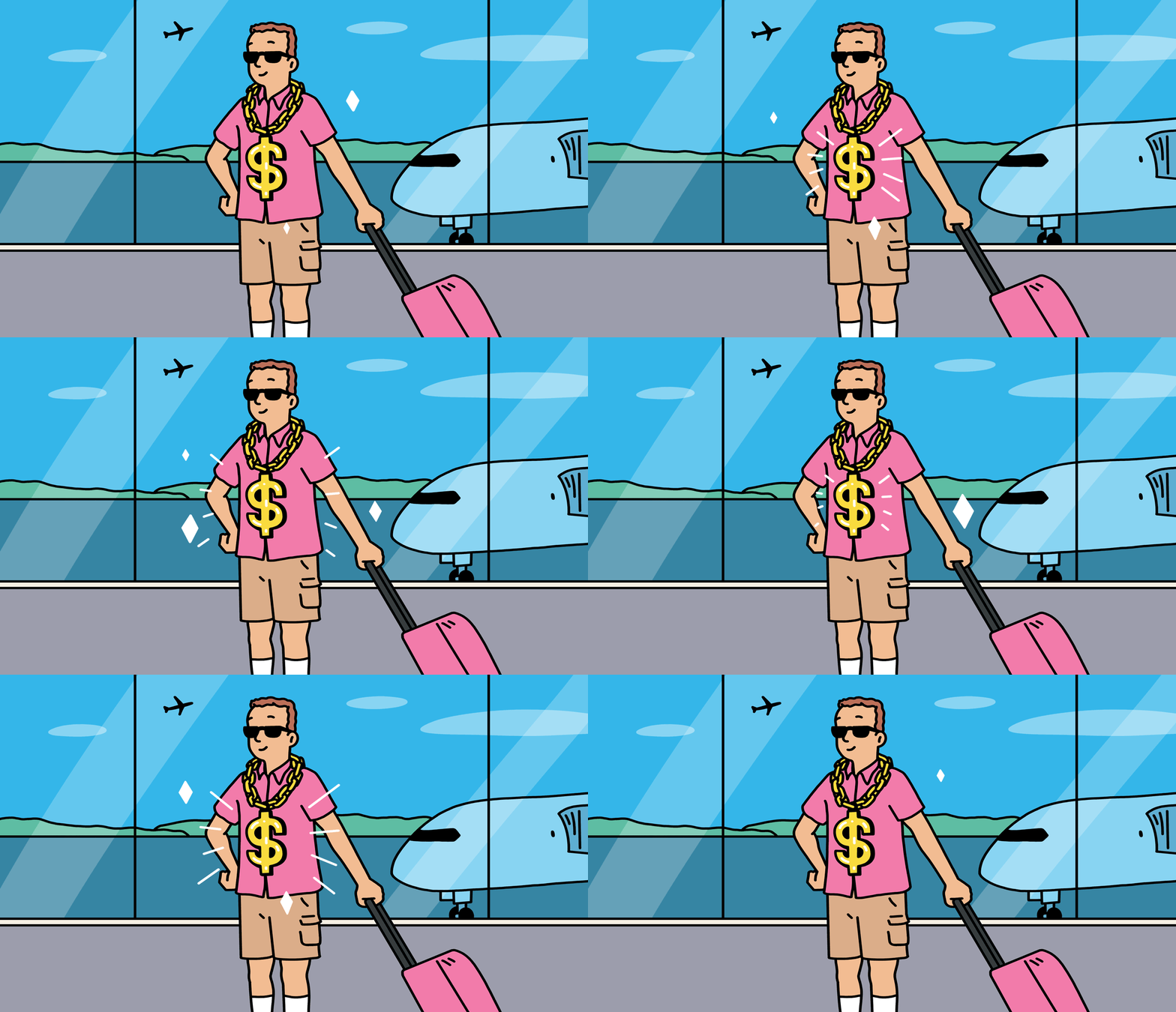
an illustration of a traveler at an airport wearing a dollar sign necklace
Want the luxury travel experience without the luxury price? Follow these steps to elevate your travel game without draining your retirement funds.
Sam Island

Want to travel like the Howells even if your budget’s more Gilligan and Mary Ann? You’re in good company. Travelers over age 50 today crave luxury experiences without luxury price tags — and the savvy ones are having them. The secret isn’t about cutting corners or sacrificing comfort. It’s about knowing when to book, where to splurge strategically and which insider tricks unlock serious value. From shoulder-season timing to leveraging the skills of the right travel adviser, small moves can make the difference between cramped coach and a lie-flat seat, or a mediocre hotel and a room with a view you’ll never forget.

Here’s how to elevate your travel game without draining your retirement account. Think of it as champagne dreams on a coconut budget.

1. Make flexibility your instant upgrade button

If you’ve stopped working and have space on your calendar, travel in the sweet spot between peak and off-season. “Flexibility is what retirement is all about, and there’s no better way to enjoy it than during travel,” says travel blogger Michael Campbell, who, with his wife, Debbie, founded Senior Nomads, a blog and Facebook group for retirees who love to travel. Shoulder seasons are typically warm enough, quiet enough and have enough restaurants and shops open to make your travel dollars go further. AARP Research found that 47 percent of domestic trips and 51 percent of international trips planned by travelers 50-plus in 2025 took place during those quieter windows, and for good reason: Airfares and hotel rates drop, points redemptions open up, and you’re more likely to snag upgrades and late checkouts because staff isn’t slammed.

Weather tends to cooperate in many places (think the Mediterranean from April to May and September to October; Alaska in May or September; the Caribbean in late April or early December), tours run with smaller groups, and famous sights stop feeling like mosh pits. “Book flights earlier than you think,” Michael Campbell says, suggesting six to eight weeks ahead for domestic, and up to 12 weeks for international trips.

2. Use a travel agent: the smart, old-school kind that still gets you extras

Travel is mostly DIY these days, but agents are particularly helpful for cruises and specialty trips such as safaris or Disney. For cruises, they often get you onboard credits, upgrades or extra perks even if the base price is the same; with safaris or Disney trips, expertise and connections matter. 

How do you find a good agent? Start by checking online travel agencies to compare prices. If you’re new to the game, start with AAA, the AARP Travel Center, Vacations to Go or a reputable cruise or tour specialist (read their reviews first). 

What can an agent help with? AARP’s 2025 travel trends survey showed a strong interest among older travelers in guided tours (24 percent). Additionally, 55 percent of travelers expressed interest, once introduced to the concept, in curated trips, which bundle hotels, local transit and key activities at negotiated rates. An agent stitches those pieces together, adds perks like breakfast or late checkout, and keeps surprise costs from creeping in. As Patty David, vice president of consumer insights for AARP Research, puts it, older travelers “bundle the basics so they can go upscale on the experiences.” This means you lock in essentials at a value, then spend your freed-up budget on the fun stuff. 

A good adviser also saves you time and stress: They monitor fare drops, flag better cabin categories, steer you to shoulder-season dates and advocate for you when something goes sideways. “For cruises especially, agents often have access to group space, extra amenities … like prepaid gratuities or drink credits and promo codes you won’t see booking on your own,” says Erica Silverstein, a cruise industry analyst. 

Pro tip: Tell your agent your must-haves and your budget ceiling, and you’ll get a cleaner plan, fewer surprises and enough cushion left over to say yes to a chef’s-table dinner or a private guide.

3. With Global Entry plus TSA PreCheck, you’ll feel like a million bucks (for around $120)

For older travelers, this combo buys the two things that make trips feel luxurious: time and calm. TSA PreCheck gets you through security faster. “Laptops stay in your bag, and lines move quicker,” says Kyle Potter of Thrifty Traveler. Global Entry includes PreCheck and fast-tracks you through U.S. customs when you return, so you’re not standing in a massive line after a red-eye from Europe. Both last five years and cost $120 for Global Entry, and “many travel credit cards reimburse the full fee, making your net cost zero,” Potter says.

You’ll need to book an in-person interview at an enrollment center at an airport or other location, but here’s a hot tip: “Enrollment on Arrival” allows you to complete your interview on the spot upon returning from an international trip. Just make sure to enroll online before your trip to receive conditional approval.

4. Turn coach into business-ish class with seat selection and carry-on comforts

“Start with the airline seat, because that affects the whole trip,” says Debbie Campbell of Senior Nomads. She likes a window seat, and Michael’s OK with the middle. If they need to, they “will spend a bit of our hard-earned savings to upgrade to a little more legroom if a flight is longer than a few hours,” Debbie says. After visiting more than 95 countries, the Campbells also have a few DIY tricks to add comfort: Bring a bed pillow from home or a neck pillow, a snack box containing protein and chocolate, a tiny face-mister, maybe a scent roller. “These little things don’t cost much, but they transform how you feel when you land,” Debbie says.

an illustration of a person looking at a sparkling cruise ship
For more affordable luxury at sea, go “vintage” by choosing an older ship.
Sam Island

5. Go vintage for more affordable luxury at sea

Want a cheaper cruise? Pick an older ship, says Silverstein. Example: Royal Caribbean’s Oasis of the Seas, an older ship in the fleet, had a six-night Western Caribbean sailing that departed in November 2025, priced at about $477 per person for an interior cabin. That’s around $79.50 per night. By contrast, its brand-new Star of the Seas regularly lists seven-night interior cabins on a similar route for around $1,050, or roughly $150 per person, per night, which is more than double the per-night cost. “It’s often the same line with similar routes but very different price bands. because new ships carry a novelty premium,” Silverstein says. If your itinerary is your priority, choosing an older vessel can trim hundreds of dollars per cabin and still deliver the core experience.

6. Fly flat without going flat broke

If you’ve ever eyed those fancy lie-flat airline seats up front and thought “keep dreaming,” here’s a bucket-list hack worth considering. You can fly business class with a flat bed domestically for as low as $900 round-trip, and even lower on shorter routes, if you know where to look, says Potter. Business-class seats on American, JetBlue Mint and Delta One are almost always cheaper on transcontinental flights than international ones, especially if you’re flexible with dates and ready to jump when fares drop. Start with Google Flights (Skyscanner and Kayak are other great options): Set the cabin filter to “Business” and search for wide-body aircraft like the Boeing 777, Boeing 787 or the Airbus A350, since those planes are most likely to have true lie-flat configurations. Watch for fares highlighted in green — those are the current lows.

If you’re more interested in the lie-flat experience than the destination, hunt for short premium routes. “Once a day, Delta flies its Airbus A350 with Delta One Suites between Minneapolis and Detroit,” Potter says. “You might not feel like a millionaire for long, but getting that lie-flat [seat] and a glass of champagne at boarding for an hour-and-a-half [flight] gives you that mile-high rush at a fraction of the cost.”

7. Cruise like a high roller using casino reciprocity

Here’s a bet worth considering if you like playing poker or blackjack on cruises. “Some casino loyalty programs have reciprocity, so you might leverage that into a free or reduced-price cruise,” Silverstein says. In this case, you can use your loyalty status at a casino for perks at another brand. Even casual players can get future sailing offers after spending time in a ship’s casino. Silverstein is quick to add: “Gamble at your own risk, but if you were going to play anyway, make it count.”

8. Use a day pass to save for first-class experiences

Ride like a local, save like a pro and spend where it actually feels fancy. “We make buses, trams and subways our default,” says Debbie Campbell. Buy a day pass on a local public transit line, follow transit directions from Google Maps, Moovit or Transit, or do what the Senior Nomads do whenever they arrive in a new city: “Take one scenic line end-to-end to get the lay of the land” without the price of more expensive tour buses, Debbie Campbell says. Many transit systems offer senior discounts or off-peak pricing, so your discounted pass can cover a whole day of crosstown sightseeing. Pocket the savings and upgrade the fun: Book a nicer lunch, spring for a small-group tour or reserve first-class seats on longer European train hops.

9. Sail when ships relocate — and pay half

Repositioning cruises are the ultimate hack for travelers with time to spare. When ships relocate between seasons (say, from Alaska to the Caribbean), you can hop on for a two-week transoceanic trip, often at significant savings. “It’s usually a bunch of sea days, a longer itinerary and always a lot less expensive,” Silverstein says. Think European ports one week, Caribbean beaches the next, all on the same voyage — exactly the kind of unhurried travel that suits retirement schedules.

The savings are no joke. For instance, as of mid-December, Celebrity Ascent’s April 2026 Fort Lauderdale to Rome crossing costs $2,519 per person for 14 nights, compared to $6,799 per person for 10 nights in January from Fort Lauderdale on a loop through the Caribbean. Yes, the sail around Barbados and St. John’s is more exotic, but it’s the same ship at a huge discount. And you still get a vacation. As Silverstein says, “It’s the rare case where the journey really is the destination.”

an illustration of a person walking from one house to the next
Live in luxury for (almost) free by home-swapping or house-sitting.
Sam Island

10. Live in luxury for (almost) free: Home swaps and house-sitting

Hotels are delightful, but traveling can feel even snazzier with a full kitchen and spare bedrooms in a quiet neighborhood. For the cost of a yearly membership or service fee, you can do a home exchange that works like an old-fashioned trade: You stay in someone’s Paris apartment while they use your Phoenix condo, either simultaneously or banked for later through a points system. Sites like HomeExchange (with an annual fee of $235), Kindred (which charges nightly service fees of $5 to $45 a night) and ThirdHome (with weekly fees starting at $495) provide identity verification, damage protection up to $1 million and backup support if plans fall through.

House-sitting is the pet-lover’s secret weapon: You care for a homeowner’s dog, cat or garden in exchange for free lodging, often for weeks at a stretch. Platforms like TrustedHousesitters, HouseSitter.com and MindMyHouse allow travelers to immerse themselves in the local community and spend time with adorable pets.

Common sense leads the way: Read house rules carefully, communicate like a considerate neighbor and nail down the details on responsibilities, accessibility and what type of rubbing Bogey the schnauzer likes best. Whether you’re after a month in a Tuscan villa or a cozy week caring for a spoiled terrier in Seattle, home-sharing and house-sitting services “give you that cozy nest without the nightly hotel tab,” Debbie Campbell says.

11. Know who gives upgrades and who doesn’t

Not all airlines play the upgrade game the same way, so it pays to know which ones are actually willing to move you up. “I wouldn’t book a cheap fare and bank on snagging an upgrade,” Potter cautions. Most legacy carriers have tightened their policies dramatically in recent years. But a few airlines still routinely sell last-minute paid upgrades at reasonable prices, often just hours before departure.

Potter has seen Aer Lingus offer one-way business class upgrades from the U.S. to Dublin for as low as $199 per passenger. That means if you booked an economy ticket for around $1,000, you could end up with a lie-flat seat across the Atlantic for well under $2,000 total, a fraction of what business class costs outright. He’s also seen sub-$500 upgrades on Air France-KLM transatlantic flights — “not a slam dunk,” he admits, “but a real possibility.”

For a fixed-income traveler, a well-timed $300 upgrade can be the difference between “got through it” and “arrived rested,” and that’s worth planning for.

12. Try a ‘guarantee cabin’ and let fate upgrade you

When booking a cruise, consider selecting a room category (inside, ocean view or balcony) instead of your exact room. The cruise line will assign what’s left. “It’s a roll of the dice, but guarantee cabins are almost always the lowest fare in their class,” Silverstein says. “You might end up near the elevator, but you also might score a mini-suite for the price of a standard balcony.” Since these “guarantee” fares are the lowest in their class, you’ll often save hundreds. Just read the fine print; some don’t qualify for perks like drink packages or free Wi-Fi.

13. Book ‘private room + private bath’ to get a suite feel for less

After overnighting in hundreds of vacation rentals, the Senior Nomads now sometimes skip whole apartments and target private rooms in owner-occupied homes that function like mini-suites. “They’re less expensive,” says Michael Campbell, adding that with an attached bathroom, it’s often “a self-contained place with a little kitchenette, and it maybe even has its own entrance.”

The Campbells recommend filtering for “private room,” then scanning for an en-suite bath, a kitchenette and a separate entrance. When Airbnb launched Airbnb Rooms in 2023, it reported that 80 percent of rooms were under $100 per night, with an average of around $67. The rooms included privacy indicators such as bedroom locks and private baths. But there’s one more perk: “You have a local contact who knows where you are and can tell you about the best local places,” says Michael Campbell. “It’s so much better than arriving to a lockbox with your key inside. It’s sometimes even a local concierge,” and a bit of a safety net.

14. With credit card points, focus on welcome bonuses and flexibility

If you’ve never gotten into the points game, here’s what you need to know: It’s basically using credit cards to collect airline miles or travel points, then turning those points into cheap (or free) flights and hotel nights. The trick is to work with the system, not let it work you. Banks are eager for new customers, so the real payoff is in the welcome bonuses, not the tiny trickle of points from everyday spending. “Every bank, as an incentive to get a new card member, will offer anywhere in the neighborhood of 75,000 to as much as 200,000 miles for spending $4,000 to $8,000 in a three- to six-month window,” Potter says.

Step one: Don’t open a card just because the offer looks big; wait until you have a big known expense — property taxes, a home repair or holiday gifts — so you can meet that spending requirement with money you were going to spend anyway, Potter suggests. Step two: Favor flexible programs such as Chase Ultimate Rewards, American Express Membership Rewards, Capital One VentureOne and Citi ThankYou Points, which let you move points to many different airlines and choose whichever has the best deal when you’re ready to travel. Step three: If you tend to fly with the same one or two airlines, consider their branded cards as well. As Potter’s Thrifty Traveler colleague Gunnar Olson noted in a recent article, “The return from my travel rewards credit cards is worth way more than what I pay in annual fees every year. It’s as simple as that.” 

an illustration of people sitting on a bookshelf
Shhh! The quietest luxury in travel can be found in a local library.
Sam Island

15. Shhh! The quietest luxury in travel is a local library

The public library can be the most underrated travel hack in any city, the Campbells say. “You can get free Wi-Fi, clean restrooms, free guidebooks, newspapers and bulletin boards with a jajillion things to do, and nobody’s trying to sell you anything,” says Debbie. Plus, you’re almost guaranteed to find someone who speaks English. Find a table and plan your next few days from there, allocating your paid time and money precisely. 

16. For car rentals, search for big-box savings

If you belong to a warehouse club, don’t overlook their travel sites. BJ’s, Costco and Sam’s Club all negotiate discounts on flights, hotels and simple resort or cruise packages. It’s great if all you really want is an easy beach week someone else has bundled for you. For car rentals, though, Costco Travel is the standout, Potter says. The automotive blog Jalopnik recently compared Costco’s prices with rental agency prices in five U.S. cities and found that Costco often came in lower. At New York’s John F. Kennedy International Airport, an Avis economy car booked through Costco ran about $162 a day, versus roughly $245 booking directly with Avis — and it was still cheaper than Avis’ own “pay now” discount rate of $209.10. Costco’s travel portal displays the full price, including taxes and fees, up front, and usually allows you to cancel without penalty if your plans change, Potter says. 

If Costco Travel isn’t your thing, AARP and AAA also offer car rental discounts.

17. Stay longer so nightly costs and fees ‘shrink’

When you add more days to a stay, there’s generally greater savings. NerdWallet analyzed thousands of Airbnb stays and found a median savings of about 32 percent for one-week stays and about 46 percent for one-month stays, versus nightly pricing. Hotels show the same pattern. Extended-stay brands publicly advertise bigger discounts the longer you book, reflecting standard length-of-stay pricing across the sector.

18. Book direct to outsmart travel fees (and maybe get an upgrade)

For straightforward travel plans, avoid the middleman to keep more of your money. “When you book direct, you see every tax, resort fee and cancellation term up front, and you’re far more likely to reach a human who can waive a charge or throw in something, which might be a free breakfast,” says AARP’s David. Hotels save up to 30 percent in commissions when guests skip third-party sites, leaving wiggle room for perks like room upgrades or early check-in. “Older travelers don’t want surprises,” David says, “so call before you click, and you’ll get clarity, control, and sometimes a nicer room for the same price.”

19. Start every city with a free walking tour

In almost every new city, the Senior Nomads will kick off their visit with a free walking tour. “It’s the best time investment you can make on day one,” Debbie Campbell says. Well-reviewed companies, including Sandemans, FreeTour and GuruWalk, offer tip-based options with clear notes on pace, accessibility and local guides. “You’re tipping what you think it’s worth at the end, so there’s no sticker shock,” Campbell says. “And you leave with the layout of the city, the history, and most important, intel on where locals actually eat and drink.”

Then switch to an on-your-own audio tour and keep the stories rolling without the group price tag. Rick Steves’ Audio Europe has dozens of pause-friendly walks; SmartGuide layers narration with offline maps and insider tips; VoiceMap hosts hundreds of locally narrated walks, bike rides and scenic drives worldwide; and TravelStorys offers GPS-based tours packed with place-specific tales from locals. One tip: Download everything over Wi-Fi, bring comfy earbuds and flip to airplane mode to save your battery. You’ll move at your own pace, spend pocket change and still get the good stuff (with time and money left for the city’s poshest pastry).

an illustration of a person with clouds in the shape of dollar signs over their eyes
Think rich by trying for extras, then savoring them.
Sam Island

20. Think rich

Adopt the millionaire mindset and buy yourself time. “You don’t need marble and caviar to have an amazing vacation [and] feel like a million bucks,” cruise expert Silverstein says. Happiness science backs that up: A large cross-national study in PNAS found people were happier when they spent money to save time — outsourcing small hassles, then using the freed minutes to actually enjoy themselves. So lean into the luxuries. Pick the rate that includes breakfast, book the hotel transfer, say yes to late checkout and linger in a quiet lounge or on the ship’s deck at sunset. Gratitude plus a few time-saving choices equals first-class memories on a retiree’s budget.

21. Use tech to catch cheap fares — then move fast

For airfare, the scariest move isn’t using technology; it’s ignoring it and overpaying. Today’s tools can watch prices for you while you go about your day. Start with Google Flights to see whether a fare is high, average or low, then double-check Kayak, which gives simple “buy” or “wait” advice. On both sites you can turn on price alerts, so they email you when the fare changes. Sites like Going.com (formerly Scott’s Cheap Flights) and services like Thrifty Traveler do the same thing on a personalized level, sending you email alerts when unusually cheap flights pop up from your home airport.

Thrifty Traveler’s Potter recalls waking up to an alert that flights from Minneapolis to Bogotá, Colombia, had dropped from $800 to $221. “Colombia wasn’t super high on my travel list,” he says, but he booked it, and it turned into one of his favorite trips ever. The lesson: Let the tech do the hunting, and when a truly good fare lands in your inbox, be ready to pounce.

22. Cushion your journey with travel insurance

“Trip insurance could be your most valuable travel investment,” Michael Campbell says. One fall, heart episode or unexpected hospitalization abroad can cost tens of thousands of dollars out of pocket, so protect your travel investment with insurance. Start with trip cancellation and interruption coverage, add medical and evacuation coverage for overseas travel (original Medicare stops at the U.S. border), and spring for a pre-existing condition waiver if you purchase soon after your first payment, typically within 10 to 21 days. Consider “Cancel For Any Reason” (CFAR) coverage, which reimburses 50 percent to 75 percent if you change your mind for any reason, but only if you buy it within about 15 days of your first payment and cancel at least 48 hours before departure. The bottom line: Spending around 6 percent of your trip cost now means the retirement savings you worked decades to build remains protected, so one bad break abroad doesn’t undo your careful budget at home.

23. Bring the crew and split the nice stuff

Traveling with family or friends can multiply your buying power. AARP’s 2025 Travel Trends survey showed 15 percent of domestic and 11 percent of international trips were multigenerational — an ideal setup for sharing costs on a larger rental, private drivers or guides. The same report found 38 percent of domestic and 16 percent of international travelers planned to stay with friends or relatives, saving significantly on lodging. Among those tightening budgets this year, 57 percent said they’re choosing less expensive trips, and 11 percent are splitting costs outright, but that can boost the experience and make you feel good, too. “An overwhelming majority agree travel is good for physical health and mental health — motivated by spending time with family and friends, taking time to get away from normal everyday life and taking time to relax and rejuvenate,” says AARP’s David.

24. Book your own cruise tours

Four people with a passionate local guide beats 40 people on headsets every time. On port days, skip the ship’s cattle call and hire locals who can tailor the time to you. “It can actually work better to do a small van kind of tour rather than a giant bus tour,” Silverstein says. Read reviews on Airbnb Experiences, Viator and ToursByLocals to trade the cookie-cutter museum stop for a family-run olive-oil farm, a seaside café or a few extra minutes at that perfect viewpoint because the light’s just right. Study port maps to determine if you can walk into town or need transport. Choose small groups (six to 12) with clearly defined cancellation windows. Always build a generous “all-aboard” return buffer (like 90 minutes before your ship departs). There’s nothing luxurious about missing your ride out of town.

25. Ask! It’s free, and it works

Here’s the truth most travelers miss: Front-desk agents can upgrade you — they just don’t always volunteer to do it. Potter can’t count how many times he’s “walked into [a hotel] room and had a bottle of champagne waiting” because he’d mentioned it was his anniversary or his wife’s birthday. The secret, he says, is in the asking. When you’re booking or checking in, be gracious and friendly and ask, “Are there any complimentary upgrades available?” As Potter says, “Worst case scenario? They say no, and you get the same room you already paid for. Best case? You’re sipping that champagne in a suite with a view you didn’t budget for.”

Unlock Access to AARP Members Edition

Join AARP to Continue

Already a Member?

AARP Travel Center

Or Call: 1-800-675-4318

Enter a valid departing date

Enter a valid returning date

Age of children:

Child under 2 must either sit in laps or in seats:

Enter a valid departing date

Age of children:

Child under 2 must either sit in laps or in seats:

Enter a valid departing date

Age of children:

Child under 2 must either sit in laps or in seats:

Flight 2

Enter a valid departing date

Flight 3

Enter a valid departing date

Flight 4

Enter a valid departing date

Flight 5

Enter a valid departing date

+ Add Another Flight

Enter a valid checking in date

Enter a valid checking out date


Occupants of Room 1:


Occupants of Room 2:


Occupants of Room 3:


Occupants of Room 4:


Occupants of Room 5:


Occupants of Room 6:


Occupants of Room 7:


Occupants of Room 8:


Enter a valid departing date

Enter a valid returning date

Age of children:

Occupants of Room 1:

Age of children:


Occupants of Room 2:

Age of children:


Occupants of Room 3:

Age of children:


Occupants of Room 4:

Age of children:


Occupants of Room 5:

Age of children:

Age of children:

Child under 2 must either sit in laps or in seats:

Enter a valid start date

Please select a Pick Up Time from the list

Enter a valid drop off date

Please select Drop Off Time from the list

Select a valid to location

Select a month

Enter a valid from date

Enter a valid to date