
AARP Hearing Center















































9 Surprising Things Your Hands Can Tell You About Your Health
These surprising health clues are within your grasp, if you know how to recognize them


Anuj Shrestha
Hands are, by definition, pretty darn handy. But one of their hidden talents is divulging potentially subtle health problems that need a doctor’s attention. Here are nine things your hands and fingers may be trying to tell you.
More Ways to Benefit
- Related Benefit 1
- Related Benefit 2
- Related Benefit 3
- Related Benefit 4
- Related Benefit 5
1. A weak handshake
Condition: Increased frailty
Grip strength reflects overall body strength and health, and has been linked to dementia, cardiovascular disease and even mortality, says Mark D. Peterson, a professor of physical medicine and rehabilitation at the University of Michigan.
Grip strength correlates with changes in a person’s DNA that indicate how fast they are aging, Peterson explains.
What to do: Strength training. Says Peterson, “Strength preservation is the most important thing one can do when they pass their 50th birthday.”
2. Swollen, painful fingers
Condition: Arthritis
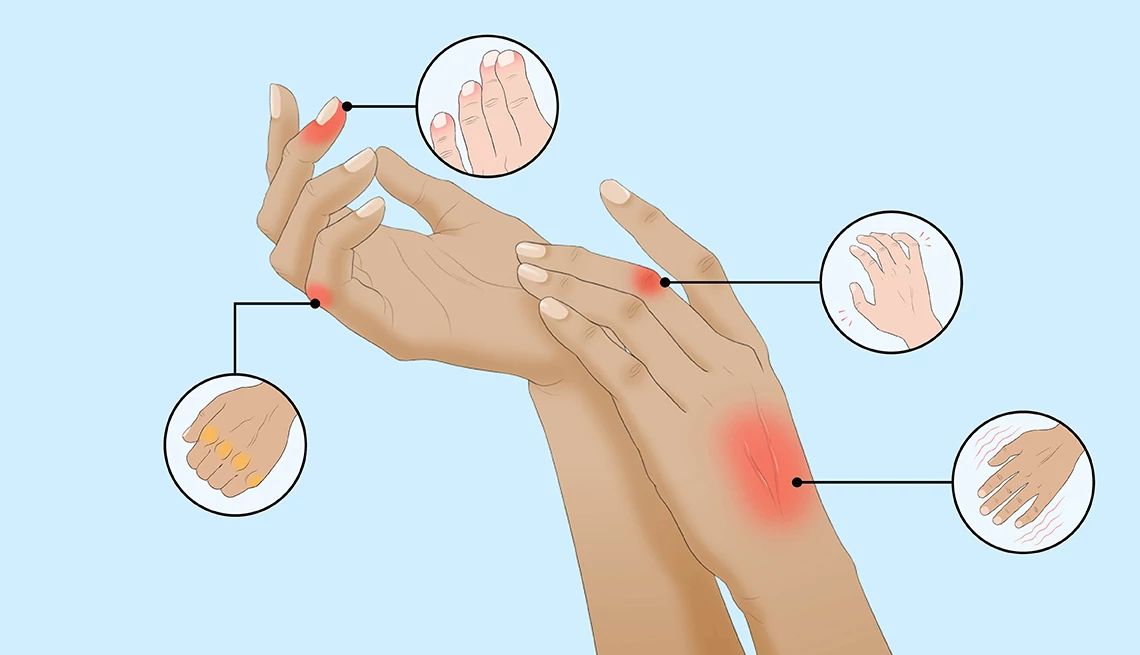
The two most common types are osteoarthritis (OA)—often called the wear-and-tear form of the disease — and rheumatoid arthritis (RA), the autoimmune condition.
“RA is usually symmetrical—affecting both hands—and often involves the joint where the fingers meet the hand,” says Stuart D. Kaplan, M.D., chief of rheumatology at Mount Sinai South Nassau in Oceanside, New York. With RA, the joints are swollen and spongy, he adds. By contrast, OA may affect a single hand (or digit) and often leads to bony overgrowths at the finger’s middle or last joint.
What to do: “We have great drugs for RA, called biologics, that can change the course of the disease and stop it in its tracks,” says Kaplan. “The key is catching and treating it early enough, before the damage is done.” For OA, nonsteroidal anti-inflammatory drugs (NSAIDs) and topical anti-inflammatory creams can help ease the discomfort.
3. Yellow knuckle bumps
Condition: High cholesterol
Hard yellow bumps under the skin of the joints are often deposits of fat called xanthomas, says Shari Lipner, M.D., associate professor of clinical dermatology at New York-Presbyterian Hospital/Weill Cornell Medical Center in New York City. “People who have them may have high lipid levels in their blood.” Xanthomas may signal diabetes, liver disease or an underactive thyroid.
What to do: Consult a doctor. You can usually get rid of these bumps by tackling the elevated lipid levels with cholesterol-lowering drugs.
4. Downward-curved nails
Condition: Lung diseases
Nails that curve down and bulging fingertips are signs of a possibly serious health condition involving the lungs.
“The most common association is with lung disease, including lung cancer,” Lipner says, but they may also indicate COPD, tuberculosis or other health issues.
What to do: See a doctor as soon as you notice a change, she advises, since treatment may require speed.
5. Hand tremor
Condition: A neurologic disorder
The two most common — and concerning — causes are Parkinson’s disease and essential tremor, says Mark Hallett, M.D., former chief of the Medical Neurology Branch at the National Institute of Neurological Disorders and Stroke. The difference? With essential tremor, the hands are still when at rest. “People will notice the tremor when they are doing something like handwriting, grabbing a cup or eating with a fork,” says Hallett. With Parkinson’s disease, however, the tremor occurs when the hands are at rest and stops when they’re in motion, though that can change as the disease progresses.
What to do: See a neurologist to get to the bottom of your symptoms. A hand tremor is occasionally a sign of other rarer neurological conditions or hyperthyroidism, Hallett notes.
6. Spoon nails
Condition: An iron imbalance
If your fingernails are raised on the sides, creating an indentation, you may have a condition known as koilonychia, or spoon nails. “To test for this, you can put a drop of water on the nail,” says Lipner. “If the water stays on the nail, you’ve made the diagnosis.”
The condition has long been associated with an iron deficiency, but it can also indicate an excess of the mineral, as well as both hyperthyroidism and hypothyroidism. Your doctor may need to run some tests to determine the exact cause of the issue.
What to do: Start by consulting your general practitioner, especially if you’re also experiencing fatigue and anxiety, which can be symptoms of both iron imbalances and thyroid problems. Says Lipner, “If you treat the underlying cause, the spooning usually resolves.”

7. Joints that pop
Condition: Trigger finger
Finger joints that stick or lock, accompanied by a pop or clicking sound, are clues to this common condition, which happens when the tendon that allows a digit to bend gets stuck and can’t glide smoothly in its sheath. The condition, which often occurs in the middle and ring fingers, can be quite painful, says Kaplan.
“Trigger finger usually happens in people who have underlying osteoarthritis due to some overgrowth of the bone irritating the tendon,” he explains.
What to do: Rest, splints, gentle stretching and NSAIDs are helpful in quelling the pain. If these don’t work, your doctor may recommend a steroid injection. Surgery to release the tendon is a last resort.
8. Nail pitting, red-brown lines under nails
Condition: Psoriasis or skin cancer
“Commonly, we see [nail issues] in association with psoriasis as well as psoriatic arthritis,” says Lipner.
While you might expect to see skin problems with psoriasis, sometimes pits in the nails are the condition’s only sign. But they may be accompanied by splinter hemorrhages (red-brown vertical lines under a nail that look like splinters), and the nail may be lifted from the nail bed. Dark streaks under the nails can, in rare instances, indicate skin cancer.
What to do: Consult a dermatologist about the possibility of psoriasis or skin cancer, the latter of which can be deadly if not treated.
9. Dark fingernail streaks
Condition: Skin cancer
Black or brown streaks in a fingernail can be a mole or a sign of infection, but there are more concerning possibilities. Dark streaks can also indicate melanoma, the most dangerous form of skin cancer.
“Nail melanomas are actually quite rare,” says Lipner. “However, they’re important to diagnose early because they can be much more deadly than even skin melanomas.” In addition to the vertical lines, melanomas may also cause the nail to split, bleed or seep pus.
What to do: See your doctor if you notice an issue. And since nail changes can go unnoticed among people who get regular manicures, be sure to give your nails a good look once a month, Lipner adds.

AARP Membership
Join AARP for only $15 per year with automatic renewal. Get instant access to members-only products and hundreds of benefits, a free second membership, and a subscription to AARP The Magazine.
More on Health
8 Major Health Risks for People 50 and Older
A look at the top killers — and how to dodge them
10 Things Your Toes Could Say About Your Health
Doing a little digit detective work might help you spot heart disease, diabetes and moreWhat Your Nails Say About Your Health
They can hold clues to a number of conditions