
AARP Hearing Center





































15-minute read

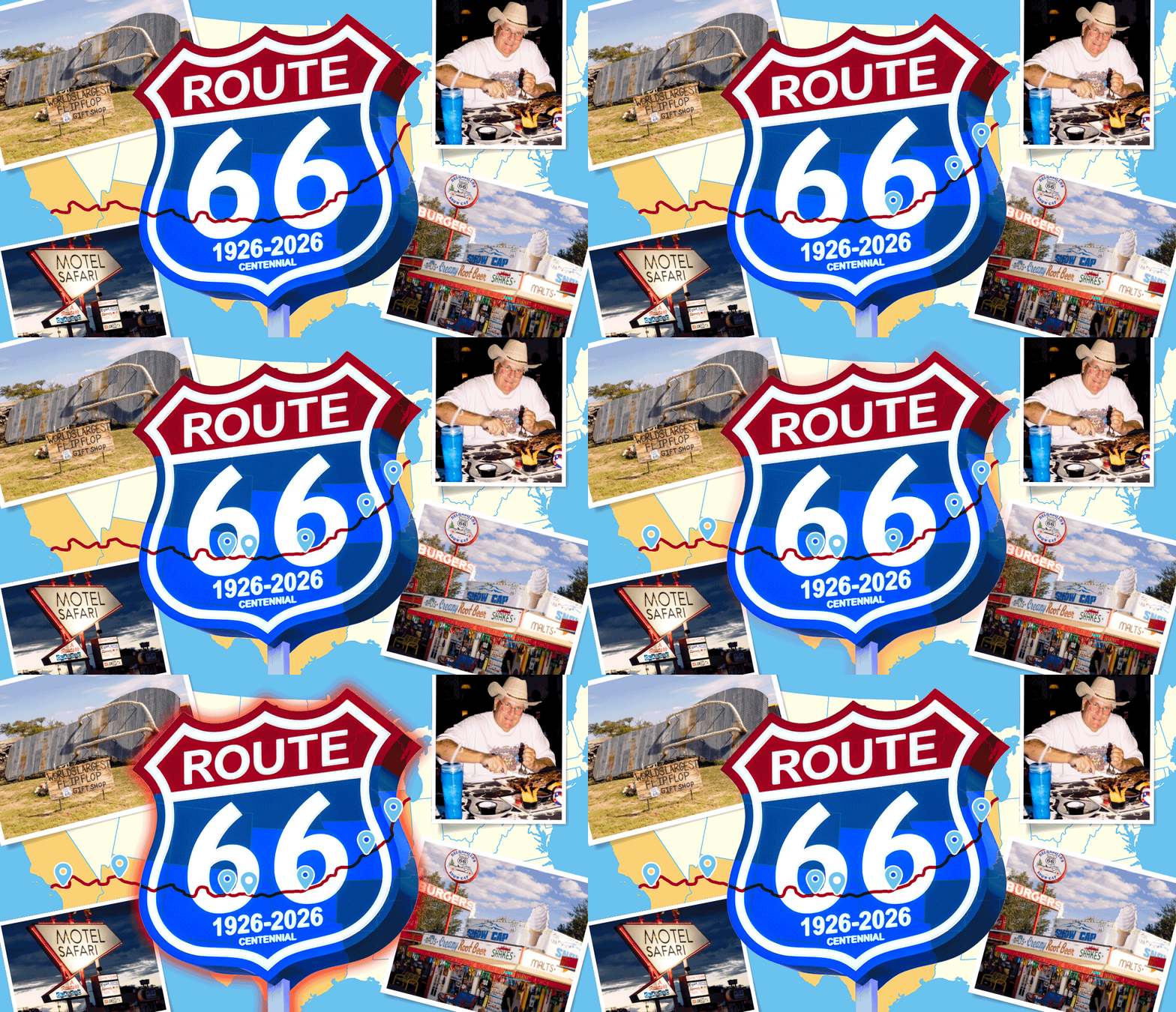
In November 2026, Route 66 celebrates 100 years of roadside attractions, restaurants and motels, connecting America’s Midwestern and Southern states en route to California.
AARP (Cassidy Araiza 4; Map: Shutterstock)
Born on Nov. 11, 1926, Route 66 was built to link America’s heartland to the sun-drenched promise of its glamorous West Coast. It swung south between the shores of Lake Michigan in Chicago to Los Angeles’ Pacific Ocean beachfront, connecting 2,400 miles of existing local, state and national roads.
When the Great Depression hit, the road served as an escape route, escorting desperate families out of the Dust Bowl to the promise of a better life. This purpose is what prompted author John Steinbeck to give Route 66 its beloved nickname: The Mother Road.
More Ways to Benefit
- Related Benefit 1
- Related Benefit 2
- Related Benefit 3
- Related Benefit 4
- Related Benefit 5
The end of WWII brought more prosperous times, and Americans with shiny new cars traveled Route 66 just for kicks. Over three decades, America’s speedy four-lane interstate highway system developed, culminating in the route’s official decommissioning in 1985.
But Americans missed the drive-ins, motels, roadside oddities and more that had collectively come to symbolize the classic American road trip. It was revived — designated as a historic route — for generations of nostalgia-seekers to enjoy. Those travelers include some of the 43 percent of Americans 50 and older who planned to road trip this year, according to AARP’s latest Travel Trends survey. To celebrate the iconic highway’s 100th anniversary, we spoke to the people keeping Route 66’s history and allure alive.

Angel Delgadillo, 99, recognized as the Father of Historic Route 66, enjoys visiting with travelers in his longstanding barber/gift shop in Seligman, Arizona.
Cassidy Araiza
The Birthplace of Historic Route 66
Seligman, Arizona
Angel Delgadillo, 99, grew up along Route 66 during the Depression, when he and his siblings entertained themselves by creating shadow figures on roadside buildings in the headlights of passing cars. Now known as the “Father of Historic Route 66,” Delgadillo’s preservation efforts, on behalf of his hometown of Seligman, are recognized as a key inspiration for the 2006 movie Cars.
The traffic took to [Interstate] 40 like ducks take to water, and we were forgotten. That was Sept. 22, 1978. The town died. My wife, Vilma, and I raised a son and three daughters here, and we didn’t have the money to leave. I somehow kept my barbershop and pool hall [built by his father more than 50 years earlier] open. My wife helped by making and selling donuts and enchiladas. We hung on.
Every now and again, a car came back into Seligman. Some ended up in my pool hall and they would tell me, “This has got to be the highway that my parents traveled from the Midwestern states to go to California.” The more I heard it, the more I was puzzled, thinking, you got that interstate highway that you could travel at 70, 80, 90 miles an hour — whatever you could get away with. What are you looking for?
Finally, I understood: They were looking for America of yesterday. They missed the small towns and the mom-and-pop businesses. And that’s where I got the idea to ask Arizona to make Route 66 historic, from 17 miles east of Seligman, exit 139, to the California border.
My sweetheart and I went to Kingman to see what people would think about my idea. They liked it, and so did people in every town we stopped at along the way. We formed the Historic Route 66 Association of Arizona, the first Route 66 preservation association in the world.
The first letter we sent to the Arizona Department of Transportation asking them to make Route 66 historic was ignored. But those big boys in Phoenix didn’t know who they were dealing with. We all grew up during the Depression; when things were not tough, they were double tough. We didn’t know the words, “No, you can’t.” To make a long story short, the state finally made Route 66 historic in November of 1987, almost 10 years after the interstate opened here.
The telephone began to ring from other people in other states, and they also did what they needed to do. So we, the people, saved a highway that’s going to be 100 years old on Nov. 11. There will be celebration from Chicago to Santa Monica [California]. People keep a-coming and a-coming. Because in getting Route 66 back, we helped to capture the imagination of the world.

Rich Havlik, owner of Motel Safari in Tucumcari, New Mexico, turned a motel storeroom into a community tiki room after purchasing the motel in 2025.
Cassidy Araiza
Motel Safari
Tucumcari, New Mexico
Rich Havlik, 59, left his career as a funeral director in Minnesota to purchase and run Motel Safari, which has welcomed Route 66 travelers to downtown Tucumcari since 1959.
When my last kid was graduating high school, one of my sons asked me, “Now that you can do a vacation for yourself, what are you going to do?” And it was like, “I have no idea.” I never thought that far down the road.
That question bothered me for months. Then, for some reason, doing a road trip on Route 66 popped in my head. When I started researching the route and checking out all the stops, I got this deep nostalgia for decades I never experienced. There’s a word for it: anemoia. So I went on a road trip by myself with a loose game plan. Nothing rigid, just open to anything.
I fell in love with everything I was seeing and experiencing — being on the open road, eating at the ma-and-pas and staying at ma-and-pa hotels and motels. It lit something up inside of me. I did all of Route 66 in chunks over three years, and I wanted to do it again. I’ve done some parts two and three times. I couldn’t get enough.
At the time, I was a funeral director in Minnesota. Then the pandemic hit, and I got burnt out. I was at my desk one day just thinking, Am I going to do this until I retire? Mentally and physically, I wasn’t in a good spot. I thought about it for a few days, and owning and running a motel on Route 66 checked all the boxes in my head. I loved serving families, but everything else made me miserable.
I started looking at motels toward the end of the pandemic and had lots of swings and misses before I quit looking in January 2025. After the owner of one of the missed opportunities had some personal challenges, he emailed me saying, “Okay, let’s talk terms.” I became the owner of Motel Safari on Route 66 in June 2025.
It was a very turnkey situation. The only major thing that I’ve done is add a new themed room for my generation, Happy Days. Growing up Gen X, that was really my only experience with the ’50s. People are great. Everything seems to be falling into place. I consider this serving families, same as I used to. The difference is that people are happy to be here.

A chance meeting at a Route 66 conference led Beth Wiles, then executive director at the Pulaski County Tourism Board, to spearhead the idea of a neon park in St. Robert, Missouri.
Courtesy Pulaski County Tourism Bureau
St. Robert Route 66 Neon Park
St. Robert, Missouri
For more than a decade, Beth Wiles, 62, played a lead role in the campaign to preserve and display Route 66 neon signage at a roadside park on a median of the main thoroughfare in St. Robert, Missouri. The signs now shine from dusk to midnight and during winter’s dark early-morning hours.
Back in 2013, I represented the Pulaski County Tourism Bureau at the Road Ahead conference in California to rally for Route 66 funding and start discussions on the 100th anniversary. During a session regarding the preservation of neon signs along the route, the gentleman who was speaking, Jim Thole, said, “I’d love to see a neon park on Route 66.” The minute he said that, I grabbed the arms of my chair, and I thought, “Oh my gosh. St. Robert, Missouri. That is what we need.” I immediately envisioned it at George M. Reed Roadside Park, in the center of town. It’s the longest continuously operating roadside park in the state of Missouri on Route 66.

The St. Robert Route 66 Neon Park in St. Robert, Missouri, is on a Route 66 median, making it easy for travelers to access from either direction.
Jeff Roberson/AP Photo
After the session was over, I ran up to my hotel room and called my husband. I said, “I’m not going to call you later. I gotta run to the banquet and stalk a gray-haired man.” I went down and slid in behind Jim, following him over to a table. The minute he grabbed a chair, I grabbed one next to him, and said, “Anyone sitting here?” When he said no, I stuck out my hand and said, “I’m Beth with Pulaski County, Missouri.” And he said, “George M. Reed Roadside Park.” It was one of a few parks his small committee had in mind.
I looked into a lot of ways to make it happen and eventually just started a preservation organization to fundraise and collect signs. The first one, Modern Cabins, had been sitting in a local garage attic and hadn’t seen the light of day since 1977. Others were in fields, just laying out in the weather. When COVID hit, tourism was severely impacted, and I thought, I just can’t do this anymore. That’s when the City of St. Robert stepped up and took over. If they hadn’t, the park wouldn’t exist.
At the opening in 2025, I told the story of how this all began. I left the stage to enjoy the lights coming on for the first time, and I hear Mayor James Breckinridge calling me back. He looked at me with tears in his eyes and said, “This is your honor. You need to be the one to flip the switch.” I couldn’t believe it. I flipped that switch, and it was the exact vision I had sitting in that session 12 years earlier.

Ed Threatt’s grandfather founded the Threatt Filling Station, along Route 66 near Luther, Oklahoma, more than a century ago. The Threatt family is currently turning the station into an interpretive center.
Ilana Panich-Linsman
Threatt Filling Station
Luther, Oklahoma
Ed Threatt, 76, is the grandson of Allen Threatt Sr., who built the first Threatt Filling Station around 1915 on 160 acres along what would become Route 66, as a haven for Black locals and travelers. That building burned down and was replaced by a sandstone structure that’s being turned into an interpretive center to educate visitors about the station’s history. Its cornerstone is inscribed March 22, 1933.
When I was growing up, there was a whole three-mile section of land here that was owned by Black people, and all of those people supported the Threatt service station. We sold produce out of the station. My aunt, she used to fix hamburgers, hot dogs, things like that. And my dad owned the bar next door. He named it The Brown Bomber in reference to Joe Louis, the boxer. One thing that Grandpa insisted on is if somebody came to get gas, it didn’t matter what color they were. It didn’t matter if they’re white, green or yellow. It just didn’t matter. You treat them with the same kind of respect that you want to receive.
During the Jim Crow era, the property was a safe haven. There were a lot of what were called sundown towns that had signs up that said people of color could not be in town after 6 o’clock at night. Literally, you could be made to disappear. There was a sundown town to the east of us. There was a sundown town to the west of us. But as far as our property was concerned, no one ever bothered us. Ever. And growing up here was just a joy because I was well protected. The adults knew what the real world was like, what Jim Crow was like, what could happen to Black people. They knew, and so they protected us.
There’s a nice area right behind the service station where people could park, get rest. My dad also owned a Negro baseball team, and we had a full-size baseball diamond and field. There used to be Easter egg hunts and family gatherings on the property. During the race massacre in 1921 in Tulsa, where Black Wall Street was burned to the ground and people’s livelihoods were destroyed, some of those people ended up coming to Threatt service station so that they could feel safe and try to get their lives back together again.
The inside has been fully restored, and we have restored [nonworking] gas pumps in place. We have plans to build a pavilion and create walking trails. We’ve started to clear land for an RV park and to bring that baseball diamond back. It will give a glimpse of what life was like during the Jim Crow era, not just for my family, but for Black folks in general. It’s for everybody. I think that people knowing that they’re welcome here is something that would make Grandpa feel good, because that’s the way he taught us. To welcome everyone in.


The Big Texan co-owner Bobby Lee is seen with the restaurant’s famous 72-ounce steak. The steak-eating challenge area is live-streamed worldwide from the restaurant in Amarillo, Texas.
Cassidy Araiza
Slug Bug Ranch at The Big Texan
Amarillo, Texas
The Big Texan opened in 1960 to meet the Texas-sized expectations of Route 66 travelers through the panhandle. It’s grown into a compound of affiliated attractions, including the Slug Bug Ranch. Now run by the second generation — boomer Bobby Lee, whom we spoke with, and his brother, Danny — a transition to the third generation is in the works.
These real-deal cowboys would get off work at the Amarillo stockyards and stop at The Big Texan for nickel beers. My dad put them at the center table, right in front of the char-broiler, so tourists could see these cowboys sitting there trying to outdo each other. One day, he said, “You know what? We got 12 seats at this table and it’s $5 a seat. I’m going to bring out one-pound steaks over an hour, and whoever eats the most gets to keep that money.”
One cowboy ate four-and-a-half one-pound steaks, which is 72 ounces. He showed off by ordering a baked potato, a shrimp cocktail, a tossed salad and some bread. It was so impressive, my dad said that anybody who comes in and can eat the same meal in one hour, I’m going to give it to you for free.
When Route 66 was bypassed here, we went from a full dining room to two people for the whole day. We had to move, and land was available a few miles away along I-40, off the original Route 66 alignment. Over the years, we added a motel with a Texas-shaped swimming pool, an RV park, a brewery and the Starlight concert venue. Then two summers ago, we got the call about the Slug Bug Ranch — five Volkswagens buried at an angle, inspired by the Cadillac Ranch here in Amarillo.
It was nearby in Conway, right on Route 66. The family that owned it sold the land, but the new owners didn’t want the Volkswagens. When they asked if I’d like to continue the legacy, I said, “You better believe it.” We went with a tow truck and a couple of flatbeds and moved them down here, next to our RV park.
Anything that we put out there will get painted, including trash cans and signage. We put in concrete sidewalks, so people can access it in a wheelchair. We put lights up, because people don’t want to go out there in the middle of the day when it’s 105 degrees. During summer, we have a dance there every Friday and Saturday night, underneath the stars.

Emma Jean’s Holland Burger Café in the Mojave Desert near Victorville, California, has welcomed Route 66 truckers and travelers for decades.
Alamy Stock Photo
Emma Jean’s Holland Burger Café
Victorville, California
Opened by the Hollands in 1947, the cafe catered to Route 66’s long-haul truckers. When one of those truckers bought it for his wife, a waitress there, her name was added to the café’s title. Now, Emma Jean’s daughter-in-law, 51-year-old Shawna Gentry, is the owner, serving food made from scratch to locals and tourists alike.
Back in the day, the cement workers and truck drivers would come in before work, and they would all line up at the counter, drink their coffee and smoke their cigarettes. They’d flip me a quarter and tell me, “Baby, play my song.” I’d go over to the jukebox and play that truck driver’s favorite song. I knew them all.
I was seeing Emma Jean’s son, Brian, and coming in for her when she needed me to. Pretty soon Brian and I were running it together — he was the cook, and I was the waitress. When she passed away in ’96, Brian’s dad was going to sell it, and I said, “You know what? I don’t like that deal. You tear those papers up and take that ‘for sale’ sign down.”
We ran the café together for almost 30 years, until Brian passed away unexpectedly in 2024. I didn’t realize how many lives we’d touched until his celebration of life — there had to have been anywhere from 350, 400 people, if not more. People thought, Oh, she’s going to sell it. When I told everybody I was going to keep it open; if the roof could’ve come off that chapel, it would have. I felt it was my duty to continue to be part of this good, supportive community and preserve our history.
Now we’re more family friendly. We do Mickey Mouse pancakes; the kids get all excited. And I still get my regulars in. I’ve got a couple of families I’ve been waiting on for five, six generations, and customers that’ve come in for 40 years. I know their orders. We don’t even have a conversation about what they want to eat.
And I get tourists every single day. Like today, I had them from the U.K., from Germany, Brazil. And you just go, How did you find this place out in the middle of the desert? Some of them have had friends come and tell them, “Oh my god, you gotta stop here!” In other countries, they don’t have diners like this. They only see it on TV. They want to come feel real Americana.

After Tim Dye fixed up a Pontiac in his teens with his dad, he went on to write books about the brand and amass enough Pontiac items to open a museum.
Courtesy Pontiac-Oakland Museum
Pontiac-Oakland Museum
Pontiac, Illinois
Tim Dye, 65, who founded the museum in July 2011, notes that the Pontiac car and Route 66 both turn 100 this year. Coincidentally, Dye and the route share a birthday — his 66th.
When I was 16, my dad and I fixed up a wrecked ’68 GTO that I drove to school. Ever since then, I’ve had GTOs and Pontiacs. After getting settled in life, my regular pay would go toward paying the bills and I’d work overtime for money toward Pontiacs, Pontiac parts and Pontiac memorabilia.
On April 27, 2009, General Motors announced they were dropping the Pontiac. I turned to my wife, Penny, and said, almost jokingly, “It’s up to us now, I guess. Since they don’t care about selling new Pontiacs, they probably don’t care about preserving that history.”
Months later, as a friend and I were headed back home to Oklahoma from Chicago, we saw the sign for Pontiac, Illinois. I’m like, “I’ve never been here. Let’s pull in.”
We stopped into the Walldog, [a mural and sign art exhibit about the history of painted outdoor advertising], for not even 10 minutes. I’d just finished writing a book about Pontiac memorabilia and history, and the woman working that day bought one from me. As I turned to leave, I said, “If you ever think you want to do a Pontiac car museum, let me know.” She gave that book to the mayor, and the next day he called me and said, “How would you like to move your collection to Pontiac, Illinois?”

The Pontiac-Oakland Museum on Route 66 in Pontiac, Illinois, opened to showcase founder Tim Dye’s collection of cars and memorabilia.
Courtesy Pontiac-Oakland Museum
Penny and I sold our home in Oklahoma and jumped in with both feet. By then, we had 20 cars we’d collected over the years, including a 1970 Firebird Formula 400 with 436 miles on it from new, and a bright red ’54 Star Chief convertible. We moved everything into a city-owned building with wood floors and a tin ceiling, right across from the beautiful courthouse on the classic Midwest small-town square. It was an instant museum.
Lots of people doing Route 66 start in Chicago and go west. Pontiac, Illinois, is one of their first stops. The Route 66 museum is here. Then they did the big Route 66 shield mural, one of the most famous sites on the route. Everybody wants to photograph their car or just themselves with that mural. So many little towns turned into ghost towns, and the city didn’t want to see that happen. They saw tourism as the key to keeping downtown Pontiac alive.
Inspired to hit the route? Find anniversary events at route66centennial.org.

AARP Membership
Join AARP for only $15 per year with automatic renewal. Get instant access to members-only products and hundreds of benefits, a free second membership, and a subscription to AARP The Magazine.
More From AARP
Lesser-Known Historic Sites in Every State
Go beyond the Liberty Bell to find American history in these unexpected places
Explore 7 Hidden Revolutionary War Gems
Visit these 7 spots to celebrate the 250th anniversary of the American Revolution
Recreating Life, and Strife, in 1776
Older Americans participate in historical reenactments and ‘living history’ exhibits