
AARP Hearing Center























.jpg?anchor=17,8&q=80&color=ffffffff&u=8wsalu&w=375 "Fall Movie Preview 2026")
















I Found a Lost, and Surprisingly Timely, Edith Wharton Story
Discovering an unpublished manuscript by the literary legend was a career highlight. Its story of war and privilege feels startlingly relevant today

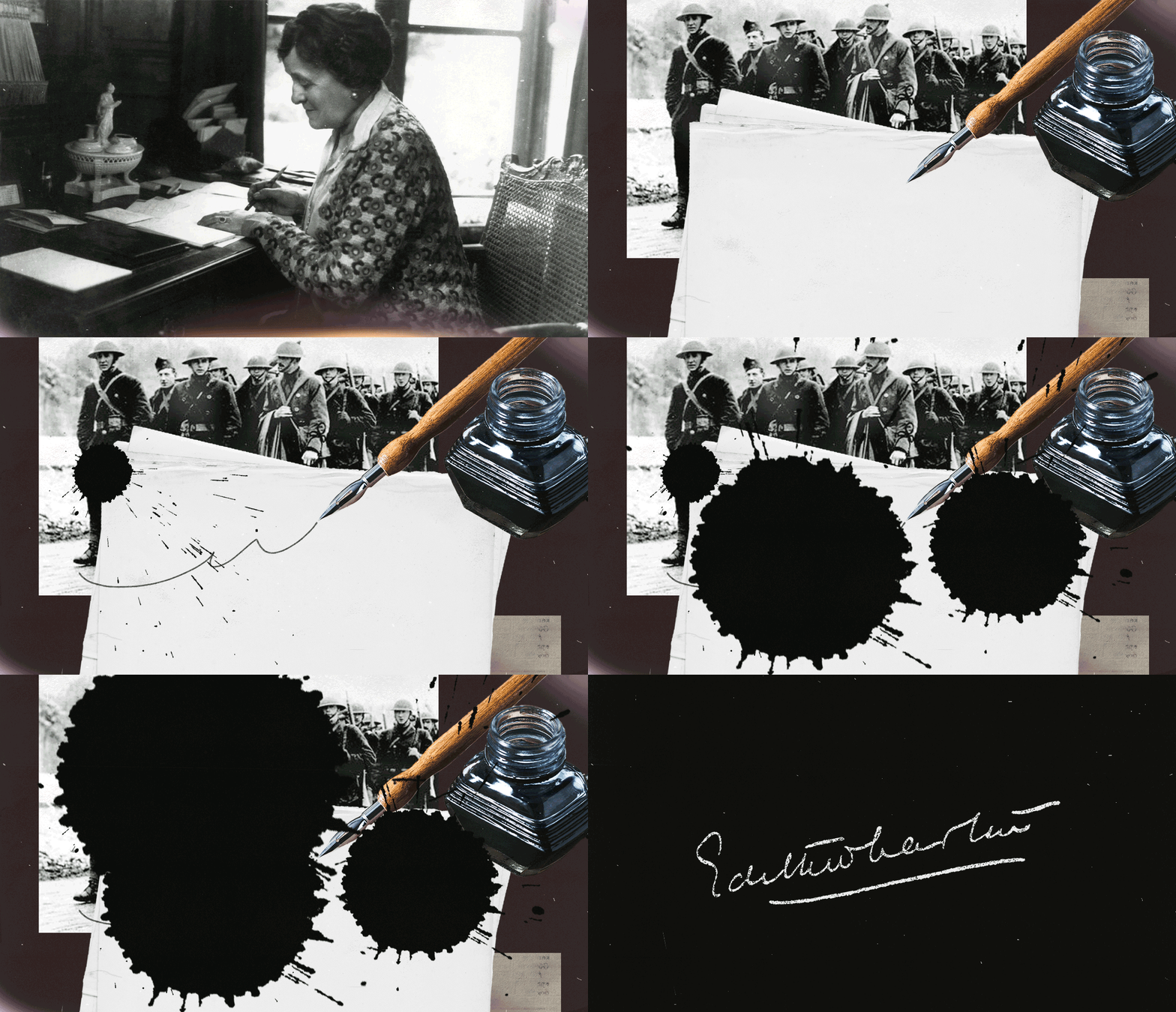
An unpublished story by Edith Wharton was discovered earlier this year by Andrew F. Gulli.
AARP (Everett/Shutterstock; Getty Images,2; AP; Alamy)
For more than 28 years, I’ve been managing editor of The Strand Magazine, a quarterly devoted to mystery fiction and previously unpublished works by literary masters. The best moments come when years of hunting through archives finally pay off: A writer you have admired left behind something the world has never read.
Finding an unpublished Edith Wharton story was one of those moments. “The Men Who Saved the World,” set in France during the First World War, follows a society trying to restore comfort and status while war presses in around it. Its portrait of people insulated from suffering they can see but do not fully confront feels uncomfortably familiar today. Wharton had long been on my personal “hit list” of writers whose unpublished work I’d hoped to find. Many of her manuscripts were handwritten and difficult to decipher. I had requested archival material only to fling my arms up in defeat.
More Ways to Benefit
- Related Benefit 1
- Related Benefit 2
- Related Benefit 3
- Related Benefit 4
- Related Benefit 5
I’ve been chasing lost Wharton stories for over two decades now — long enough that my own relationship to her work has changed with age. Readers who’ve lived a few decades themselves will know that shift: A book that felt like one thing at 25 can feel like something else entirely at 75.

Wharton was the first woman to win the Pulitzer Prize for fiction.
Apic/Getty Images
Early this year, I saw a reference in an index of Wharton materials to a typed manuscript titled “The Men Who Saved the World.” A typed manuscript meant I would not have to spend hours unsuccessfully decoding a single paragraph, but it raised a question: If this was a typed Wharton story, surely it must have been published?
That is where the real work began.
To confirm it was unpublished, I researched bibliographies, correspondence, library catalogs, old magazines, auction listings and title variations, as well as clues within the manuscript itself.
For weeks, I worked through Wharton collections, my pulse quickening at every table of contents. Usually, the trail ends in disappointment; a piece will have appeared long ago in an obscure periodical or under another title. But after exhausting every avenue, I felt the jolt of realizing that “The Men Who Saved the World” had apparently never been published.
Those moments are rare. Archives are full of dead ends: fragments, drafts and manuscripts that are not what they first appear to be. For more than two decades, I’ve examined tens of thousands of pages, and most lead nowhere. But every so often, a search turns up something that makes you feel as though you’ve won the lottery.
I’ve been a Wharton fan since I read her ghost story “Afterward” as a 12-year-old in Greece. The deeper I went into her work, the more I appreciated what a pioneering writer she was. In 1921, she became the first woman to win the Pulitzer Prize for fiction, for The Age of Innocence. Her work was unsparing about the hypocrisies of high society, the limits placed on women, and the double standards of a world largely governed by men.

Gulli is managing editor of The Strand Magazine.
Courtesy Andrew F. Gulli
We often think of Wharton as the great chronicler of the Gilded Age: grand drawing rooms, elaborate dinners, glittering parties and families bound by archaic rules. But her work during the First World War reveals a different side of her — one shaped by witnessing the war’s human suffering.
Wharton was living in France when the war began. With rare permission to report from the front, she wrote vividly for Scribner’s Magazine. But she did far more than report. She helped establish hostels for refugees, aided displaced children and created a workroom for women who had lost their jobs because of the war.
When I first saw the title of the unpublished story, I assumed the manuscript might be a dispatch from the front. Instead, I found a story with a sharp irony.
Set in a French château near the front lines, “The Men Who Saved the World” is seen through the eyes of Milly Arden, a young American nurse who is about to leave for an American unit in the Vosges. At Mrs. Upshall’s dinner, orchids, hothouse fruit, champagne and gold plates have been restored to a table where, according to the château’s legend, a haggard army surgeon had performed life-saving amputations from dawn to dark during the war’s early days. Outside, the guns still shake the windows. Inside, Mrs. Upshall worries over place cards, flowers and whether the evening might include dancing.
When the young officers finally arrive from the fighting, it seems to Milly that they are the only “real people” in a room full of society figures resuming the gestures and manners of a vanished world.
The contrasts in “The Men Who Saved the World” echo those of her novel The Age of Innocence, which exposed a society capable of ruining lives through gossip, exclusion and conformity. Here, Wharton confronts a different kind of cruelty: the ability to enjoy comfort while others suffer just beyond the walls.
Why Wharton never published it is unknown. Perhaps the subject became too raw, her view of the war changed or she simply chose to set the story aside.

Why keep looking for forgotten stories when most searches lead nowhere? Because every so often a manuscript emerges that does more than add to a writer’s record. It speaks directly to the world in which it is finally read.
Over the years, The Strand has published rare works by Ernest Hemingway, Louisa May Alcott and others. Few recovered manuscripts have felt as immediate as this one.

“The Men Who Saved the World” asks an unsettling question: What happens when war becomes something we witness from a safe distance, through screens, headlines and photographs? One thing that has struck me is how strongly this issue of The Strand has resonated with older readers, who have lived through enough decades to feel the weight of that question firsthand.
So many wars later, the story still does its work.
“The Men Who Saved the World” appears in The Strand Magazine, Issue 78.
AARP essays share a point of view in the author’s voice, drawn from expertise or experience, and do not necessarily reflect the views of AARP.

AARP Membership
Join AARP for only $15 per year with automatic renewal. Get instant access to members-only products and hundreds of benefits, a free second membership, and a subscription to AARP The Magazine.
You Might Also Like
50 Novels With Fantastic Older Characters
Enjoy these great reads with fun or fascinating protagonists over 50
Allen Levi on What Inspired ‘Theo of Golden’
The author chats with AARP about becoming a novelist late in life and his inspiration
AARP’s Favorite Books of 2026 (So Far)
AARP’s books editor shares her top 10 reads