
GETTY IMAGES
Search PPI
Find the Public Policy Institute content you are looking for by entering in search terms below.

Our Issues
Social Security. Medicare. Health costs. Consumer fraud. Caregiving. Aging in your community. Find analysis and perspectives on these and other issues from experts at AARP Public Policy Institute.

Initiatives
We collaborate with other organizations to find policy solutions for problems facing older Americans. Some of these major initiatives include: a focus on jobs, unemployment and work opportunities for the 50-plus; an effort to change the way health care organizations and professionals interact with family caregivers; and a near decade-long push to transform health and health care through nursing.

Experts
Our experts cover a wide range of issues from Social Security and Medicare to health reform, livable communities, consumer protection, long-term care, caregiving, financial security and more.

AARP Nursing Home COVID-19 Dashboard
AARP fought for public reporting of nursing home COVID-19 cases and deaths. Using this data, the AARP Public Policy Institute, in collaboration with the Scripps Gerontology Center at Miami University in Ohio, created the AARP Nursing Home COVID-19 Dashboard.
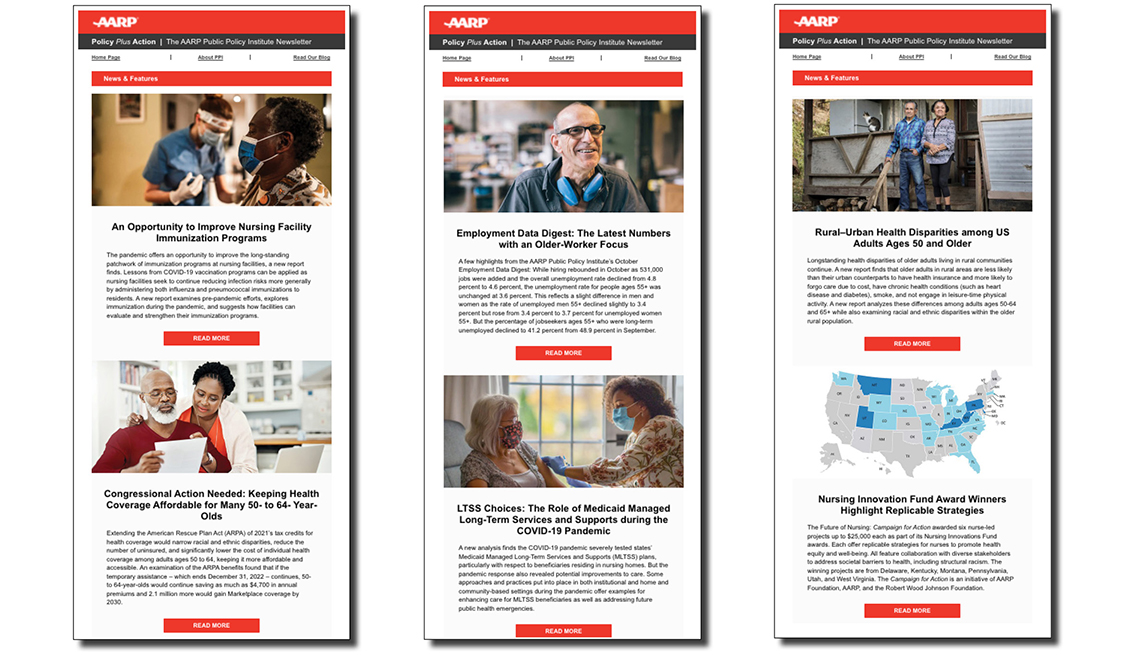
Policy Plus Action Newsletter
Issues that affect older adults are many, and the AARP Public Policy Institute understands how they all connect. Powered by that expertise, Policy Plus Action newsletter gives you the full aging-issue landscape so you stay informed on your areas of interest plus see how they interact other issues.

About AARP Public Policy Institute
The Public Policy Institute is the focal point of public policy analysis and development at AARP. We work to design policies that help improve life for older Americans.
AARP Livability Index: Great Neighborhoods for All Ages
This important resource helps communities assess how well they're meeting the needs of people as they age.



Long-Term Services and Supports Scorecard
This scorecard ranks each state on its ability to provide long-term services and supports for older adults, people with disabilities and family caregivers, with the goal of improving service delivery and lives.
Award-Winning Policy Now Video Series Highlights PPI Research
AARP Policy Now videos explain high-level research findings from PPI reports in clear, accessible ways.
Learning and Education at 50+
AARP Public Policy Institute is working with The Graduate! Network on a series of state pilot programs in Kentucky, Texas, and Michigan to help older learners connect with resources and support that can help them overcome barriers, reskill or upskill for their careers, and, for some, fulfill a lifelong dream of higher education.