Join AARP
Get exclusive member benefits & effect social change. Join Today
The 22-member volunteer AARP Board of Directors — the governing body of our organization — approves all policies, programs, activities and services for AARP. Read
Meet the members of our Executive Team, their backgrounds and their leadership responsibilities. Read
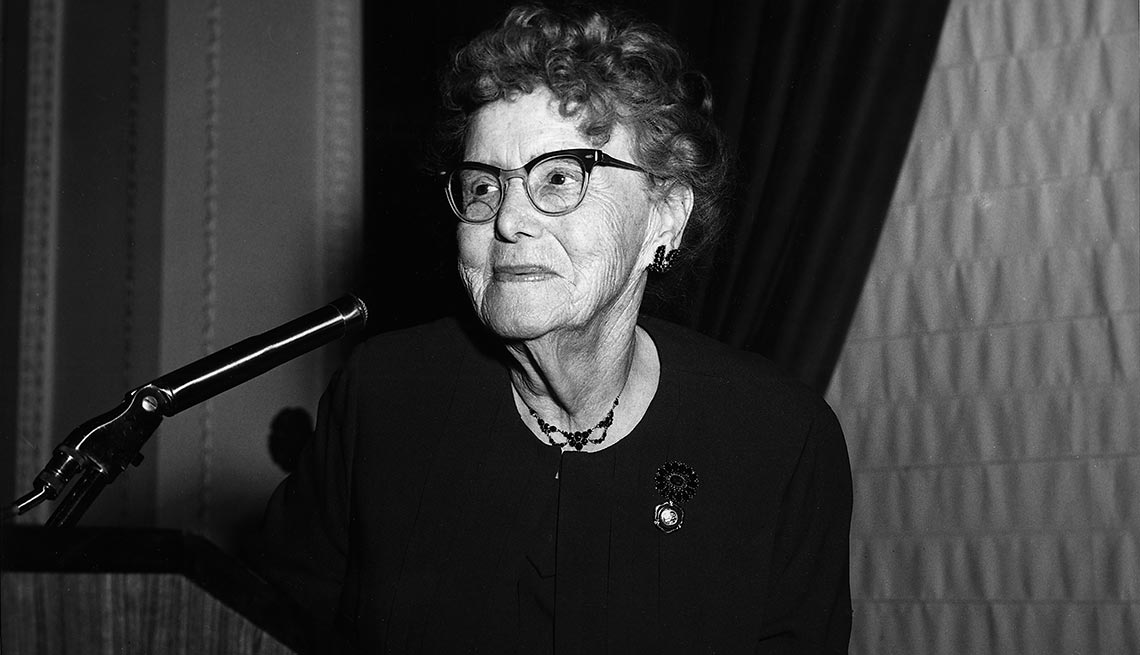
Learn more about the history of the organization and our founder, Dr. Ethel Percy Andrus. Read

Learn more about AARP's efforts to champion diversity and inclusion. More
Find out about opportunities to volunteer with AARP. Read
Get the latest news and read our blog, shAARPsession. Read
Learn about AARP's positions on public issues and how we develop them. Read
Read AARP’s annual report and consolidated financial statement for the current or previous year. Read
Learn more about job opportunities at AARP and what makes this a great place to work. More

The AARP National Policy Council (NPC) Nominating Committee is accepting applications for the volunteer NPC. To get more information and obtain an application, please go to the application process page.
The NPC studies public policy options, considers opinions of members, guidance of staff and nationally renowned policy experts and makes annual public policy recommendations for the Board's consideration and approval.
The NPC, composed of a diverse cross-section of AARP members with a proven record of public policy experience and accomplishments, serves as an advisory body to the AARP Board of Directors. The NPC members serve overlapping terms so that the entire Council does not turn over at one time. This year, the Nominating Committee is recruiting to replace eight members whose terms are concluding. This is a highly competitive process with approximately 200 applications received for the few openings available every two years. Read
An advisory committee to the AARP Board of Directors, the AARP National Policy Council (NPC) is composed of volunteers who represent a diverse cross section of AARP members and have a proven record of public policy experience and interest. The NPC helps the board to perform its governance responsibilities in setting policy and strategic policy direction for the Association. The presence on the NPC of seven regional representatives, three board members and AARP's president-elect, facilitates integration among AARP's state offices, national staff, volunteers, and the Board.
Members of the Council develop and make public policy recommendations to the Board of Directors regarding AARP's federal, state and local legislative and regulatory issues. In making public policy recommendations for the board's consideration and approval, the NPC studies public policy options and considers opinions of members, guidance of staff and analysis from nationally-renowned policy experts. Official policies are approved by AARP’s independent, all-volunteer Board of Directors.
At AARP, we represent nearly 40 million Americans over 50, including workers and retirees, people living alone or with families, and people of various financial means. Using our expertise, research and input from members, AARP develops public policies that reflect our members' concerns and interests. These policies are published every two years in The Policy Book: AARP Public Policies and in regular supplements to The Policy Book.
To see where AARP stands on a wide range of issues, check out The Policy Book: AARP Public Policies 2011-2012. The Policy Book is
an in-depth compilation of AARP public policy expertise and positions. The Priorities Book, the companion piece to The Policy Book, explains AARP's positions on our top policy priorities. The Priorities Book is not a substitute for The Policy Book, the official guide for determining AARP's policy on a particular issue.
See where AARP stands on the issues in The Policy Book: AARP Public Policies 2011-2012.
On February 24, 2011, the AARP Board of Directors approved the National Policy Council's recommended changes to AARP's public policies to help guide the organization's advocacy over the next two years. AARP updated its policies concerning health care, including important elements of the new health care law such as guaranteed access to insurance for those with preexisting conditions, the expansion of home and community-based long-term care services and the strengthening of Medicare. We also added new guidance on policies related to Social Security solvency and strengthened policy on key issues affecting Americans over 50, including protecting the savings and investments of older persons; setting up the new consumer financial protection bureau to strengthen consumer protection; reforming the nation's housing finance system, and making our communities more livable.
The Policy Book: AARP Public Policies 2011-2012
Use the links below to download sections in Adobe PDF format. You will need the free Acrobat Reader to access these files.
Table of Contents(42k)
Introduction(67k)
Setting Public Policies(103k)
Chapters
1 - Government Integrity and Civic Engagement(129k)
2 - Budget and the Economy(227k)
3 - Taxation(267k)
4 - Retirement Income(297k)
5 - Employment(232k)
6 - Low-Income Assistance(203k)
7 - Health(723k)
8 - Long-Term Services and Supports(455k)
10 - Utilities: Telecommunications, Energy and Other Services(384k)
11 - Financial Services and Consumer Products(408k)
12 - Personal and Legal Rights(257k)
Accompanying References
Acronyms and Abbreviations(195k)
Glossary(147k)
Index(278k)
The Priorities Book offers a brief overview of AARP policy positions, reflecting our mission to make things better for society and our goal of playing a positive role in communities of all kinds.
We believe that fair, balanced public policies — reinforced by a spirit of shared as well as individual responsibility — can support economic and health security for everyone, even in a time of fiscal limits. We place a premium on fairness and quality of life across the lifespan. And we believe all generations benefit from the right priorities.
The Priorities Book explains AARP's positions on our top policy priorities and serves as a companion piece to The Policy Book, a more complete, in-depth compilation of AARP public policy expertise and positions on a wide range of issues. The Priorities Book is not a substitute for The Policy Book, the official guide for determining AARP's policy on a particular issue.
Read more about specific AARP priorities by topic:
To order print copies of The Priorities Book, please contact the AARP Office of Policy Integration at npc@aarp.org or 202-434-3720. You can also download The Priorities Book (171KB) in PDF format. You will need the free Acrobat Reader to access the file.
Read more about other AARP priorities.
As one of the leading voices for an aging America, AARP regularly monitors its members' needs, concerns and opinions. AARP develops its public policies through a consistent, ongoing process that begins with member input and policy analysis. The National Policy Council, an advisory committee to the AARP Board of Directors, recommends the policies that eventually appear in The Policy Book and form the basis for all its advocacy efforts.
National Policy Council
The AARP National Policy Council (NPC) is composed of volunteers who represent a diverse cross section of AARP members and have a proven record of public policy experience and interest. The NPC helps the board perform its governance responsibilities in setting policy and strategic policy direction for the Association. The presence on the NPC of five regional representatives, three board members and AARP's president-elect facilitates integration among AARP's state offices, national staff, volunteers and the board.
Members of the council develop and make public policy recommendations to the board regarding AARP's federal, state and local legislative and regulatory issues. In making public policy recommendations for the board's consideration and approval, the NPC studies public policy options and considers opinions of members, guidance of staff and analysis from nationally renowned policy experts.
NPC Responsibilities
Throughout the year, council members are asked to participate in a variety of activities including maintaining ongoing relationships with states, hosting AARP policy forums, and representing the council before AARP members and the public. NPC members are expected to attend all NPC meetings held throughout the year. Meetings are generally held at the AARP national office in Washington, D.C.
Some of the major responsibilities of an AARP National Policy Council member are the following:
The AARP Office of Policy Integration coordinates the activities of the NPC. For more information, call 202-434-3720.
Robert Romasco, NPC Chair
Rob is chair of AARP's National Policy Council. He became AARP president–elect in 2010 and will become president in 2012. His professional experience includes service as senior vice president of customer, distribution and new business development at QVC Inc. and as executive vice president and chief marketing officer of CIGNA Inc. Before his election to the AARP Board of Directors, Rob was a member of the AARP Foundation Board.
A leader in his field, serving on various commissions and on the board of the League of Wisconsin Municipalities. Stephen has been most recently the city manager of Racine, Wisc. He brings a valuable perspective on local factors that are critical to policies at all levels, including utilities, public revenues and budgets, and livable communities.
Currently the general manager and former government and community relations director for the Port Authority of New York and New Jersey, Richard brings more than 20 years of experience in transportation and urban planning. He served the American Planning Association (APA) as president and board member.
In addition to a long career as a law enforcement officer, Dennis has held elective office in South Dakota, including mayor of Pierre and member of the Public Utilities Commission. As a member and chairman of the SD Public Utilities Commission he worked on the deregulation of the telecommunications industry. Dennis has been interim state president of AARP South Dakota.
A member of AARP’s Board of Directors, Mara Mayor, Ph.D., is an educator focused on extending learning opportunities in both formal and informal settings. Mara is the former associate director of education at the Smithsonian Zoological Park in Washington, DC. Previously she was director of The Smithsonian Associates for the Smithsonian Institution and director of The Annenberg/CPB Projects (at the Corporation for Public Broadcasting).
Ann M. Norton
Ann’s professional work has involved a focus on the needs of lower-income persons and social justice. She has worked for 40 years on affordable housing and community development as a practicing attorney, a Housing Court judge, and general counsel for a large public agency. Ann is the founder of the Housing Preservation Project, headquartered in Minnesota.
In addition to completing a long career in naval aviation and starting his own fiduciary practice, Bob has been a certified long-term care and Medicare counselor, a chair of the Advisory Council of San Diego County Aging and Independence Services, and a manager of a Meals-on-Wheels program. He is a member of AARP's California State Executive Council and received the California AARP State Andrus Award for exceptional volunteer service.
Through his work at the Government Accountability Office, Bill developed policy recommendations to Congress and federal agencies to increase efficiency and effectiveness in housing and community development, energy and natural resources, and consumer protection programs. He also has experience at the local level advising on community development and planning with special consideration to issues of cultural sensitivity. Bill is the NPC's representative to the AARP Southeast region.
As support service manager/board secretary of a major public water district in Southern California, Lynn developed management policy that became the model for other water districts throughout the state. Her background also includes public utilities advocacy, the development of a school accountability reporting system, and testimony before the Idaho Public Utilities Commission and the Idaho Legislature. Currently retired, she has served as an AARP Idaho volunteer.
Catherine Alicia Georges (Board Member)
A nurse and national expert in health quality measurement and improvement, Dr. Genovich-Richards was a policy expert for the Department of Health and Human Services. She has worked for or consulted with three of the national health care accreditation organizations (NCQA, URAC and The Joint Commission). Her engagements, research, publications, and presentations cover a wide range of operational issues including quality/performance measurement, organizational development for strategic improvement, and systems for routinely eliciting perceptions from a wide range of customers.
Michael is an expert developer and manager of programs and services that address prevention and health promotion within diverse and marginalized populations. He has previous experience in the Indian Health Service, the National Native American AIDS Prevention Center, and Value Options New Mexico.
A senior research associate at the Institute on Aging at Portland State University, Chad focus his current research on teaching chronic disease self-management skills to Latinos through a community-based process. He has more than 30 years of health and long-term care policy experience, including director of the Oregon Office of Health Policy. He has been an Executive Council member for Oregon AARP and is the NPC's representative to the AARP West region.
Catherine Alicia Georges (Board Member)
A member of AARP's Board of Directors, Catherine Alicia Georges, Ed.D., R.N., F.A.A.N., is a professor and chair of the Department of Nursing at Lehman College and the Graduate Center at the City University of New York. Her career spans more than three decades as a nurse, educator and leader in efforts to eliminate health disparities and improve the health of minorities and the disadvantaged. Currently, she serves as president of the Black Nurses Foundation.
A recognized leader in aging issues and long-term care systems, Neal has served in a number of national organizations such as the American Society in Aging and the National Association of State Units on Aging, and the New York State Office for the Aging. He is currently a partner and analyst at Optimum Partners Consulting in Albany, NY.
An expert in health care reform and former Vermont state senator and chair of the Senate Health and Welfare Committee, Jim was the lead sponsor of Vermont's Health Care Reform Legislation of 2006— perhaps the most comprehensive health care legislation enacted by any state thus far. From 1980 to 2000 Jim directed the largest non-profit social service agency in northern New England. Jim is the NPC's representative to the AARP Northeast region.
A nurse educator who has focused professionally and in civic activities on gerontology, Sandra presently teaches at Lincoln Memorial University in Harrogate, Tenn., where she is active in the university's interdisciplinary gerontology program. She is a professor emeritus at the University of Tennessee in Knoxville. She has worked in her community of Knoxville, to develop more home and community-based options for the aging.
Ritch has a wealth of health policy experience through positions with a major Southwest health system. He has also been actively involved on the Arizona Governor's Advisory Council on Aging, served on an Arizona Task Force to recommend quality rating system policies for skilled nursing facilities and participated in a Citizen's Workgroup to enhance job skills and recognition for HCBS workers. Ritch has served as AARP Arizona state president for six years and currently serves as chair of the AARP Arizona Advocacy network. He makes numerous television and radio presentations on behalf of AARP Arizona.
Owner of a consulting firm conducting policy analyses and strategic planning for state and local governments, Carla coauthored an organizational evaluation tool that analyzes internal and external policies for service delivery. Carla served as a program manager and organization development resource for more than 20 years in publicly-funded health and human services agencies and in municipal government. Carla is the NPC's representative to the AARP Southwest region.
Yash is an attorney, academic, and community activist. A former member of AARP's Board of Directors, he retired from MetLife as a financial planner and risk manager, and had a successful career in the field of seismology. He has worked exhaustively to foster better relations between the US and India, and for the main stream integration of Asian Americans.
Currently the President of the Board of La Familia Medical Center, a member of the Community Advisory Committee, Con Alma Health Foundation, and the Santa Fe County Health Policy Planning Commission, Lou brings more than 30 years of work experience as a teacher, administrator and analyst in the New Mexico school system.
As Ohio's tax commissioner for seven years and as founding partner and president of Limbach and Associates, a consulting firm specializing in state and local taxes, Joanne brings extensive tax-based knowledge. Joanne currently serves as AARP Ohio state president and as the NPC's representative to the AARP Midwest region.
A former professor and graduate school dean, Frank brings more than 25 years of national policy experience. He served the Community Services Administration as chief of planning and policy analysis, is a former CEO of the Congressional Black Caucus Foundation, and is a decorated senior Foreign Service officer for the Agency for International Development.
A member of AARP’s Board of Directors, Carol is currently President and Chief Executive Officer of the Visiting Nurse Service of New York, the largest non-profit home health agency in the United States. She is a recognized leader in health care policy particularly in regard to long-term services and supports and, integrated care for high-risk, special populations. Carol has served on and chaired numerous commissions, boards and advisory bodies and has co-edited the book Home Base Care for a New Century.
Cathy brings 30 years of experience in policy analysis, development, implementation and management in state government. She helped craft Washington state's response to the 1996 welfare reform legislation. She also served as executive policy advisor to the governor regarding human services including senior issues, disability issues, welfare reform, long-term care, and services to persons with mental illness and developmental disabilities.
During her federal government career in human resources management Jo reviewed, interpreted and recommended policies at all levels of government. She worked on Capitol Hill as an American Political Science Association Congressional Fellow and participated in the Symposium in International Manpower Problems in Mexico. Jo currently serves on the AARP Mississippi Executive Council.
Members can receive limited time offers on AARP member discounts at AARPdiscounts.com.
Members receive 10% off room rates on select days with advance reservations at MGM Resorts.
Members can save on eyewear with AARP® Vision Discounts provided by EyeMed.
Members receive exclusive member benefits & affect social change. Join Today