COVER STORY: FRAUD 2026
SUNSHINE, PICKLEBALL … AND SCAMS?
Residents of retirement communities across America can be prime targets for fraud
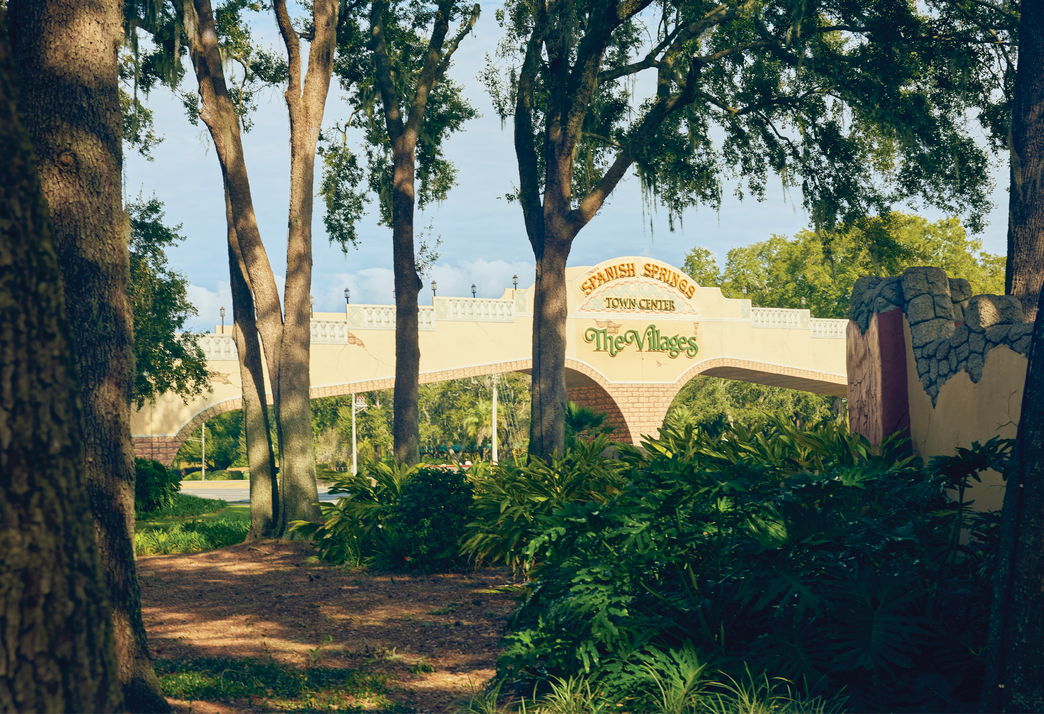
Drive about an hour northwest of Orlando, Florida, and you’ll come across the pleasant, popular retirement haven called The Villages. What began as a trailer park in a quiet area of central Florida in the 1970s is now the country’s largest community for adults 55-plus, home to more than 150,000 residents spread across roughly 57 square miles of manicured neighborhoods spilling into three counties.
Some residents left snowy hometowns in the Midwest or New England for this oasis of golf courses and endless activities, from Boozy Bingo to wood whittling. “It’s like Disney World for adults,” Villagers like to say.
But there’s a hidden scourge. Like many other retirement communities, it has become a focus for criminals who target residents with ever-evolving scams.
“People move to these places that have security gates with these expectations of safety in their golden years … but are immediately besieged by numerous scam attempts,” says Thomas Blomberg, dean of Florida State University’s (FSU) College of Criminology and Criminal Justice. He and assistant professor Julie Brancale have been studying a large Florida retirement community since 2016 as codirectors of their college’s Aging Adult Fraud Research & Policy Institute.
The researchers were stunned by what they found. “It was abundantly clear that the residents we spoke with were targeted almost immediately after moving in, and then it was just constant,” Brancale says. “All said that when they moved there, something was different, and they felt targeted. One resident said that they just all feel like sitting ducks.”
A crypto kiosk in The Villages

A crypto kiosk in The Villages
That’s what Teresa (a pseudonym to protect her identity), 81, discovered. Her costly encounter with criminals began when she opened her iPad last September and it began beeping loudly. A warning appeared: Her iPad had been infected with a virus, and here was a number she could call for assistance.
Teresa was soon speaking with a polite, professional-sounding man, who told her he worked for Apple and that someone had hacked her iPad to try to get into her bank accounts. He stopped the beeping, then offered to help her connect with her bank to make sure her account was safe.
The woman who claimed to be from her bank was ready to “protect” Teresa’s savings. She directed Teresa to withdraw $25,000 in cash from her account and convert it into cryptocurrency by feeding it into a crypto kiosk at a nearby vape shop. This would transfer the money to a supposedly safe account. Lucky for Teresa, when the scammer guided her to a second bank to withdraw more funds the next day, an alert teller brought in the bank’s manager, who told Teresa she was in the midst of a scam. “It is just so scary,” Teresa says. “They are so convincing.”
“One resident said they just all feel like sitting ducks.”
—RESEARCHER JULIE BRANCALE
The FSU researchers believe that criminals targeting older residents is likely a problem in retirement communities around the country. They’re testing that hypothesis in a joint study with researchers at the University of California, Berkeley, School of Law, surveying people in California’s Contra Costa County (home to a variety of communities for older adults) and across Florida.
And experts say international organized crime gangs are likely behind many of the scams targeting older Americans.
Ed Kelly from Seniors vs Crime
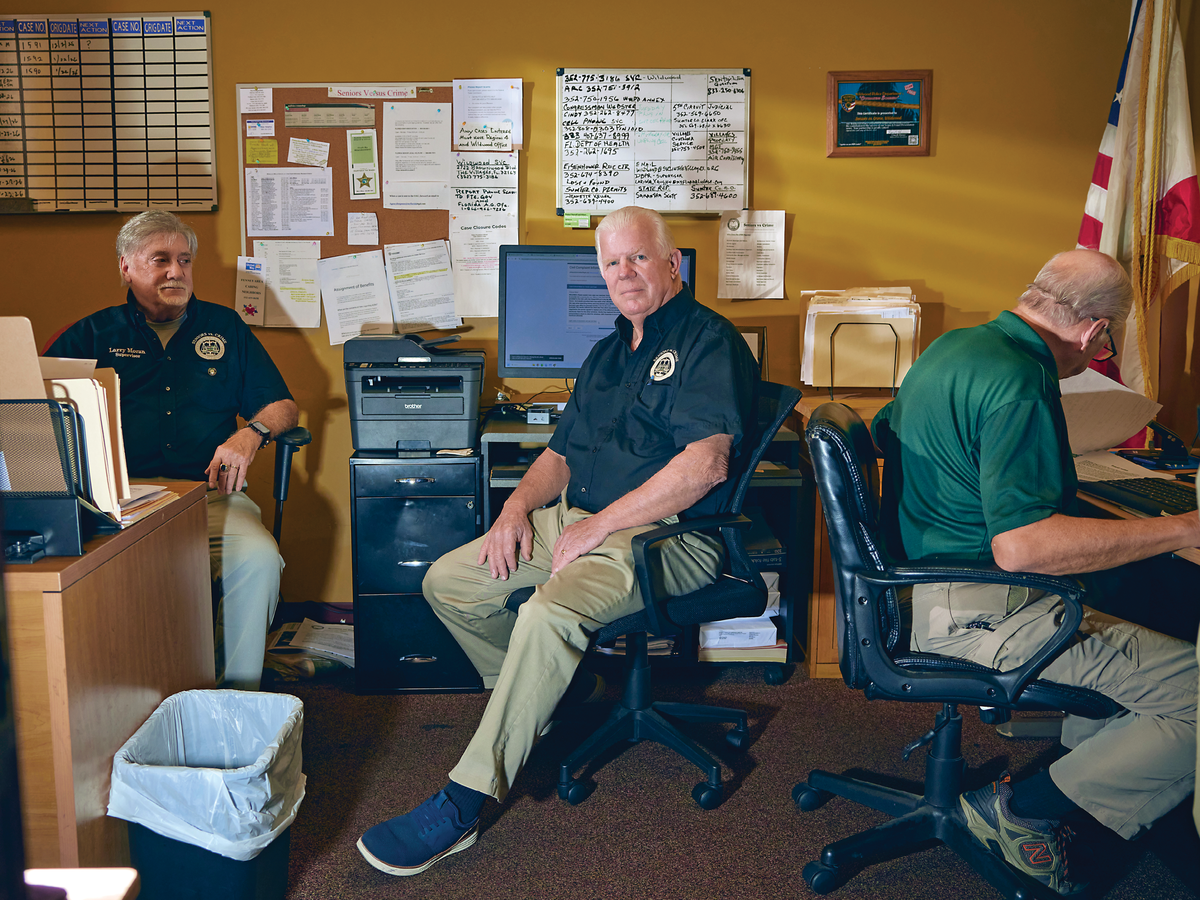
Ed Kelly from Seniors vs Crime
“It makes sense,” says Frank McKenna, chief innovation officer for Point Predictive, a San Diego–based fraud prevention company. “The international crime rings perpetrating some of today’s biggest frauds can target victims using information readily available online.” Why wouldn’t they home in on retirement communities?
One nonprofit has already witnessed fraud in The Villages close up. The Seniors vs Crime Project is a fraud-fighting group started by the state attorney general’s office in 1989; it now has 31 offices across Florida focused on educating older people about scams and assisting fraud victims.
The Seniors vs Crime volunteers, called “sleuths,” often handle complaints about in-person scammers who roam the region—contractors who promise to install a pool or do landscaping, then disappear with the money after doing only partial or shoddy work or no work at all.
The organization estimates that it has recovered around $40 million for victims over the years, with volunteers working as mediators between contractors and customers. “We’re persistent,” says Ed Kelly, a former Philadelphia police detective and special agent with the Pennsylvania Office of Attorney General who now heads four Seniors vs Crime offices spread throughout the community.
Bill Eder dodged a jury duty scam.

Bill Eder dodged a jury duty scam.
But fraud attempts by phone, email or text message are the most insidious.
Bill Eder, 74, who owns a golf cart rental business in The Villages, had his own recent brush with scammers. He received a call on a Saturday morning in December from someone claiming to be a Derek Henderson from the Sumter County Sheriff’s Office (he even provided his badge number and a case number), who said Eder had failed to appear for federal jury duty and owed a $7,000 fine. “I’m thinking this guy’s legit,” says Eder. “He’s got the sheriff’s office address and phone number, and he had all my information. [So] I said, ‘I’ll tell you what. I’ll meet you guys down at the sheriff’s office.’ ”
Nope. You could get arrested if you drive, Henderson told him. We will send someone to escort you. Eder drove to the sheriff’s office anyway, without telling Henderson, and quickly realized he was dealing with a scammer. He figures if he’d entered a car with the supposed escort, he’d “probably take me to an ATM to get money out.”
Still, Eder, like many Villagers interviewed, says he loves the lifestyle and won’t be scared away by scammers. “I wouldn’t live anywhere else,” he insists. (A spokesperson for The Villages declined to comment. Its community-watch organization recently held a speakers series with law enforcement officials and Seniors vs Crime explaining how to avoid the latest scams.)
“These retirement communities are wonderful alternatives when people reach a certain age,” says FSU’s Blomberg. “There’s so much that’s positive.” But he believes that older people need to be educated about scams and fraud wherever they live. Many of the people researchers interviewed expressed frustration that their communities weren’t taking more steps to protect them from scams.
“There was no institutionalized effort to implement education programs designed to protect residents from financial exploitation,” Blomberg says. Education builds skepticism, which is crucial, he adds: “In this day and age, skepticism is a must.”
Christina Ianzito reports on fraud for AARP. Go to aarp.org/fraud for more on this story and all our daily fraud coverage.
STATES PASS LAWS TO FIGHT CRYPTO ATM ABUSES
AARP IS URGING ACTION WHERE YOU LIVE TO PROTECT CONSUMERS
BY CARINA STORRS
Last August, Linda Kay Simmons frantically drove to a gas station—her 6-year-old granddaughter in the back seat—to feed thousands of dollars into a cryptocurrency ATM. Two men claiming to be sheriff’s deputies had called to warn she could face arrest for evading grand jury duty if she didn’t deposit the cash as a bond.
The men demanded she stay on the phone, but concern for her granddaughter spurred the 71-year-old author from Moneta, Virginia, to call her daughter. She ended up feeding close to $16,000 into the machine before her daughter arrived and convinced her it was a scam. “I didn’t want to listen to her at first, but she was so adamant that I just stopped,” Simmons says.
Cryptocurrency kiosks, also called crypto ATMs, are a popular tool criminals use in fraud schemes. The transactions typically move quickly into overseas exchanges that don’t have to comply with U.S. laws. The machines, which convert cash into digital currency, often resemble traditional ATMs and are located in supermarkets, bars, convenience stores and other common businesses.
In 2024, Americans reported $247 million in losses involving crypto ATMs—a 31 percent increase from 2023, FBI data shows. And in cases where the victim’s age was known, people age 60 and older accounted for 86 percent of the losses.
AARP has pushed for protections from crimes facilitated by crypto ATMs. And a growing number of states are cracking down on use of the machines.
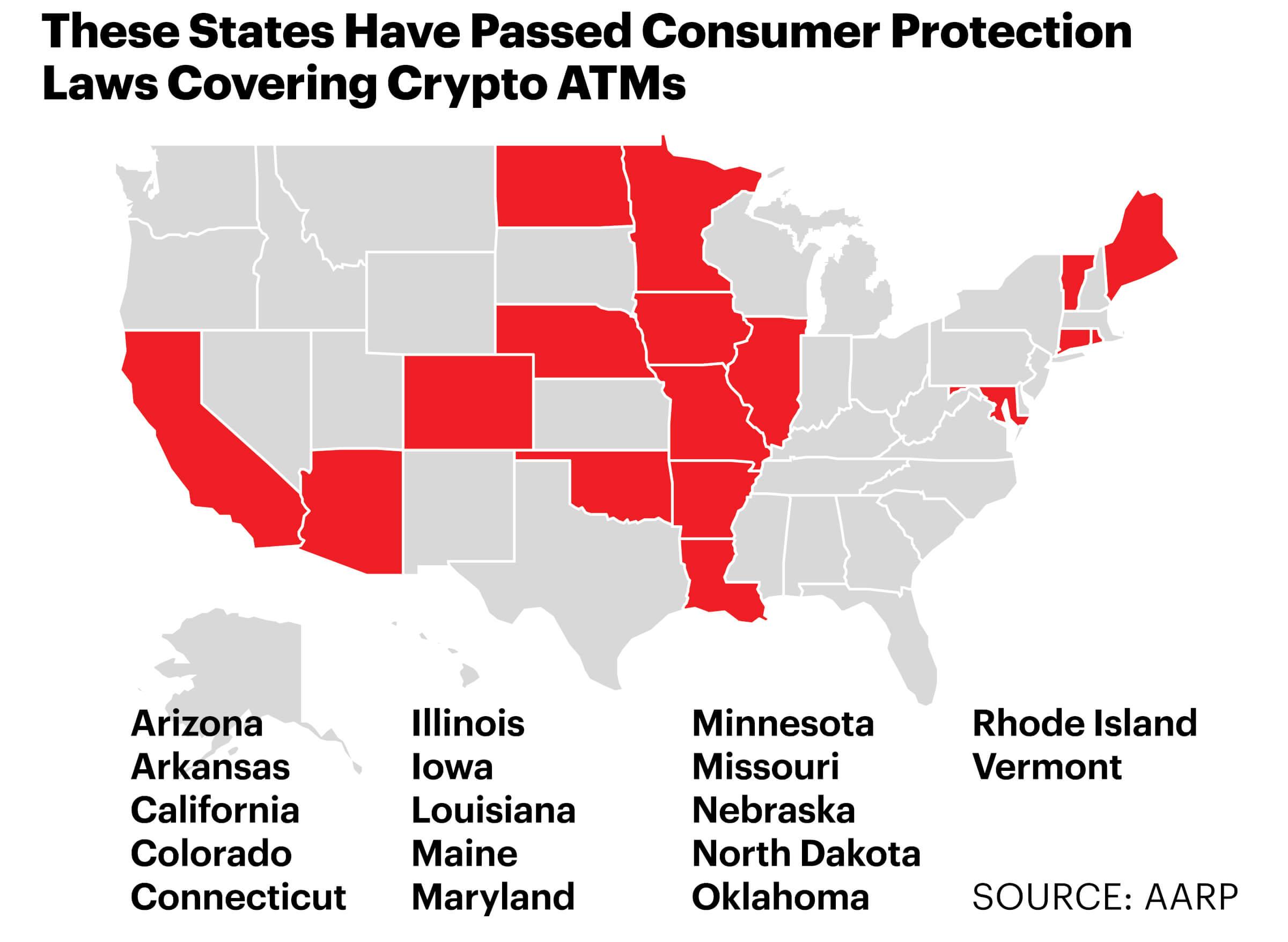
In 2025, 14 states passed laws to protect consumers from crypto kiosk–related scams, bringing the total to 17 states. The laws provide several critical protections, including setting daily transaction limits and requiring fraud warning signs. Many also require operators to be licensed by the state and to provide transaction receipts to help with investigations.
AARP will ask lawmakers in every state that does not have a law to consider legislation in 2026 or 2027. Go to aarp.org/cryptoATMs to find out what is happening in your state.
Carina Storrs is a New York–based writer and frequent contributor to the AARP Bulletin.