COVER STORY: FRAUD 2026
FRAUD WARS
She believed she was helping the FBI—and lost $600,000
What if your life spun out of control because you did what you thought was the right thing?
Judith Boivin’s descent into financial jeopardy began with a phone call from a man claiming to be Police Chief Victor Brito of Rockville, Maryland, where she lives.
The man told Boivin, 81, that she was being investigated for “fraudulent money activity.”
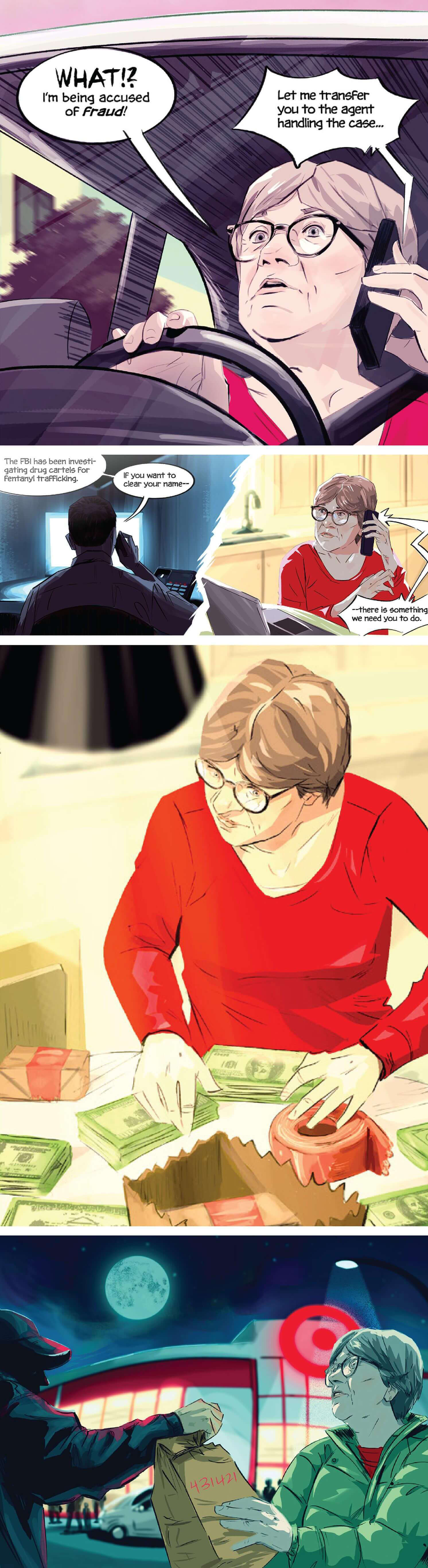
“It was the end of September of ’23, and I was in the car with my husband, dropping him at a medical appointment,” recalls Boivin. “ ‘Brito’ told me that there was a charge against me of fraud and money laundering. I said, ‘Well, that’s not possible.’ ”
The “chief” told Boivin he would transfer her to the FBI, which he said was handling the case. The person who picked up the call identified himself as FBI Special Agent Wayne A. Jacobs, director of cybersecurity.
“ ‘Jacobs’ launched into the story of how they had been investigating drug cartels for fentanyl trafficking and the amount of deaths that were being caused. Then he told me all about my résumé, my time living in Mexico, and the impression was, Well, they already know everything about me. It was quite terrifying.”
Boivin looked up the purported Agent Jacobs online, and he seemed legitimate. Soon she was in dialogue twice a day with “Jacobs” about a supposed investigation of drug money laundering to entrap drug dealers who had supposedly stolen her identity and were using it to traffic fentanyl.
As their talks unfolded, Boivin was told to quietly liquidate her financial assets and move them into four new accounts she opened.
“It took multiple weeks to liquidate,” she recalls. “I had two IRAs, and I had a joint savings with my husband.”
She was then told to withdraw the money, as part of the supposed scheme to entrap the drug dealers. “The instructions for sending the money were that I would take the amount I had, which was usually $20,000 bundles. I was told to wrap it in a plastic bag, and then put it in a brown wrapping and then secure that with duct tape. And then I had to write on it my case number and the locker number. And it would be going into a locker as evidence.”
Within a month, from mid-November to mid-December 2023, Boivin made five cash drops in places like Target parking lots. By then, she had drained her assets: $595,000. At that point, “Agent Jacobs” said he was going on a brief hiatus. She never heard from him again.
Boivin found out through a news account that she was only one victim of a criminal enterprise. “Twelve other people had been scammed by the same story in different states,” she says. Criminals stole a total of $2.9 million, and Boivin’s scammer was traced to a call center in India, according to a Washington Post article.
The Post reported that Boivin’s case is still under investigation.
“My daughter found the AARP fraud support group online, which I had no idea was available,” Boivin says. “I can’t say enough for the AARP Fraud Watch Network and the fraud support groups,” which she has been attending.
The scammers stole her savings, but they did not steal her spirit. “My belief system is not based on fear,” she says.
Find out more at aarp.org/fraudwatchnetwork, or call the AARP Fraud Watch Network Helpline at 877-908-3360.
Adapted from AARP’s video series Fraud Wars. Visit aarp.org/fraudwars to watch the series.